Indian · Authentic-ish Indian
Baingan Bharta
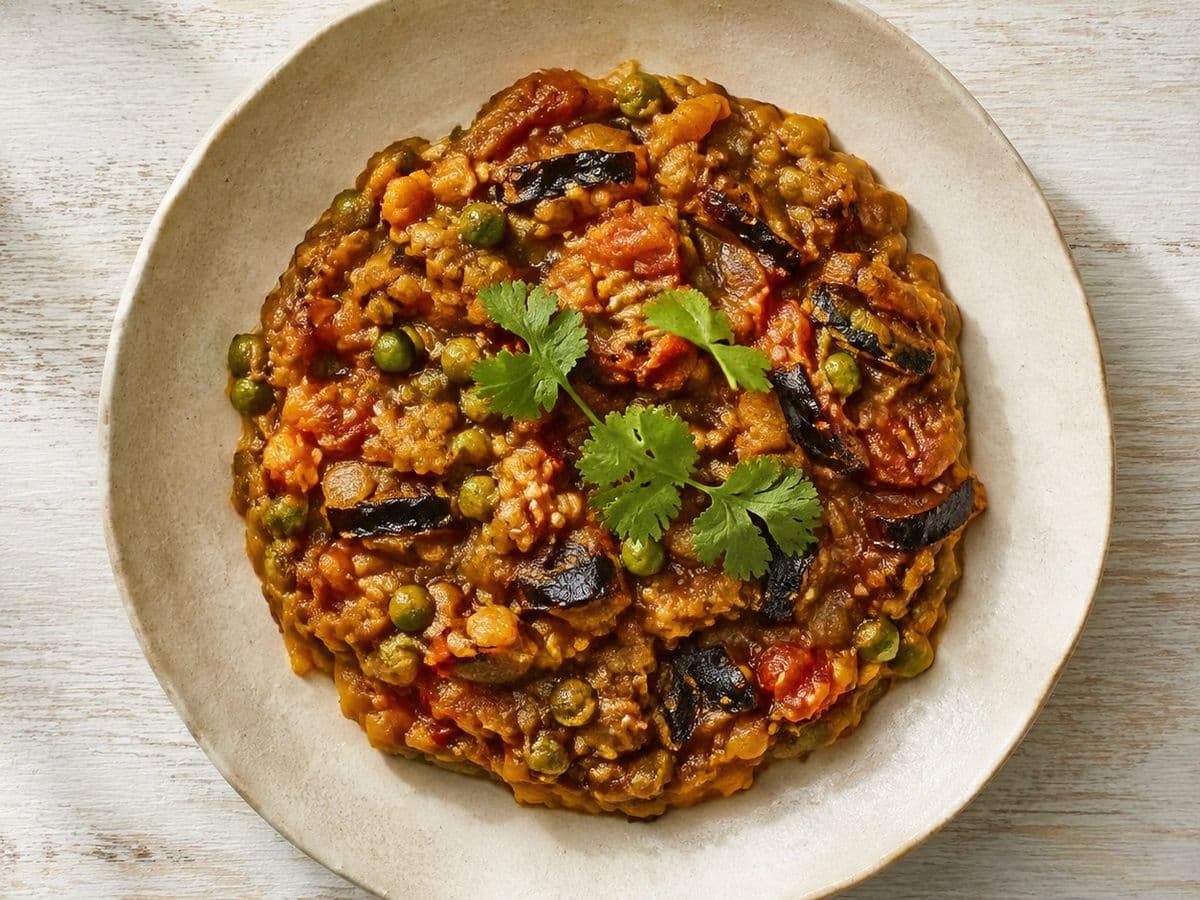
184 kcal a serving, against 301 for the traditional version. That is 117 kcal off, or 39%, with 7.2g of protein. Serves 4. 60 minutes.
What the traditional version is
Whole aubergines roasted until charred and collapsing, then peeled and mashed into a rich base of onions, garlic, ginger and tomatoes, all fried in a very heavy dose of oil.
What changed, and what each change costs
80g of vegetable oil down to 15g
Aubergine will absorb absolutely any liquid fat you throw at it, expanding to hold staggering amounts of grease. You just don't need a deep pool of oil to fry a few onions and spices. A tiny splash does the job perfectly if you manage your heat and keep things moving in the frying pan.
What it costs you. You'll lose that ultra-glossy, heavy mouthfeel that coats your lips after every single bite. The resulting mash is noticeably drier and clings together in a tight pile rather than sliding around the plate.
100g of frozen peas up to 250g
Stripping out 65g of pure fat leaves a physical hole in the volume and satisfaction of the meal. Pouring in a massive mountain of peas fills that space brilliantly. They bring a sharp pop of sweetness and a decent hit of plant matter to bulk out the mash without adding heavy grease.
What it costs you. It changes the texture entirely. You end up with a chunky, highly textured mix where the peas demand just as much attention as the smoked aubergine. The version that's a completely smooth puree anymore is still out there and still better.
What goes in it
The ingredients, without the quantities. The weights are what the figures below are computed from, and they are in the book.
- Aubergine
- Vegetable oil
- Frozen peas
- Onion
- Ripe tomatoes
- Garlic
- Fresh ginger
- Green chillies
- Ground cumin
- Ground turmeric
- Fresh coriander
- Salt
How it starts
- First, you need to completely incinerate the aubergine.
- Once the aubergine is black and totally collapsed, transfer it to a bowl and cover it with a plate.
- Heat the vegetable oil in a large frying pan over a medium heat.
The rest of the method, and every weight, is in Authentic-ish Indian.
The numbers
| Per serving | Traditional | Lightened |
|---|---|---|
| Calories | 301 | 184 |
| Protein | 5.2g | 7.2g |
| Fat | 21g | 4.9g |
| Saturated fat | 2.8g | 0.7g |
| Carbohydrate | 26.3g | 31.4g |
| Protein per 100 kcal | 1.7g | 3.9g |
Every figure is computed from the recipe's own weighed ingredient list against public food composition databases. The appendix in Authentic-ish Indian prints the exact database row used for each ingredient, so any number here can be checked. How every number is computed sets out the method.
The method is in the book
This is peasant food in the absolute best sense of the word. You take a cheap vegetable, burn it until it yields, and mix it with aggressive spices. I removed the senseless restaurant grease and replaced it with a massive pile of sweet peas. You get all the campfire smoke and the sharp tomato tang, but you can actually eat a huge bowl of it without feeling utterly terrible afterwards.
The quantities and the method for this dish are in Authentic-ish Indian, along with 54 more. Buy the paperback
More from Authentic-ish Indian
- Saag Aloo, 188 kcal a serving, 48% off
- Palak Paneer, 501 kcal a serving, 29% off
- Aloo Gobi, 204 kcal a serving, 49% off
- Matar Paneer, 402 kcal a serving, 51% off
- Bombay Potatoes, 235 kcal a serving, 26% off
- Malai Kofta, 315 kcal a serving, 52% off
Every Indian dish and its calories · Every dish in the series