Indian · Authentic-ish Indian
Carrot Halwa
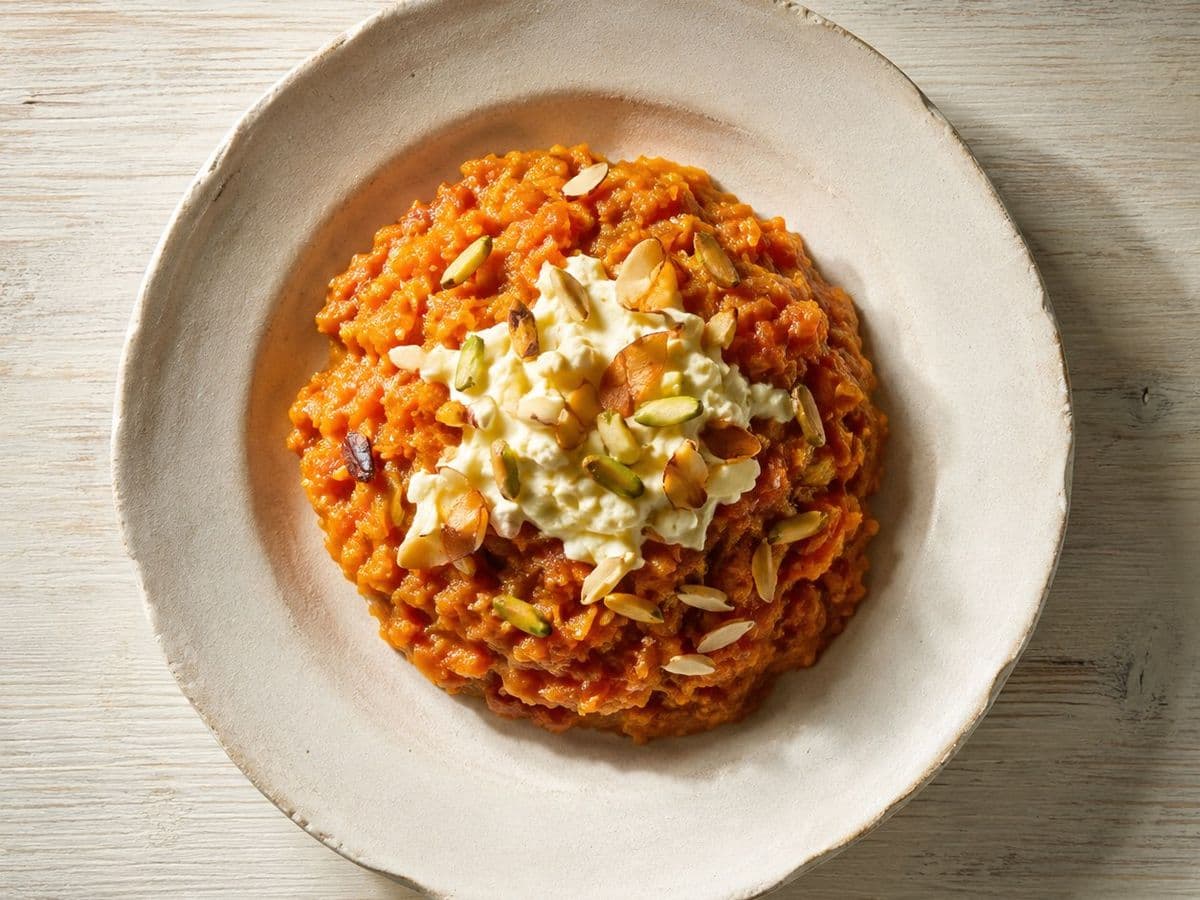
179 kcal a serving, against 430 for the traditional version. That is 251 kcal off, or 58%, with 10.4g of protein. Serves 8. 45 minutes.
What the traditional version is
A mountain of grated carrots simmered relentlessly in whole milk until the liquid reduces to rich solids, then fried heavily in ghee, heavily sweetened with white sugar, and finished with crushed cardamom pods and rich cashew nuts.
What changed, and what each change costs
1000g of whole milk and 150g of ghee for 400g of light evaporated milk and 15g of ghee
Boiling down whole milk takes 3 hours and concentrates the fat right alongside the flavour. Light evaporated milk gives you a massive head start on that condensed, fudgy texture without the waiting. Keeping a tiny spoonful of ghee is essential because you need that distinct roasted dairy flavour to hit the carrots first, but you don't need a swimming pool of it to get the job done.
What it costs you. You lose that ultra-rich, buttery slick that traditionally coats the back of your spoon and your tongue. The texture is distinctly lighter, which means it feels less like a dense fudge.
200g of sugar and 50g of cashews for 50g of sugar, 30g of blanched almonds and 250g of quark
Traditional recipes often use khoya, a dried milk solid, to add richness. Quark mimics that dense dairy protein perfectly without the massive fat penalty. Because quark adds so much body, you don't need sugar to act as a structural ingredient. Carrots are fundamentally sweet root vegetables, so a mere 50g of sugar is plenty to pull it together.
What it costs you. So: a mellow, milk-forward pudding. A hypersweet dessert anymore was never on the table once the fat came out. Quark carries a very faint acidic tang that real khoya does not have, so the flavour profile shifts slightly.
What goes in it
The ingredients, without the quantities. The weights are what the figures below are computed from, and they are in the book.
- Carrot
- Evaporated milk
- Quark
- Caster sugar
- Ghee
- Blanched almonds
- Cardamom
How it starts
- Peel the carrots and grate them on the coarse side of a box grater.
- Put a large, wide frying pan over a medium heat and melt the ghee.
- Pour in the light evaporated milk and the sugar.
The rest of the method, and every weight, is in Authentic-ish Indian.
The numbers
| Per serving | Traditional | Lightened |
|---|---|---|
| Calories | 430 | 179 |
| Protein | 6.3g | 10.4g |
| Fat | 25.9g | 4.3g |
| Saturated fat | 14.1g | 1.4g |
| Carbohydrate | 45.3g | 26.3g |
| Protein per 100 kcal | 1.5g | 5.8g |
Every figure is computed from the recipe's own weighed ingredient list against public food composition databases. The appendix in Authentic-ish Indian prints the exact database row used for each ingredient, so any number here can be checked. How every number is computed sets out the method.
Allergens. milk, nuts.
The method is in the book
This is a massive bowl of comfort food that actually delivers on its promises. I stripped away the heavy fat and the absurd sugar levels, but kept the earthy sweetness of the carrots and the fragrant cardamom. You have to accept a slightly softer, less fudgy texture, but the trade is a massive win. You've got a rich, spiced pudding that leaves you feeling satisfied, not sedated.
The quantities and the method for this dish are in Authentic-ish Indian, along with 54 more. Buy the paperback
More from Authentic-ish Indian
- Kheer, 191 kcal a serving, 35% off
- Gulab Jamun, 137 kcal a serving, 59% off
- Mango Lassi, 148 kcal a serving, 24% off
- Shahi Tukda, 319 kcal a serving, 22% off
- Chicken Tikka Masala, 390 kcal a serving, 37% off
- Butter Chicken, 409 kcal a serving, 46% off
Every Indian dish and its calories · Every dish in the series