Jewish · Authentic-ish Jewish
Potato Latkes
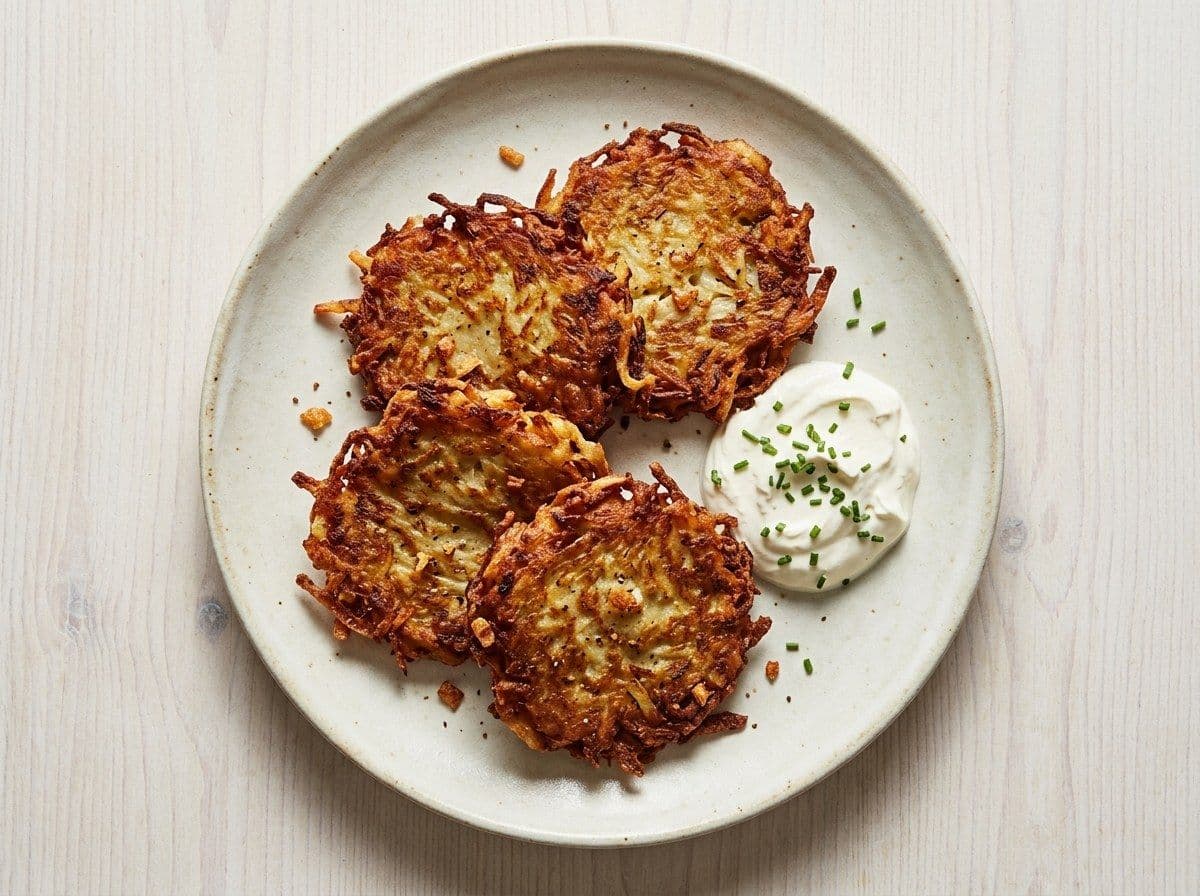
285 kcal a serving, against 408 for the traditional version. That is 123 kcal off, or 30%, with 10.3g of protein. Serves 4. 1 hour.
What the traditional version is
Classic latkes are made with about 600g of grated potato, 100g of onion, one or two eggs, a scattering of plain flour, salt and pepper, shallow-fried in a heavy pan with about 250ml of vegetable oil. Each cake is pressed flat so you get a deep-fried, lacy edge and soft centre. They're usually eaten with sour cream or apple sauce and, if your family has taste, plenty of salt.
What changed, and what each change costs
Swap half the potato for grated courgette
Courgette holds water and bulks out the patty without adding much energy, so the latke is still thick and moist inside but carries fewer calories per bite. I know, it's not potato all the way. But it works.
What it costs you. You lose some potato flavour and that lovely chew you get from 100% spud. It's a greener, slightly softer centre, but it's still satisfying.
Replace plain flour with gram flour and add in 100g of firm tofu
Gram flour boosts the protein and gives a subtle nuttiness. The tofu may look daft, but mashed up, it's all but invisible and holds everything together while keeping it moist.
What it costs you. You sacrifice the pure potato-onion punch, but the texture is still close. There's a faint hint of chickpea and a touch more density in the bite.
Reduce the frying oil from 99g absorbed to 60g, and fry latkes in a non-stick pan instead of a deep pan
Most of the deep-frying oil in the traditional recipe never makes it to the finished latke, but with less oil, even less soaks in. That reduces the fat by a landslide, as only about 12% of the latke's weight is absorbed.
What it costs you. You miss out on those crazy-crisp, ragged edges and the deep crunch that comes from hot oil. Instead, you'll get a latke that's crisp enough on the outside, but never quite shatters in your mouth. It's the price for less grease on your plate.
Use two egg whites instead of two whole eggs
Egg whites boost protein and keep the structure, without the extra fat of egg yolks. The finished result is ever so slightly less rich.
What it costs you. You don't get the same golden colour and there's less roundness in flavour. But no one comes to latkes for finesse.
What goes in it
The ingredients, without the quantities. The weights are what the figures below are computed from, and they are in the book.
- Floury potatoes
- Courgette
- Onion
- Gram flour
- Firm tofu
- About 2 medium egg whites
- Vegetable oil
- Salt
- Black pepper
How it starts
- Grate the potatoes and courgette using the large holes of a box grater.
- Grate the onion and mix it into the potato and courgette.
- Add the gram flour, salt, black pepper, and egg whites.
The rest of the method, and every weight, is in Authentic-ish Jewish.
The numbers
| Per serving | Traditional | Lightened |
|---|---|---|
| Calories | 408 | 285 |
| Protein | 7.2g | 10.3g |
| Fat | 27.4g | 17.9g |
| Saturated fat | 4.1g | 2.4g |
| Carbohydrate | 33.8g | 22.7g |
| Protein per 100 kcal | 1.8g | 3.6g |
Every figure is computed from the recipe's own weighed ingredient list against public food composition databases. The appendix in Authentic-ish Jewish prints the exact database row used for each ingredient, so any number here can be checked. How every number is computed sets out the method.
Allergens. gluten, soybeans, eggs.
The method is in the book
Let's be clear: if your heart is set on a traditional, blistered-edged latke that crunches like a crisp, this won't quite do it. The third mouthful is the first time you notice something's missing. But they still scratch the Hanukkah itch and taste like the real thing, especially when you're not thinking about oil stains on your shirt. You get the comfort, you get a hot, savoury patty, and you can eat more before you feel like lying on the floor. It's not all bad.
The quantities and the method for this dish are in Authentic-ish Jewish, along with 51 more. Buy the paperback
More from Authentic-ish Jewish
- Israeli Salad, 90 kcal a serving, 49% off
- Roasted Cauliflower, 137 kcal a serving, 37% off
- Fried Aubergine, 74 kcal a serving, 63% off
- Carciofi alla Giudia, 196 kcal a serving, 57% off
- Beetroot and Walnut Salad, 146 kcal a serving, 60% off
- Roast Chicken, 312 kcal a serving, 40% off
Every Jewish dish and its calories · Every dish in the series