Mexican · Authentic-ish Mexican
Ceviche
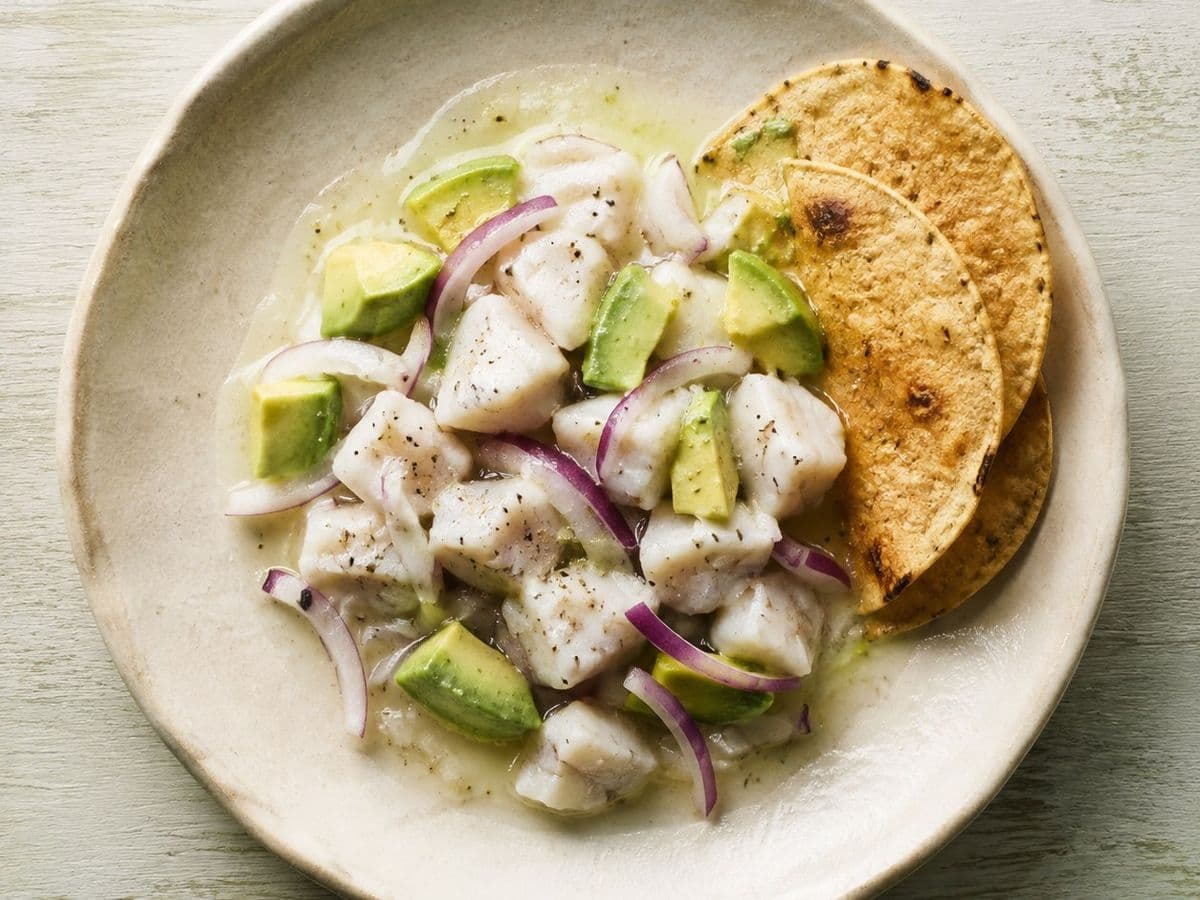
253 kcal a serving, against 276 for the traditional version. That is 23 kcal off, or 8%, with 26.1g of protein. Serves 6. 30 minutes.
What the traditional version is
Raw white fish, cured in a bath of fresh lime juice until opaque. Mixed with sharp red onion, fierce chillies and coriander. Served with huge slabs of creamy avocado and a mountain of fried corn tortillas to scoop it all up.
What changed, and what each change costs
The avocado stays exactly where it is
It's 200g and about 320 kcal across 6 people, which is 53 kcal a serving, and it is the only soft thing on a plate of otherwise sharp, firm, acidic food.
What it costs you. Nothing, because nothing changed. I drafted a version that swapped it for diced cucumber and it was a worse plate of food for the sake of 40 kcal a head. The saving in this recipe comes from the tortillas and the extra fish instead.
300g of corn tortillas reduced to 150g, and baked instead of fried
Halving the tortillas slashes the starch. Baking them saves you the oil from the deep fryer while still giving you a rigid vessel for the fish. You've still got a crunch, but without the grease.
What it costs you. Baked tortillas are brittle and lack the rich, oily satisfaction of a proper fried tostada. You get fewer of them too, so you can't scoop up every single bite. You'll need to use a fork for most of the fish.
600g of sea bass increased to 800g
With the avocado gone and the tortillas halved, the plate needs a serious anchor. Bumping up the raw fish keeps you full and centres the dish entirely on pure, lean meat.
What it costs you. Good quality, sashimi-grade sea bass is expensive. You'll feel the hit in your wallet, even if you don't feel it on your waistline. There's no escaping the price of good fish.
What goes in it
The ingredients, without the quantities. The weights are what the figures below are computed from, and they are in the book.
- Sea bass fillet
- Avocado
- Lime juice
- Onion
- Red chilli
- Fresh coriander
- Corn tortillas
How it starts
- Take your sea bass and cut it into small pieces, roughly 15mm across.
- While the fish cures, prepare your vegetables.
- Heat your oven to 200C.
The rest of the method, and every weight, is in Authentic-ish Mexican.
The numbers
| Per serving | Traditional | Lightened |
|---|---|---|
| Calories | 276 | 253 |
| Protein | 21.6g | 26.1g |
| Fat | 8.5g | 8.7g |
| Saturated fat | 1.4g | 1.5g |
| Carbohydrate | 30.1g | 18.5g |
| Protein per 100 kcal | 7.8g | 10.3g |
Every figure is computed from the recipe's own weighed ingredient list against public food composition databases. The appendix in Authentic-ish Mexican prints the exact database row used for each ingredient, so any number here can be checked. How every number is computed sets out the method.
Allergens. fish.
The method is in the book
This is a bracingly sharp, fiercely acidic slap in the face. Call it a stark, bright plate of pure coastal flavour rather than a comforting bowl of rich guacamole and fried chips and you'll be about right. You absolutely lose the luxurious mouthfeel of the avocado, but you gain a massive pile of prime sea bass that leaves you feeling completely awake. It works brilliantly if you accept it for exactly what it is.
The quantities and the method for this dish are in Authentic-ish Mexican, along with 56 more. Buy the paperback
More from Authentic-ish Mexican
- Camarones a la Diabla, 350 kcal a serving, 44% off
- Pescado a la Veracruzana, 309 kcal a serving, 33% off
- Aguachile, 228 kcal a serving, 42% off
- Tacos de Pescado, 392 kcal a serving, 52% off
- Coctel de Camaron, 271 kcal a serving, 32% off
- Camarones al Mojo de Ajo, 210 kcal a serving, 60% off
Every Mexican dish and its calories · Every dish in the series