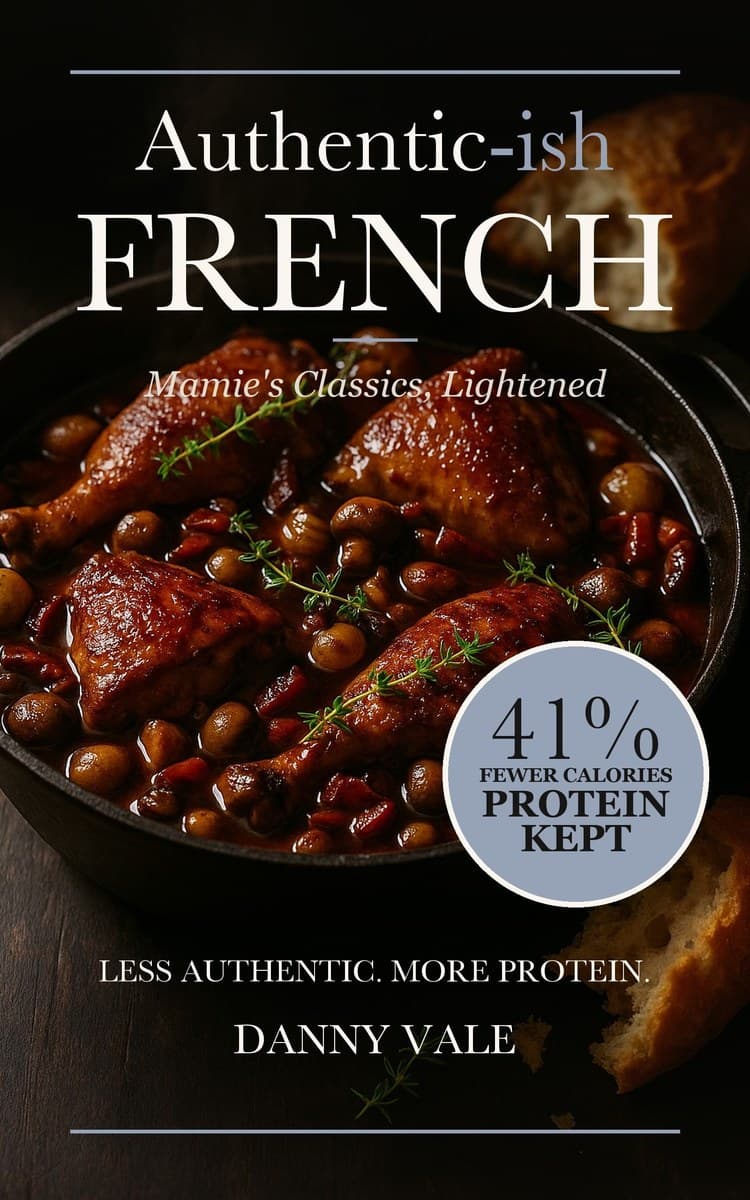
Coq au Vin, Cassoulet and 53 more French classics, with the calories cut and the protein kept. 41% fewer calories on average, and every change costed.
Buy the paperbackKindle edition
What's in it
| Recipes | Chapters | Average calorie saving | Dishes rejected |
|---|---|---|---|
| 55 | 7 | 42% | 5 |
Every dish, and what came off it
Each figure is per serving, computed from the ingredient list. The traditional column is the real dish, not a strawman: it's costed from its own ingredient list so the saving is a measurement rather than a claim.
| Dish | Chapter | Traditional | This version | Saving | Protein |
|---|---|---|---|---|---|
| Boeuf Bourguignon | meat | 564 kcal | 454 kcal | 20% | 51.3g |
| Coq au Vin | meat | 780 kcal | 464 kcal | 41% | 45.6g |
| Blanquette de Veau | meat | 902 kcal | 672 kcal | 25% | 53.5g |
| Gratin Dauphinois | vegetables | 572 kcal | 250 kcal | 56% | 8.3g |
| Soupe a l'Oignon | soup | 553 kcal | 304 kcal | 45% | 16.8g |
| Quiche Lorraine | eggs | 362 kcal | 265 kcal | 27% | 8g |
| Ratatouille | vegetables | 602 kcal | 148 kcal | 75% | 4.6g |
| Cassoulet | meat | 1012 kcal | 591 kcal | 42% | 50.6g |
| Salade Nicoise | entrees | 628 kcal | 374 kcal | 40% | 37.7g |
| Salade Lyonnaise | entrees | 478 kcal | 182 kcal | 62% | 13.1g |
| Croque Monsieur | eggs | 967 kcal | 531 kcal | 45% | 32.2g |
| Moules Marinieres | fish | 817 kcal | 529 kcal | 35% | 60.6g |
| Poulet Roti | meat | 944 kcal | 675 kcal | 28% | 50g |
| Daube Provencale | meat | 624 kcal | 476 kcal | 24% | 49.5g |
| Pot au Feu | meat | 599 kcal | 508 kcal | 15% | 62.5g |
| Soupe au Pistou | soup | 615 kcal | 447 kcal | 27% | 36.7g |
| Vichyssoise | soup | 377 kcal | 188 kcal | 50% | 9.6g |
| Soupe de Poisson | soup | 662 kcal | 331 kcal | 50% | 39.7g |
| Tartiflette | vegetables | 563 kcal | 360 kcal | 36% | 19.9g |
| Confit de Canard | meat | 1545 kcal | 1220 kcal | 21% | 34.8g |
| Duck a l'Orange | meat | 961 kcal | 275 kcal | 71% | 30.8g |
| Steak Frites | meat | 943 kcal | 570 kcal | 40% | 49g |
| Boeuf en Croute | meat | 538 kcal | 452 kcal | 16% | 39.3g |
| Poulet a l'Estragon | meat | 747 kcal | 369 kcal | 51% | 49.1g |
| Navarin d'Agneau | meat | 779 kcal | 409 kcal | 47% | 47.9g |
| Choucroute Garnie | meat | 745 kcal | 382 kcal | 49% | 41.8g |
| Cassoulet Vegetarien | vegetables | 819 kcal | 477 kcal | 42% | 25.8g |
| Piperade | eggs | 351 kcal | 195 kcal | 44% | 14.5g |
| Omelette aux Fines Herbes | eggs | 296 kcal | 151 kcal | 49% | 17.9g |
| Souffle au Fromage | eggs | 422 kcal | 231 kcal | 45% | 16.7g |
| Oeufs en Meurette | eggs | 664 kcal | 416 kcal | 37% | 22.3g |
| Salade de Chevre Chaud | entrees | 493 kcal | 217 kcal | 56% | 9.7g |
| Pate de Campagne | entrees | 270 kcal | 140 kcal | 48% | 22.2g |
| Poireaux Vinaigrette | entrees | 405 kcal | 210 kcal | 48% | 4g |
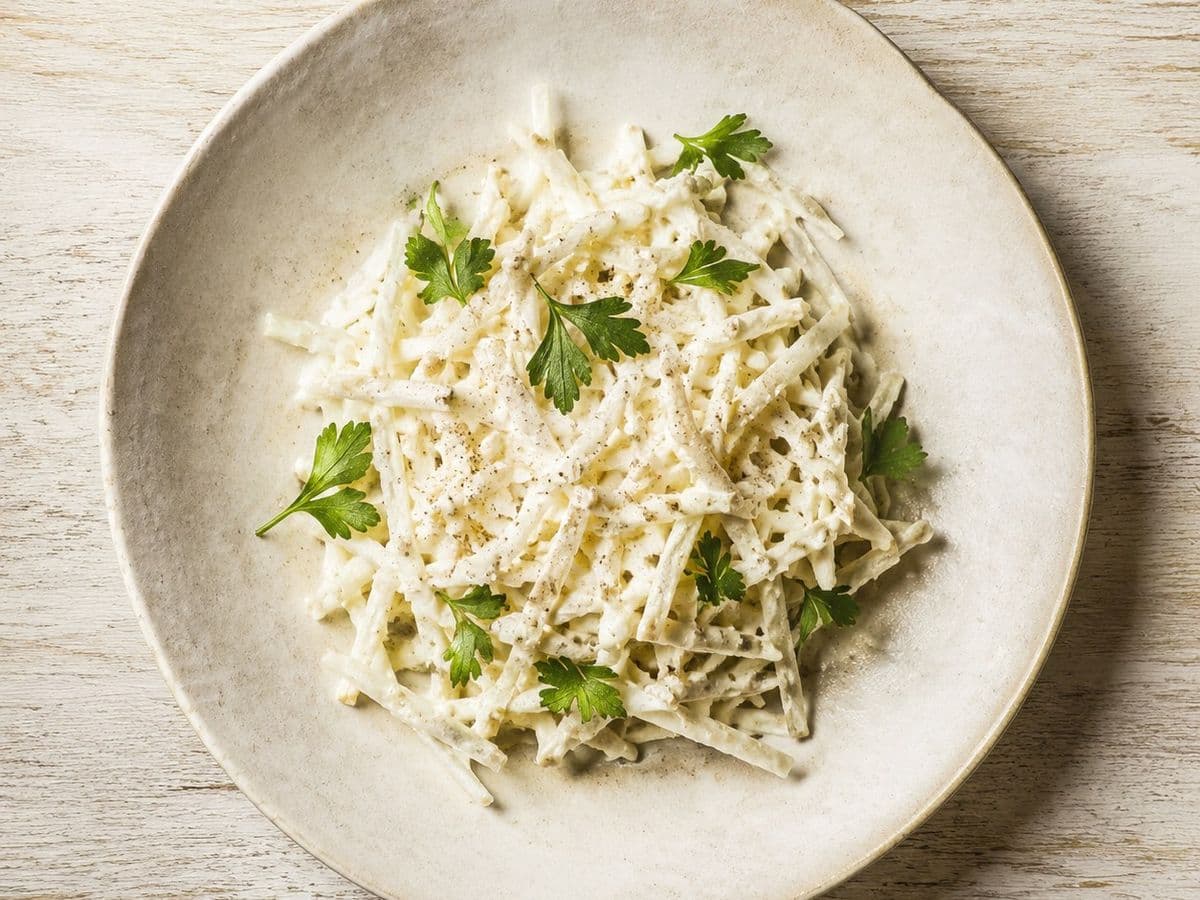
| Celeri Remoulade | entrees | 532 kcal | 96 kcal | 82% | 6.8g |
| Sole a la Normande | fish | 797 kcal | 457 kcal | 43% | 58.6g |
| Bouillabaisse | fish | 661 kcal | 432 kcal | 35% | 54.1g |
| Saumon en Papillote | fish | 501 kcal | 436 kcal | 13% | 42.6g |
| Coquilles Saint-Jacques | fish | 551 kcal | 233 kcal | 58% | 21.5g |
| Brandade de Morue | fish | 685 kcal | 423 kcal | 38% | 68.1g |
| Truite aux Amandes | fish | 569 kcal | 387 kcal | 32% | 32.5g |
| Haricots Verts a l'Ail | vegetables | 142 kcal | 68 kcal | 52% | 3.3g |
| Pommes Boulangere | vegetables | 259 kcal | 200 kcal | 23% | 6.7g |
| Petits Pois a la Francaise | vegetables | 274 kcal | 197 kcal | 28% | 14.3g |
| Endives au Jambon | vegetables | 461 kcal | 302 kcal | 34% | 24.9g |
| Carottes Vichy | vegetables | 160 kcal | 70 kcal | 56% | 1.2g |
| Gratin de Courgettes | vegetables | 343 kcal | 172 kcal | 50% | 16g |
| Tarte Tatin | pudding | 545 kcal | 314 kcal | 42% | 7.2g |
| Clafoutis | pudding | 261 kcal | 157 kcal | 40% | 6g |
| Creme Caramel | pudding | 260 kcal | 183 kcal | 30% | 7.6g |
| Mousse au Chocolat | pudding | 419 kcal | 272 kcal | 35% | 11.1g |
| Ile Flottante | pudding | 396 kcal | 165 kcal | 58% | 8.8g |
| Poires Belle Helene | pudding | 655 kcal | 252 kcal | 62% | 9.7g |
| Far Breton | pudding | 283 kcal | 174 kcal | 39% | 8.4g |
| Salade de Lentilles | entrees | 488 kcal | 328 kcal | 33% | 19.8g |
The ones I wouldn't touch
Dishes drafted for this book that didn't survive. If every dish survived lightening, that chapter would be a marketing device and you should trust none of the rest. Why some dishes cannot be lightened goes through the reasoning.
Sole Meuniere
Meuniere means "in the manner of the miller's wife", and what the miller's wife did was dust the fish in flour and cook it in a great deal of butter until the butter browned. The browned butter is the sauce. There is no other sauce.
I drafted a version with 25g of butter instead of 120g and it came out at 229 kcal against 409. The numbers are real. What I made was a nice piece of fish with lemon and parsley on it, cooked in a little butter, and that is a perfectly good dinner with nothing whatever to do with sole meuniere.
There is a second problem and I will own it. Neither nutrition database I use carries sole, so my draft was costed against sea bass. For most dishes a stand-in like that is fine and the appendix says so. For a dish that is named after the fish and has four ingredients, costing it against a different fish and then calling it lightened is not a thing I am prepared to print.
Buy a sole, buy good butter, use all of it, and eat it twice a year.
Rillettes
Rillettes are pork cooked slowly in fat until it collapses, shredded, packed into a jar, and then sealed under a layer of more fat.
It is potted fat. That is not me being unkind about it, that is the definition and the preservation method at the same time: the fat cap is what keeps the air out and lets it sit in a cellar for months.
I made a lean version with shoulder and stock. It set into a jellied pulled pork, and jellied pulled pork on toast with cornichons is genuinely good. It also has no fat cap, which means it keeps for 3 days rather than 3 months, and it spreads like meat rather than like butter, which is the entire textural point of the thing.
Make the real ones, put them in a small jar, and remember that nobody eats a whole jar of rillettes in one sitting except on purpose.
Escargots a la Bourguignonne
A snail is 90 kcal per 100g and tastes of very little. What you are eating is garlic butter, delivered in a small edible cup.
I mean that literally. The traditional recipe is snails, butter, garlic, parsley and shallot, and the butter is about 85% of the calories on the plate. Take it out and you have poached snails with herbs on them, which is not a dish anybody has ever wanted.
There is also a data problem worth admitting: neither database carries snails at all, so any figure I printed would be a stand-in for the least important ingredient in the dish while the important one is straightforwardly butter.
Six escargots is about 320 kcal. Have six, once a year, in a restaurant that has the right little dish for them, and enjoy every one.
Creme Brulee
The swap kit in chapter 2 has an entry about trading yolks for whole eggs, and that entry ends with a line saying do not try this in a creme brulee.
So I tried it in a creme brulee.
Creme brulee is egg yolk and double cream, baked barely, with a sheet of burnt sugar on top. The yolk is not a binder here, it is the texture. Fat and lecithin are what make it set into something that holds a spoon and then dissolves, and every version I made with whole eggs, semi-skimmed milk or evaporated milk set firmer and grainier and tasted of milk rather than of cream.
The evaporated milk one was closest, and it was still a baked custard rather than a creme brulee. There is a real difference between those two things and the difference is the entire reason anybody orders one.
Make it properly, in small dishes, and share it.
Madeleines
A madeleine is flour, sugar, egg and butter in roughly equal weights, baked in a shell mould, eaten within about 20 minutes of coming out of the oven.
There is nothing in it to remove. Take out the butter and you have a plain sponge in an attractive shape. I got a version down to 77 kcal a madeleine against 122, and what I had was a small light cake with none of the crisp brown edge, which is the thing that makes people eat four of them.
Also, and this is the part that decided it: a madeleine is already 122 kcal. It is one of the few things in this series where the traditional portion is genuinely small, and saving 45 kcal on something you eat two of is not a recipe. It is fiddling.
Make them properly. Eat them warm. That is the whole point of them.
Where the numbers come from
- FoodData Central, SR Legacy Release (April 2018). U.S. Department of Agriculture, Agricultural Research Service. Public domain (U.S. Government work).
- McCance & Widdowson's Composition of Foods Integrated Dataset (CoFID) 2021. Public Health England / Office for Health Improvement and Disparities. Open Government Licence v3.0.
- FoodData Central, Branded Foods (October 2024 release). U.S. Department of Agriculture, Agricultural Research Service. Public domain (U.S. Government work).
Retrieved 2026-08-21. Nothing in these books is dietary or medical advice. Danny Vale is a cook.
Also from us
The Cote d'Azur. Most of the fish chapter comes from that coast, and there is an Owner's Guide to it.