Greek · Authentic-ish Greek
Skordalia
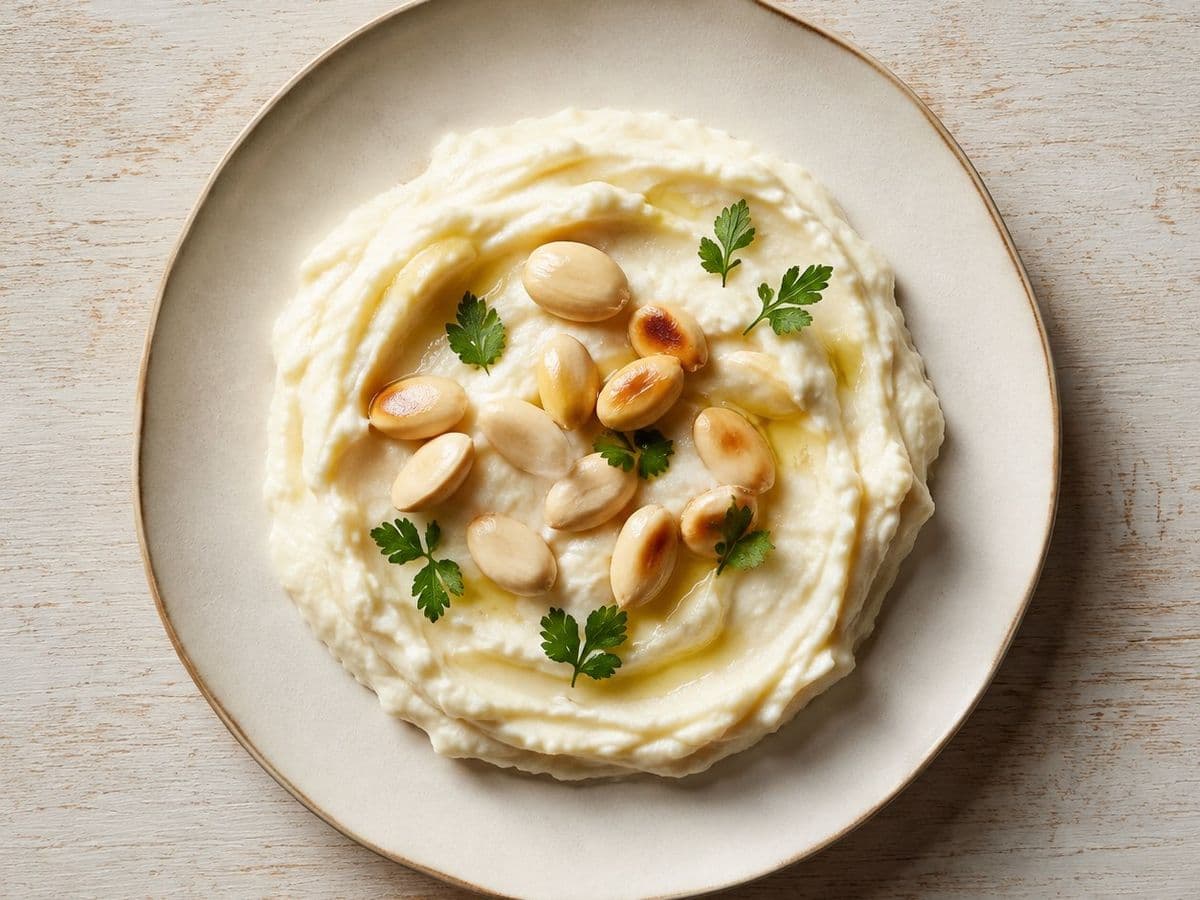
194 kcal a serving, against 503 for the traditional version. That is 309 kcal off, or 61%, with 8.9g of protein. Serves 6. 45 minutes.
What the traditional version is
A heavy, silken puree made by beating immense amounts of olive oil into boiled potatoes or soaked stale bread until it forms a thick, mayonnaise-like emulsion. Crushed almonds, sharp vinegar and masses of raw garlic give it a fierce, unforgettable kick.
What changed, and what each change costs
200g of olive oil down to 30g, bringing in fat-free Greek yoghurt
Oil makes the traditional dish a true emulsion, which is beautiful but incredibly heavy on the stomach. The yoghurt provides the necessary wetness to bring the dip together and adds a sharp tang, while jacking up the protein.
What it costs you. You lose the glossy, rich mouthfeel of a true oil emulsion. The yoghurt makes the dip slightly chalky by comparison, and it lacks that lush, fat-heavy finish.
800g of potato down to 500g
Potatoes provide the essential starch base to carry the garlic. However, eating a massive bowl of pure mash as a starter is a quick way to ruin your appetite for anything else.
What it costs you. A bit looser, then. Not a solid, sliceable brick of starch anymore, and I'm not going to pretend otherwise. You have to be careful not to over-mix the remaining potato or the texture goes completely wrong.
100g of almonds down to 50g
Nuts are fantastic for texture but they bring a lot of fat. Cutting the volume by 50% still gives you the crunch and the nutty flavour profile without the excess weight.
What it costs you. You get less of that sweet, rounded background note that usually helps balance the aggressive raw garlic. The garlic bites a bit harder here.
What goes in it
The ingredients, without the quantities. The weights are what the figures below are computed from, and they are in the book.
- Potato
- Garlic
- Olive oil
- Blanched almonds
- Fat-free Greek yoghurt
- Red wine vinegar
- Salt
How it starts
- Peel the potatoes and cut them into even chunks.
- Put the blanched almonds in a food processor and blitz them until they're very fine.
- Push the dry, cooked potatoes through a potato ricer into a large mixing bowl.
The rest of the method, and every weight, is in Authentic-ish Greek.
The numbers
| Per serving | Traditional | Lightened |
|---|---|---|
| Calories | 503 | 194 |
| Protein | 6.6g | 8.9g |
| Fat | 42.2g | 9.7g |
| Saturated fat | 5.3g | 1.1g |
| Carbohydrate | 27.8g | 19.3g |
| Protein per 100 kcal | 1.3g | 4.6g |
Every figure is computed from the recipe's own weighed ingredient list against public food composition databases. The appendix in Authentic-ish Greek prints the exact database row used for each ingredient, so any number here can be checked. How every number is computed sets out the method.
Allergens. nuts, milk, sulphites.
The method is in the book
The traditional oil emulsion is a masterpiece of Greek cooking. I admit that freely. My version is a very different beast, and arguably a compromise. It eats more like a punchy, garlic-heavy yoghurt dip with a sturdy potato backbone rather than a silky mayonnaise. But the trade is worth making. You can eat a massive pile of this skordalia with your bread and still have room for a plate of grilled meat afterwards.
The quantities and the method for this dish are in Authentic-ish Greek, along with 56 more. Buy the paperback
More from Authentic-ish Greek
- Tzatziki, 76 kcal a serving, 54% off
- Dolmades, 234 kcal a serving, 41% off
- Saganaki, 316 kcal a serving, 28% off
- Melitzanosalata, 115 kcal a serving, 58% off
- Taramosalata, 154 kcal a serving, 75% off
- Kolokithokeftedes, 152 kcal a serving, 67% off
Every Greek dish and its calories · Every dish in the series