Italian · Authentic-ish Italian
Carbonara
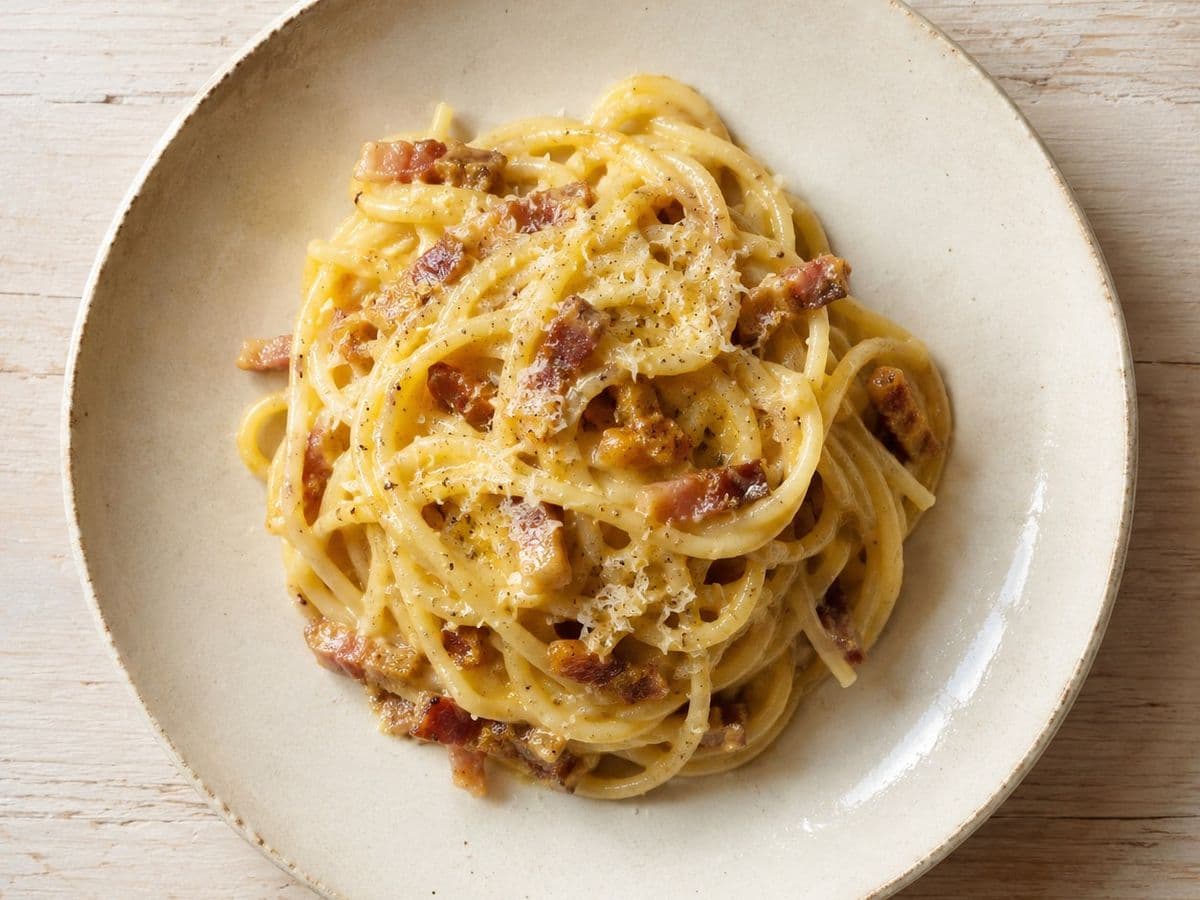
516 kcal a serving, against 649 for the traditional version. That is 133 kcal off, or 20%, with 27.4g of protein. Serves 4. 25 minutes.
What the traditional version is
Roman carbonara is 100g of dried pasta a head, 150g of guanciale, 4 yolks and a whole egg, and a fistful of grated Pecorino. Black pepper, no cream, no garlic, no onion.
What changed, and what each change costs
100g of dried pasta a head down to 80g
Pasta is most of the calories on the plate. Cutting the sauce and leaving the mountain of spaghetti alone would be theatre.
What it costs you. It looks like less food, because it is. Use a smaller bowl and it reads as a proper portion rather than a mean one. Feeding someone who's been on their feet all day? Go back to 100g and skip a swap somewhere else.
4 yolks and 1 whole egg become 2 yolks, 3 whole eggs and 2 extra whites
Whites carry protein and no fat, and they still set into a sauce. More egg by weight, roughly a third less fat from it, 12g more protein across the pan.
What it costs you. Paler sauce, a shade less rich on the tongue, and it sets faster, so you've got to keep it moving and be quicker with the pasta water. Two yolks still do the work on colour and body, and you can tell they're outnumbered. This is the swap I'd fight for.
150g of guanciale down to 85g
The pork's the other big number, and 85g still renders enough fat to coat 320g of pasta if you take your time.
What it costs you. Fewer crisp salty bits per forkful, and that's a real loss. Render it slowly from a cold pan so every gram gives up its fat, and salt the water like you mean it.
100g of Pecorino down to 70g
Hard cheese runs to about 390 kcal per 100g and a grater makes it easy to be heavy-handed.
What it costs you. Less of that sharp sheepy edge. Grate it finer than you think so it goes further, and hold 10g back for the top, where you taste it most.
What goes in it
The ingredients, without the quantities. The weights are what the figures below are computed from, and they are in the book.
- Dried pasta
- Guanciale or pancetta
- Egg yolk
- Egg
- Egg white
- Pecorino Romano
- Black pepper
How it starts
- Get a big pan of water on and salt it properly.
- Cut the guanciale into short thick batons, about the size of your little fingernail.
- Render for 8 to 10 minutes, until the fat's run and the pork is crisp at the edges.
The rest of the method, and every weight, is in Authentic-ish Italian.
The numbers
| Per serving | Traditional | Lightened |
|---|---|---|
| Calories | 649 | 516 |
| Protein | 31.4g | 27.4g |
| Fat | 23.1g | 16.9g |
| Saturated fat | 9.8g | 7g |
| Carbohydrate | 76.8g | 61.6g |
| Protein per 100 kcal | 4.8g | 5.3g |
Every figure is computed from the recipe's own weighed ingredient list against public food composition databases. The appendix in Authentic-ish Italian prints the exact database row used for each ingredient, so any number here can be checked. How every number is computed sets out the method.
Allergens. gluten, eggs, milk.
The method is in the book
This one survives lightening and I make it this way at home. The egg change is the whole trick and almost nobody spots it. The pork reduction you will notice, so if you cook carbonara twice a year, buy the full 150g and enjoy your life. That's not me going soft. It's the point of the book.
The quantities and the method for this dish are in Authentic-ish Italian, along with 59 more. Buy the paperback
More from Authentic-ish Italian
- Ragu alla Bolognese, 509 kcal a serving, 30% off
- Spaghetti alla Puttanesca, 402 kcal a serving, 30% off
- Lasagne alla Bolognese, 469 kcal a serving, 28% off
- Spaghetti alle Vongole, 460 kcal a serving, 22% off
- Pasta alla Norma, 550 kcal a serving, 41% off
- Penne all'Arrabbiata, 530 kcal a serving, 9% off
Every Italian dish and its calories · Every dish in the series