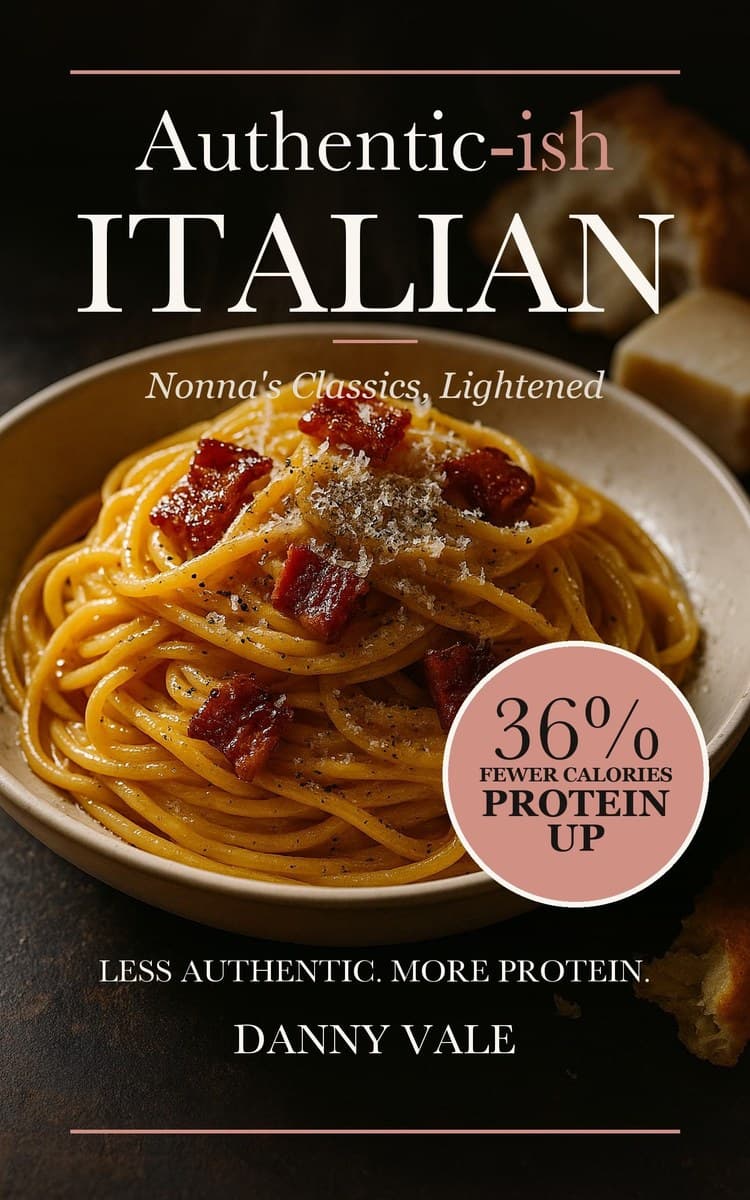
Lasagne alla Bolognese, Polpette al Sugo and 58 more Italian classics, with the calories cut and the protein kept. 36% fewer calories on average, and every change costed.
Buy the paperbackKindle edition
What's in it
Where the calories hide in Italian cooking walks through the same arithmetic on four of these dishes, free.
| Recipes | Chapters | Average calorie saving | Dishes rejected |
|---|---|---|---|
| 60 | 8 | 37% | 6 |
Every dish, and what came off it
Each figure is per serving, computed from the ingredient list. The traditional column is the real dish, not a strawman: it's costed from its own ingredient list so the saving is a measurement rather than a claim.
| Dish | Chapter | Traditional | This version | Saving | Protein |
|---|---|---|---|---|---|
| Carbonara | pasta | 649 kcal | 516 kcal | 20% | 27.4g |
| Ragu alla Bolognese | pasta | 730 kcal | 509 kcal | 30% | 31g |
| Spaghetti alla Puttanesca | pasta | 576 kcal | 402 kcal | 30% | 14.3g |
| Lasagne alla Bolognese | pasta | 648 kcal | 469 kcal | 28% | 31.6g |
| Spaghetti alle Vongole | pasta | 590 kcal | 460 kcal | 22% | 23.7g |
| Pasta alla Norma | pasta | 937 kcal | 550 kcal | 41% | 24g |
| Bruschetta al Pomodoro | antipasti | 315 kcal | 227 kcal | 28% | 7g |
| Caponata | antipasti | 663 kcal | 182 kcal | 73% | 3.8g |
| Arancini | antipasti | 546 kcal | 325 kcal | 40% | 19.6g |
| Insalata di Mare | antipasti | 359 kcal | 290 kcal | 19% | 40.5g |
| Polpette al Sugo | antipasti | 479 kcal | 305 kcal | 36% | 28.4g |
| Panzanella | antipasti | 472 kcal | 360 kcal | 24% | 14.4g |
| Zucchine alla Scapece | antipasti | 314 kcal | 82 kcal | 74% | 3.3g |
| Crostini di Fegatini | antipasti | 438 kcal | 335 kcal | 24% | 20.4g |
| Carpaccio di Manzo | antipasti | 381 kcal | 220 kcal | 42% | 25g |
| Penne all'Arrabbiata | pasta | 585 kcal | 530 kcal | 9% | 41g |
| Pasta e Fagioli | pasta | 572 kcal | 449 kcal | 22% | 28.9g |
| Linguine ai Gamberi | pasta | 613 kcal | 509 kcal | 17% | 36.9g |
| Orecchiette con Salsiccia e Broccoli | pasta | 822 kcal | 539 kcal | 34% | 30.5g |
| Pasta al Forno | pasta | 1072 kcal | 721 kcal | 33% | 48.4g |
| Tagliatelle ai Funghi | pasta | 689 kcal | 423 kcal | 39% | 24.3g |
| Spaghetti al Pomodoro e Basilico | pasta | 592 kcal | 387 kcal | 35% | 13.4g |
| Pasta al Tonno | pasta | 600 kcal | 481 kcal | 20% | 37.6g |
| Risotto ai Funghi | rice | 721 kcal | 480 kcal | 33% | 22.8g |
| Risotto alla Pescatora | rice | 674 kcal | 502 kcal | 26% | 42.5g |
| Risi e Bisi | rice | 754 kcal | 507 kcal | 33% | 23.4g |
| Polenta col Ragu | rice | 713 kcal | 492 kcal | 31% | 34.2g |
| Minestrone | soup | 392 kcal | 345 kcal | 12% | 20.1g |
| Zuppa di Ceci | soup | 652 kcal | 431 kcal | 34% | 20.3g |
| Ribollita | soup | 512 kcal | 395 kcal | 23% | 23.5g |
| Stracciatella alla Romana | soup | 288 kcal | 218 kcal | 24% | 19.6g |
| Pollo alla Cacciatora | meat | 534 kcal | 363 kcal | 32% | 41.3g |
| Saltimbocca alla Romana | meat | 529 kcal | 302 kcal | 43% | 39.6g |
| Ossobuco alla Milanese | meat | 856 kcal | 706 kcal | 18% | 59.4g |
| Scaloppine al Limone | meat | 501 kcal | 283 kcal | 44% | 35.7g |
| Branzino al Forno | fish | 532 kcal | 350 kcal | 34% | 43.5g |
| Polpettone | meat | 546 kcal | 318 kcal | 42% | 34.6g |
| Spezzatino di Manzo | meat | 648 kcal | 401 kcal | 38% | 43.2g |
| Pollo alla Milanese | meat | 669 kcal | 335 kcal | 50% | 41.7g |
| Tonno alla Siciliana | fish | 422 kcal | 273 kcal | 35% | 40.4g |
| Melanzane alla Parmigiana | vegetables | 635 kcal | 282 kcal | 56% | 15.9g |
| Peperonata | vegetables | 347 kcal | 152 kcal | 56% | 4.1g |
| Carciofi alla Romana | vegetables | 545 kcal | 193 kcal | 65% | 8.6g |
| Cime di Rapa Saltate | vegetables | 218 kcal | 126 kcal | 42% | 8.2g |
| Fagiolini al Pomodoro | vegetables | 197 kcal | 105 kcal | 47% | 4.8g |
| Insalata Caprese | vegetables | 382 kcal | 219 kcal | 43% | 16.5g |
| Finocchi Gratinati | vegetables | 352 kcal | 279 kcal | 21% | 17.9g |
| Patate al Forno | vegetables | 377 kcal | 253 kcal | 33% | 7.2g |
| Verdure Grigliate | vegetables | 285 kcal | 109 kcal | 62% | 3.1g |
| Torta Caprese | pudding | 483 kcal | 296 kcal | 39% | 7.3g |
| Semifreddo al Caffe | pudding | 268 kcal | 113 kcal | 58% | 5.9g |
| Crostata di Ricotta | pudding | 410 kcal | 263 kcal | 36% | 11.3g |
| Granita al Caffe | pudding | 268 kcal | 69 kcal | 74% | 5.2g |
| Pere al Vino Rosso | pudding | 268 kcal | 162 kcal | 40% | 5.2g |
| Insalata di Farro | antipasti | 504 kcal | 323 kcal | 36% | 20.3g |
| Frittata di Verdure | antipasti | 349 kcal | 199 kcal | 43% | 18.4g |
| Baccala Mantecato | antipasti | 738 kcal | 383 kcal | 48% | 34.6g |
| Fritto Misto | antipasti | 412 kcal | 282 kcal | 32% | 39g |
| Vitello Tonnato | meat | 987 kcal | 611 kcal | 38% | 61.2g |
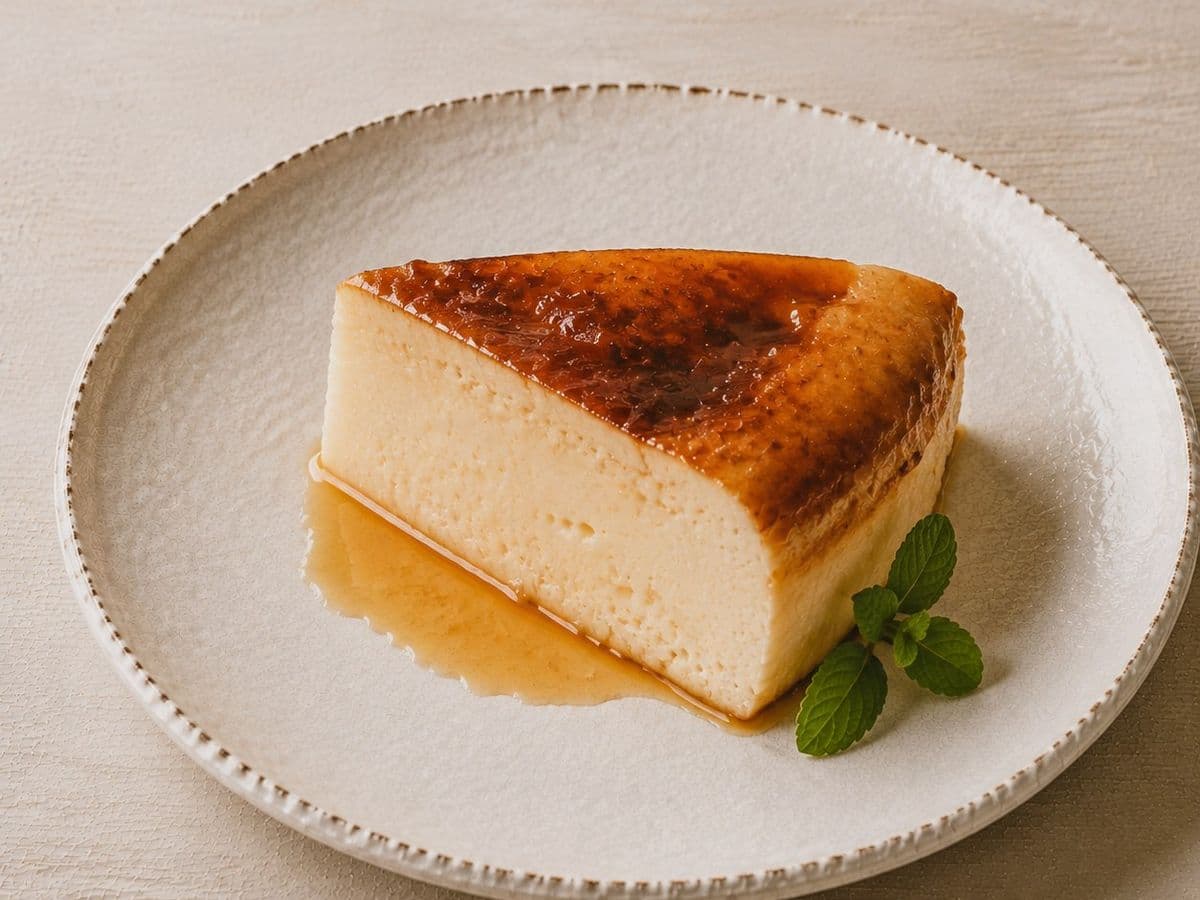
| Baked Yoghurt Flan (which is not panna cotta) | pudding | 412 kcal | 102 kcal | 75% | 9.5g |
The ones I wouldn't touch
Dishes drafted for this book that didn't survive. If every dish survived lightening, that chapter would be a marketing device and you should trust none of the rest. Why some dishes cannot be lightened goes through the reasoning.
Bucatini all'Amatriciana
It survives, but it's the thinnest margin in the chapter. If you only make Amatriciana when someone visits, make the real one. If it's on your regular rotation, this version saves you a fifth of the calories and you'll stop noticing by the third time.
Biscotti alle Mandorle
Traditional almond biscotti contain no butter at all. Flour, sugar, eggs, almonds, twice baked until they're hard enough to break a tooth on. That's the recipe, and it has been for a very long time.
Which means the thing I usually reach for first isn't there to take out.
I drafted a version anyway. Cut the sugar, add an extra egg white, push the almonds up. It came out at 111 kcal a biscuit against 125 for the original. 14 kcal. Over a batch of 20 that's about one biscuit's worth, and to get it I made them slightly drier and slightly less sweet.
That is not a recipe. That is a rounding difference with a photograph next to it, and putting it in the book would be padding.
Make the real ones. A biscotto is about as lean as a biscuit gets before it stops being a biscuit, and the reason they're hard is that there's no fat in them holding them soft. If you want them lighter, make them smaller.
Tiramisu
Mascarpone is 44% fat. It's rich, sweet, heavy and coats your mouth. That's the entire point of tiramisu. It's a fat delivery system layered with coffee and sugar.
The plan was to swap most of the mascarpone for quark and fat-free Greek yoghurt. I've tried it. It's an absolute disaster.
Yoghurt and quark carry a sharp lactic tang that mascarpone completely lacks. When you mix them with cold coffee, you get a sour, acidic mess. It isn't tiramisu, it's a breakfast bowl someone dropped an espresso into.
To fix the sourness, you have to dump in a massive amount of sugar. You also lose the structural integrity. Mascarpone sets firm in the fridge because of the butterfat. Fat-free yoghurt just weeps water into the sponge fingers until the whole dish collapses into a grey puddle.
You can't fake butterfat in a raw, cold pudding. If you want tiramisu, eat the real thing, enjoy it, and have an apple tomorrow. A watery, sour, fake version is exactly the kind of food I refuse to publish.
Cacio e Pepe
I'll admit I was arrogant about this one. I thought I could outsmart hundreds of years of Roman tradition with a blender and some nutritional science. I was dead wrong.
Cacio e pepe means cheese and pepper. That's the entire dish. Dried pasta, Pecorino Romano, black pepper and a splash of starchy pasta water. It's a masterpiece of Roman cooking, built by shepherds who needed ingredients that wouldn't spoil on long journeys. They carried hard dry cheese, dried wheat and peppercorns. When you combine those three things with heat and water, you get magic.
The magic is a delicate emulsion. You grate the cheese finely. You toast the black pepper in a dry frying pan to wake it up. You boil the pasta in barely enough water so the starch concentrates. Then you beat that starchy water into the cheese until the fat melts and suspends in the liquid, creating a thick, glossy cream. There's no double cream, no butter and no oil. It relies entirely on the exact physical properties of sheep cheese and wheat starch.
I tried to fix the numbers on this dish for 14 days straight, and it broke me. To give you more protein for the energy you're consuming, you've got to manipulate the ratios. Here are the maths. Pasta is almost entirely carbohydrates. Pecorino is a hard sheep cheese made of fat and protein. If I cut the cheese down to a dusting to save you the fat, the protein vanishes with it. You're left eating a massive bowl of plain spaghetti with a bit of pepper on it.
If I cut the pasta instead, you get a smaller portion of spaghetti drowning in a puddle of salty, split fat. It's disgusting and still incredibly heavy. I tried swapping normal spaghetti for wholewheat pasta, hoping the extra fibre and slight protein bump would help. The problem is that wholewheat pasta doesn't release the same type of starch into the boiling water. The water stays too thin. When you try to beat it into the Pecorino, the cheese just turns into a greasy clump at the bottom of the bowl.
What about swapping the cheese? I tested half-fat ricotta and I tested fat-free quark. Both of them tasted like wet chalk. More importantly, they completely destroy the emulsion. Cacio e pepe works because the hard fat in the Pecorino melts at a specific temperature. Low-fat cheeses don't melt, they just split or turn grainy. You end up with a watery, split mess that clings to the bottom of the pan instead of the pasta. It looks like bad cottage cheese.
I even tried making a fake sauce using egg whites. I thought I could temper the egg whites with the hot pasta water and whisk in a tiny bit of Pecorino for flavour, essentially making a yolkless carbonara. It was a culinary disaster. The whites scrambled almost instantly, leaving me with weird strands of rubbery egg mixed through the spaghetti. It was one of the worst things I've cooked in 20 years.
I went further and pureed tinned cannellini beans into a paste, hoping to mimic the creamy texture of the melted cheese while dropping the fat. It looked like the real thing. It coated the back of a spoon perfectly. Then I tasted it. It tasted exactly like mashed beans with pepper. It wasn't terrible food, but it fundamentally wasn't the dish on the label.
What about adding chicken breast or raw prawns? That fixes the maths instantly. Lean meat makes any plate look good on a spreadsheet. But then it isn't cacio e pepe, it's chicken pasta. Adding 150g of sliced poultry to a delicate Roman cheese sauce is a crime against Italian food and a crime against common sense.
I promised you I wouldn't pretend a modified recipe is as good as the original if it just fundamentally breaks the dish. This one broke. You can't change a dish that relies entirely on an emulsion of starch and hard cheese without ruining what it is. Eat the real thing on a day you're very hungry, or cook something else entirely. I refuse to publish a bad recipe just to tick a box.
Risotto alla Milanese
I tried. I really did. But this dish is just rice, butter, stock, parmesan and saffron. The entire point of it is the mantecatura, where you beat a huge amount of cold butter and cheese into the hot rice off the heat until it forms a perfectly suspended emulsion.
If you cut the butter to save calories, the emulsion fails. You don't get a silky risotto, you get a yellow rice pudding. If you cut the rice and add a pile of chicken breast to raise the protein, you aren't making Milanese anymore, you just get chicken and rice stew. Neither of those is an acceptable trade.
Some dishes rely entirely on fat for their texture. You can't strip the fat out of this without leaving a hollow shell, and you can't sneak lean protein in without changing what the food actually is. The only honest way to eat less fat here is to make the traditional version, eat 150g of it instead of 300g, and pair it with a massive green salad. That cuts the fat, but it cuts the protein too. I am admitting defeat. Eat something else tonight.
Pesto alla Genovese
I spent 14 days trying to force this dish to behave. The rule for this book is simple: I cut the fat, raise the protein, and tell you what it costs. But Pesto alla Genovese is not a normal pasta sauce. It's a raw emulsion of pure fat and crushed leaves. You need a massive amount of olive oil, pine nuts and parmesan to trap the essential oils of the basil and stop it oxidising.
I tried dropping the olive oil down to 30ml and loosening the paste with pasta water. It simply doesn't work. Without the oil to bind it, the water separates from the cheese. The basil goes grey instantly. It doesn't taste like a fresh sauce, it tastes like the clippings from a wet lawn. The bitterness is genuinely awful.
Then I tried the classic trick of blending the basil with fat-free Greek yoghurt. That actually tastes decent. But it isn't pesto, it's a creamy herb sauce. It coats the pasta completely differently. I could write that recipe down and pretend I've solved the problem, but I promised no sanctimony and no fake wins.
I could also throw 200g of cooked chicken breast into the bowl. That adds 60g of protein instantly and makes the maths look brilliant. But traditional Pesto alla Genovese doesn't contain chicken. If I have to turn the dish into a chicken salad to hit my numbers, the dish has failed.
Proper pesto needs about 120ml of good olive oil and 50g of pine nuts for four people. That is hundreds of calories of pure fat before you even look at the pasta. You can't cheat it. If you want pesto, make the real thing, accept the heavy calorie hit, and eat a leaner dinner tomorrow. I refuse to ruin a classic just to fill a page.
Where the numbers come from
- FoodData Central, SR Legacy Release (April 2018). U.S. Department of Agriculture, Agricultural Research Service. Public domain (U.S. Government work).
- McCance & Widdowson's Composition of Foods Integrated Dataset (CoFID) 2021. Public Health England / Office for Health Improvement and Disparities. Open Government Licence v3.0.
- FoodData Central, Branded Foods (October 2024 release). U.S. Department of Agriculture, Agricultural Research Service. Public domain (U.S. Government work).
Retrieved 2026-08-21. Nothing in these books is dietary or medical advice. Danny Vale is a cook.
Also from us
Tuscany and the Amalfi Coast. If the cooking makes you want to go, the Owner's Guides cover both.