Polish · Authentic-ish Polish
Lazanki Cabbage and Pork Pasta
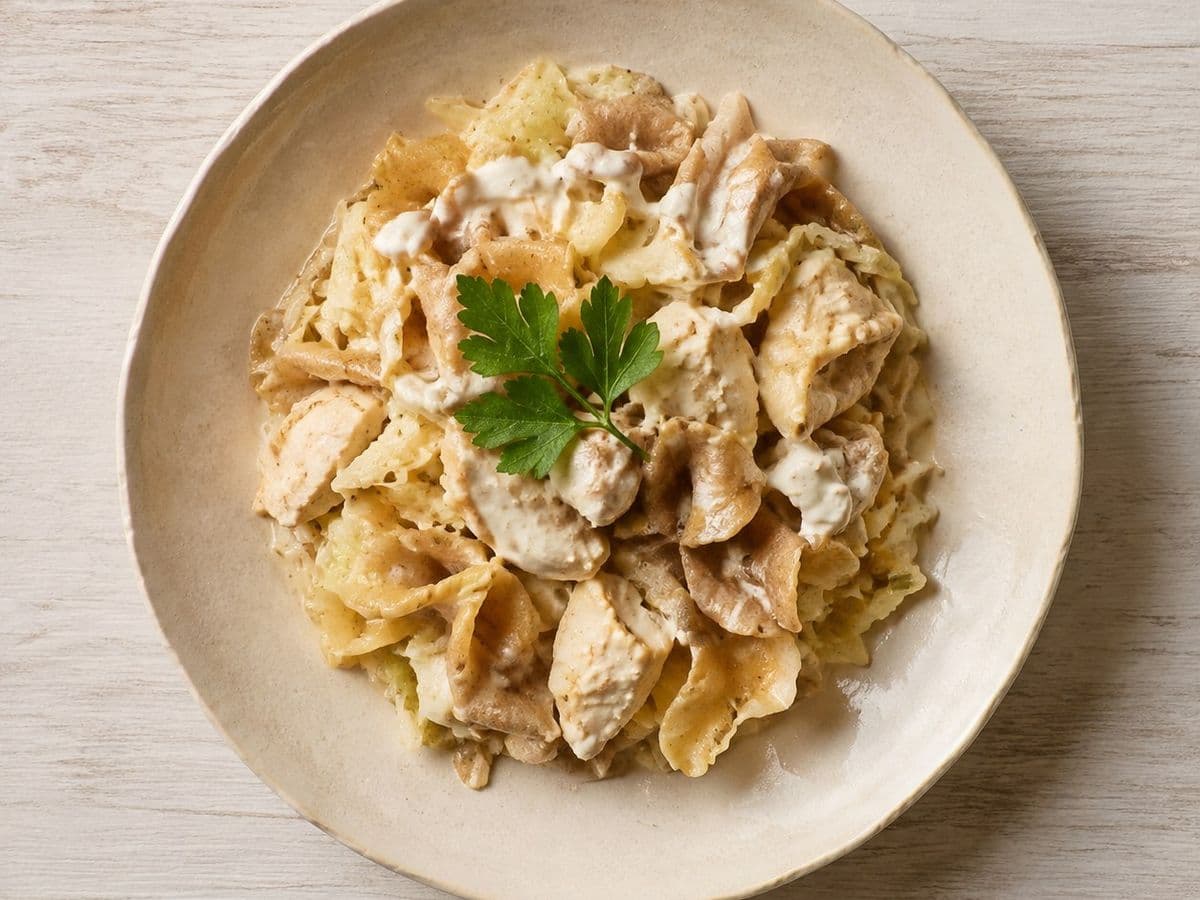
412 kcal a serving, against 552 for the traditional version. That is 140 kcal off, or 25%, with 29.5g of protein. Serves 4. 1 hour.
What the traditional version is
Egg pasta squares cooked and tossed with fried smoked bacon, sauerkraut and white cabbage, all cooked together in bacon fat. Flavoured with onions, caraway, black pepper and bay leaf, and sometimes a swirl of double cream for luxury. The top gets crispy in the pan, and every bite tastes of smoky pork and browned onions. Not a light dish, but perfect for a bleak winter night.
What changed, and what each change costs
Bacon and pork fat for roast chicken breast and a splash of chicken stock
Bacon gives you smoke, salt, and all of the fat in the dish, but it doesn't do you any favours if you want to eat this and move afterwards. Chicken breast will never taste like pork, but if you roast and chunk it, you still get actual meat in every bite and plenty of protein. A splash of chicken stock helps replace the richness you lose when you skip the pork fat.
What it costs you. The whole dish is gentler and you lose all the crispy bacon bits. Nobody will ever call this a bacon bomb, but you still get a proper protein hit.
Plain flour pasta for wholewheat pasta
Homemade pasta is charming, but unless you're a Polish nonna with time, the packet stuff works fine. Wholewheat ups the fibre and protein, and means you don't have to crack eggs or cover the kitchen with flour.
What it costs you. The biggest cost is texture - you lose those crisped, pan-fried pasta edges you get in the traditional. Boiled wholewheat lazanki is softer, but it's less work for you and your dishwasher.
Butter and double cream for a smaller amount of reduced-fat soured cream
Double cream and butter bring richness, but they're there for luxury, not necessity. Reduced-fat soured cream still gives you tang and a bit of body, at a fraction of the indulgence. You'll notice the difference on the spoon, and the sauce won't cling as thickly.
What it costs you. It's not as glossy and won't have that coat-the-back-of-the-mouth feel. If you want the real deal, you know what to do.
Extra cabbage and sauerkraut
Bulking up on veg means the bowl looks fuller, so you can eat more without feeling like you've been robbed. Sauerkraut keeps the tang you want.
What it costs you. You can't panic and hope the pasta saves you if you're cabbage-averse. This is now 75% brassica, and you'll taste it.
What goes in it
The ingredients, without the quantities. The weights are what the figures below are computed from, and they are in the book.
- Wholewheat pasta squares or short shapes
- Chicken breast
- Sauerkraut
- White cabbage
- Onion
- Chicken stock
- Reduced-fat soured cream
- Caraway seeds
- Bay leaf
- Black pepper
- Salt
How it starts
- Heat the oven to 200C.
- Put a big pan of salted water on to boil.
- While the pasta cooks, slice your onion fine, shred the white cabbage, and drain and roughly chop the sauerkraut.
The rest of the method, and every weight, is in Authentic-ish Polish.
The numbers
| Per serving | Traditional | Lightened |
|---|---|---|
| Calories | 552 | 412 |
| Protein | 23.7g | 29.5g |
| Fat | 19.9g | 6.4g |
| Saturated fat | 10.3g | 2g |
| Carbohydrate | 70.2g | 61.6g |
| Protein per 100 kcal | 4.3g | 7.2g |
Every figure is computed from the recipe's own weighed ingredient list against public food composition databases. The appendix in Authentic-ish Polish prints the exact database row used for each ingredient, so any number here can be checked. How every number is computed sets out the method.
Allergens. gluten, milk.
The method is in the book
Don't pretend this is the same as the pan-fried, bacon-laden original. You lose the crispy edges and the hit of pork, but you get a big bowl of tangy, savoury cabbage, and enough roast chicken to keep you from feeling shortchanged. It's more stew than hash, but it's honest food for a weeknight. If what you want is a reason to eat a whole tray of bacon, you're in the wrong recipe. If you want a Polish classic you can finish and still do the washing up, this gets you 80% of the way there.
The quantities and the method for this dish are in Authentic-ish Polish, along with 53 more. Buy the paperback
More from Authentic-ish Polish
- Bigos Hunter Stew, 200 kcal a serving, 60% off
- Fried Cabbage, 157 kcal a serving, 43% off
- Mloda Kapusta Young Cabbage with Dill, 113 kcal a serving, 51% off
- Kapusta Zasmazana Fried Sauerkraut, 106 kcal a serving, 55% off
- Zurek Soup, 434 kcal a serving, 38% off
- Barszcz, 72 kcal a serving, 25% off
Every Polish dish and its calories · Every dish in the series