Thai · Authentic-ish Thai
Steamed Fish Curry Custard
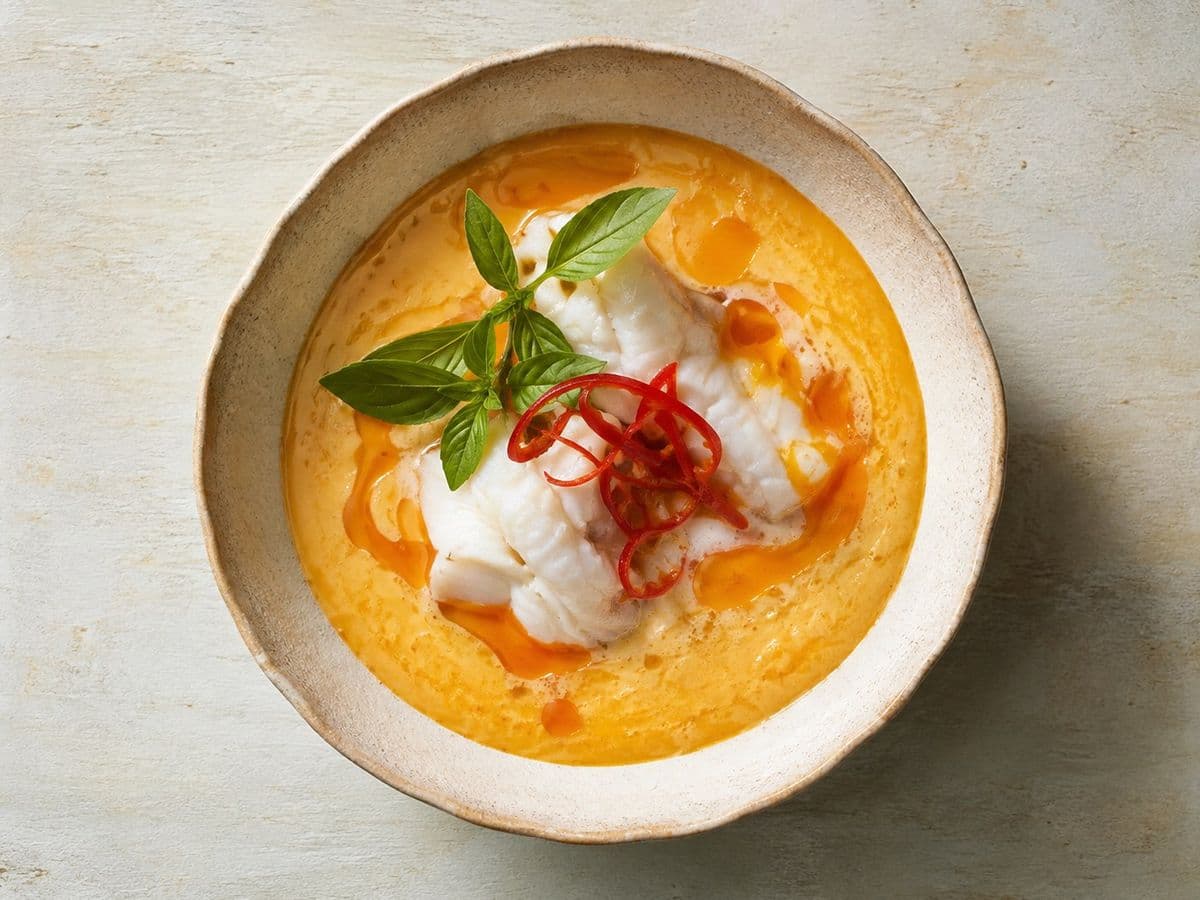
230 kcal a serving, against 297 for the traditional version. That is 67 kcal off, or 23%, with 23.5g of protein. Serves 6. 1 hour.
What the traditional version is
Classic Hor Mok beats coconut cream, curry paste, egg and fish into a mousse, then steams it in banana leaves or ramekins, usually with a few sweet basil leaves at the bottom. The best versions use fatty white fish (snapper or sea bass), plenty of coconut cream, and the odd red chilli sliver for looks. The custard is light, barely set, and tastes like the tropics.
What changed, and what each change costs
Coconut cream cut from 270g to 135g
This is where nearly all the fat comes from. Halve it and the final custard loses its shivering wobble and goes from soft-set to fairly firm. The coconut tang is still there, but it's more a supportive act than the star.
What it costs you. The mousse sets hard, and that melt-in-the-mouth finish disappears. It has lost the delicacy. It is more like a fish and egg terrine. But it's a lot less heavy and you can actually taste the curry.
Egg whites up from 60g to 120g, egg yolks down
Egg white gives lift and structure without the extra fat of yolk. Using double the whites and just one yolk means the mixture holds together even as the coconut drops.
What it costs you. You get extra protein but lose that creamy, golden colour. The custard is springier, not silky. If you're used to the original, you'll spot it straight away - a stiffer set, less unctuous bite.
Fish increased from 450g to 600g, using cod instead of sea bass
Cod is leaner than sea bass but still holds together when beaten. Upping the fish bulks the dish out, adds more protein, and helps keep each portion satisfying after cutting the coconut.
What it costs you. You get a denser, more fish-forward result. The soft mousse effect fades but you won't be hungry. Cod's flavour is cleaner, so the curry stands out more than the fish itself.
Curry paste up from 60g to 75g
The extra egg white and fish need a bit more oomph, otherwise the custard just tastes pale. Up the paste and everything smells and tastes bolder.
What it costs you. If you don't like your custard with a kick, you'll need to rein it in. The heat is up, but so's the complexity.
Keep basil and chilli about the same
These are there for scent and colour. They don't move the needle on nutrition, so they're untouched.
What it costs you. If you hate basil, sorry, it's still there.
What goes in it
The ingredients, without the quantities. The weights are what the figures below are computed from, and they are in the book.
- Cod fillet
- Coconut cream
- 1 large egg
- From 4 large eggs
- Thai red curry paste
- Fish sauce
- Caster sugar
- Fresh sweet basil leaves
- Red chilli
How it starts
- If you've got banana leaves, line 6 small ramekins or pudding moulds.
- Chop the cod into chunks, then blitz it in a food processor with the curry paste, fish sauce, sugar, coconut cream, egg, and egg whites.
- Lay a few basil leaves in the bottom of each ramekin.
The rest of the method, and every weight, is in Authentic-ish Thai.
The numbers
| Per serving | Traditional | Lightened |
|---|---|---|
| Calories | 297 | 230 |
| Protein | 19.8g | 23.5g |
| Fat | 21.4g | 12.2g |
| Saturated fat | 14.8g | 7.4g |
| Carbohydrate | 7.6g | 6.3g |
| Protein per 100 kcal | 6.7g | 10.2g |
Every figure is computed from the recipe's own weighed ingredient list against public food composition databases. The appendix in Authentic-ish Thai prints the exact database row used for each ingredient, so any number here can be checked. How every number is computed sets out the method.
Allergens. eggs, fish, milk.
The method is in the book
The swap from coconut cream to more egg white and fish is like sending a kid dressed as James Bond to a black-tie do. Looks the part, but everyone knows. The original's soft wobble and melt-in-the-mouth luxury have left the building. What you get instead is a proper lunch that actually fills you up and won't make you sweat when you check the scales. Is it as good? Not if you're after the classic, no. But it's tasty, the spice sings, and it's the only Hor Mok I've met that lets you walk away with room for a side dish.
The quantities and the method for this dish are in Authentic-ish Thai, along with 48 more. Buy the paperback
More from Authentic-ish Thai
- Green Chicken Curry, 470 kcal a serving, 33% off
- Massaman Beef Curry, 488 kcal a serving, 40% off
- Panang Curry, 421 kcal a serving, 42% off
- Red Curry with Duck, 389 kcal a serving, 49% off
- Yellow Chicken Curry, 716 kcal a serving, 27% off
- Pineapple Curry with Prawns, 304 kcal a serving, 43% off