Chinese · Authentic-ish Chinese
Steamed Sea Bass
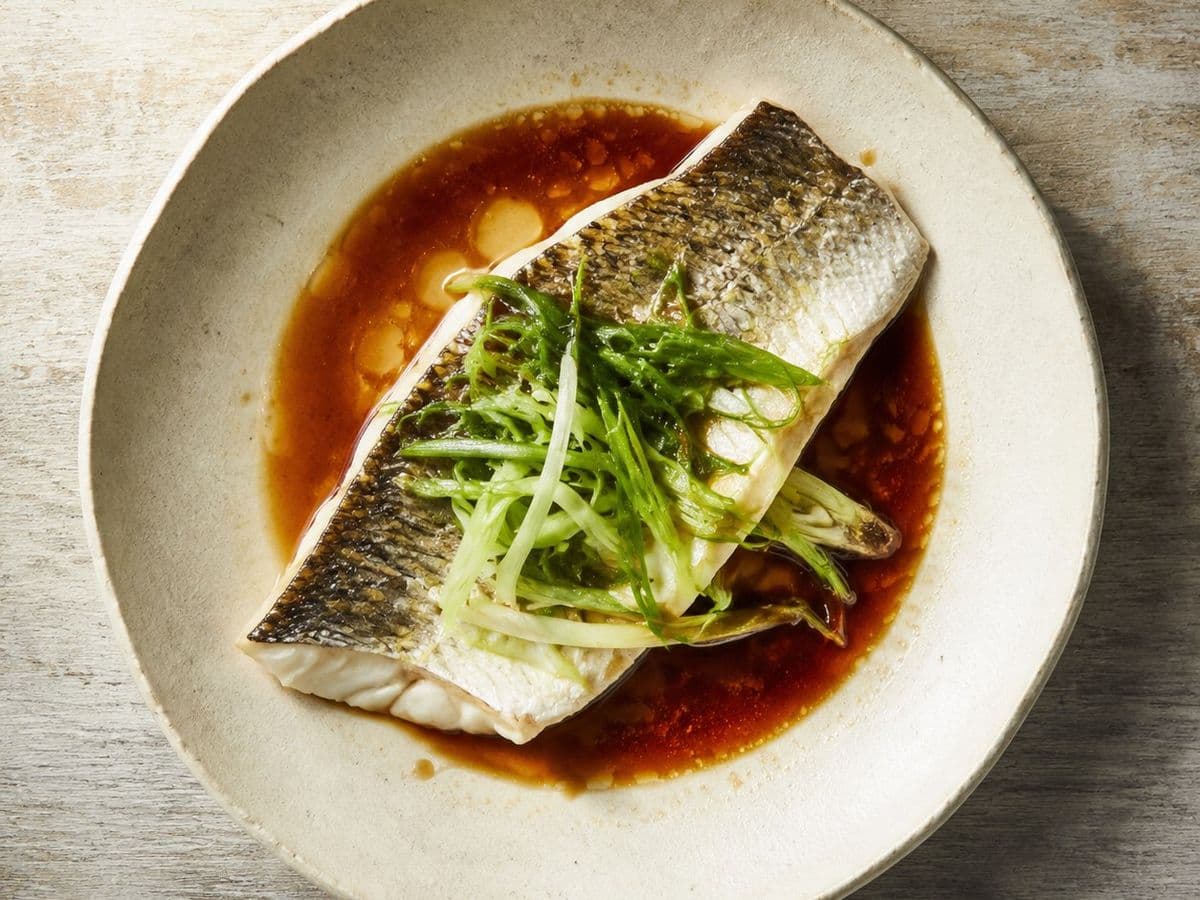
200 kcal a serving, against 305 for the traditional version. That is 105 kcal off, or 34%, with 28g of protein. Serves 4. 20 minutes.
What the traditional version is
A whole fresh sea bass steamed until just cooked, topped with piles of julienned ginger and spring onion. A large amount of smoking hot groundnut oil is poured over the top to flash-fry the aromatics, followed by a sweet soy dressing.
What changed, and what each change costs
A whole fish for 600g of sea bass fillets
Cooking a whole fish evenly requires a massive steamer most home kitchens lack. Fillets cook in a fraction of the time and are much easier to handle on a busy evening.
What it costs you. You lose the gelatinous richness of the bones and the cheeks. Fillets are less forgiving, so you have to watch the clock closely to stop them drying out.
60g of hot finishing oil down to 15g
That dramatic cascade of smoking oil at the end adds massive amounts of fat for a few seconds of theatre. A 15g splash gets the aromatics hot enough to release their scent without drowning the fish.
What it costs you. What you've got is a very clean one. A luxurious, oil-slicked dish anymore is a different dish and you know where to find it. You'll miss that greasy, satisfying mouthfeel when you mix the leftover sauce into your rice.
What goes in it
The ingredients, without the quantities. The weights are what the figures below are computed from, and they are in the book.
- Sea bass fillet
- Fresh ginger
- Spring onions
- Groundnut oil
- Light soy sauce
- Caster sugar
- Fresh coriander
How it starts
- Cut the ginger and spring onions into very fine, long strips.
- Set up a steamer basket over a pan of boiling water.
- Place the sea bass fillets on a heatproof plate.
The rest of the method, and every weight, is in Authentic-ish Chinese.
The numbers
| Per serving | Traditional | Lightened |
|---|---|---|
| Calories | 305 | 200 |
| Protein | 28g | 28g |
| Fat | 18.7g | 7.4g |
| Saturated fat | 3.3g | 1.4g |
| Carbohydrate | 5.4g | 4.2g |
| Protein per 100 kcal | 9.2g | 14g |
Every figure is computed from the recipe's own weighed ingredient list against public food composition databases. The appendix in Authentic-ish Chinese prints the exact database row used for each ingredient, so any number here can be checked. How every number is computed sets out the method.
Allergens. gluten, fish, peanuts, soybeans.
The method is in the book
This is a brilliant example of leaving well alone. Cantonese steamed fish is inherently lean and packed with high-quality nutrition. By simply scaling back the finishing oil, you maintain all the sharp, restorative flavours of ginger and soy while shedding a huge chunk of fat. Yes, you lose the theatre of a whole fish and the rich, oily sauce that usually pools at the bottom of the plate. But what you're left with is sharp, bright and incredibly fast to put together on a Tuesday night. It's proof that sometimes the smallest adjustments yield the best results.
The quantities and the method for this dish are in Authentic-ish Chinese, along with 55 more. Buy the paperback
More from Authentic-ish Chinese
- Gong Bao Prawns, 263 kcal a serving, 55% off
- Steamed Scallops with Garlic, 251 kcal a serving, 35% off
- Sichuan Boiled Fish, 338 kcal a serving, 54% off
- Sweet and Sour Pork, 339 kcal a serving, 58% off
- Kung Pao Chicken, 352 kcal a serving, 32% off
- Mapo Tofu, 314 kcal a serving, 28% off
Every Chinese dish and its calories · Every dish in the series