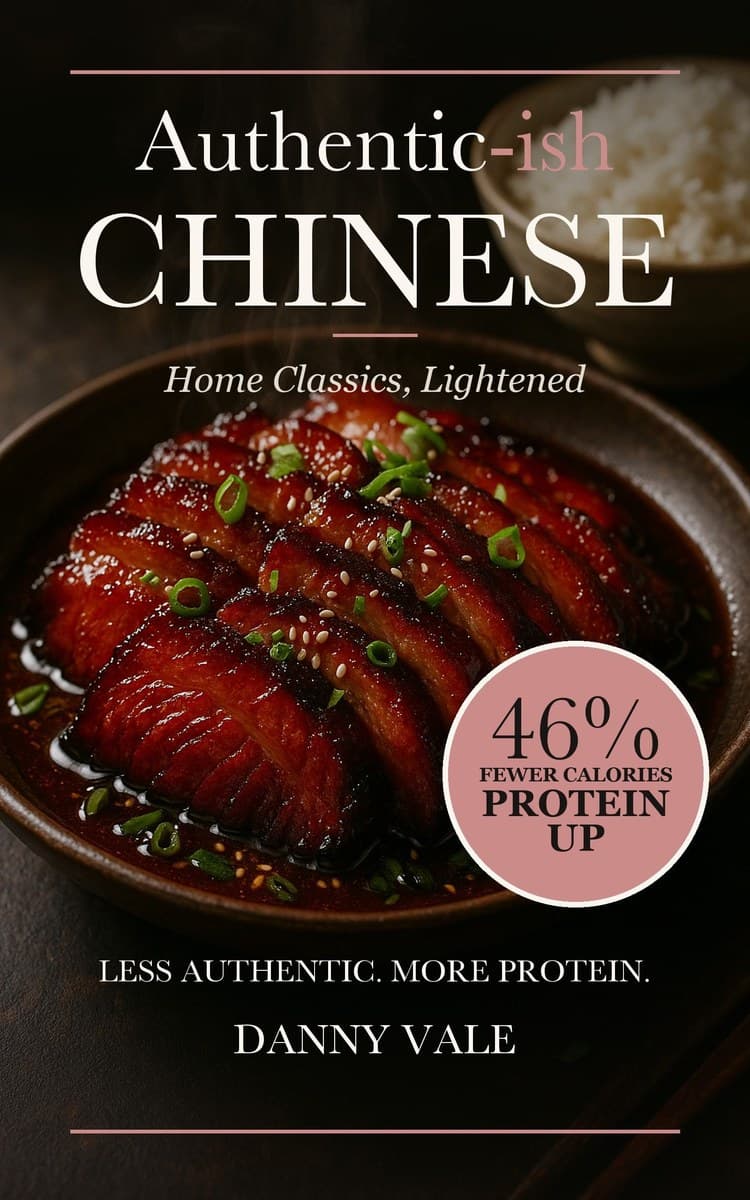
Kung Pao Chicken, Sweet and Sour Pork and 54 more Chinese classics, with the calories cut and the protein kept. 46% fewer calories on average, and every change costed.
Buy the paperbackKindle edition
What's in it
| Recipes | Chapters | Average calorie saving | Dishes rejected |
|---|---|---|---|
| 56 | 8 | 42% | 4 |
Every dish, and what came off it
Each figure is per serving, computed from the ingredient list. The traditional column is the real dish, not a strawman: it's costed from its own ingredient list so the saving is a measurement rather than a claim.
| Dish | Chapter | Traditional | This version | Saving | Protein |
|---|---|---|---|---|---|
| Sweet and Sour Pork | stirfry | 802 kcal | 339 kcal | 58% | 35.3g |
| Kung Pao Chicken | stirfry | 520 kcal | 352 kcal | 32% | 39.4g |
| Mapo Tofu | tofu | 436 kcal | 314 kcal | 28% | 30.1g |
| Char Siu | pork | 530 kcal | 322 kcal | 39% | 33.9g |
| Hong Shao Rou | pork | 620 kcal | 382 kcal | 38% | 40.7g |
| Steamed Sea Bass | fish | 305 kcal | 200 kcal | 34% | 28g |
| Chow Mein | noodles | 761 kcal | 341 kcal | 55% | 21.7g |
| Egg Fried Rice | noodles | 563 kcal | 359 kcal | 36% | 14.1g |
| Wonton Soup | soup | 449 kcal | 363 kcal | 19% | 28.4g |
| Hot and Sour Soup | soup | 314 kcal | 213 kcal | 32% | 21.7g |
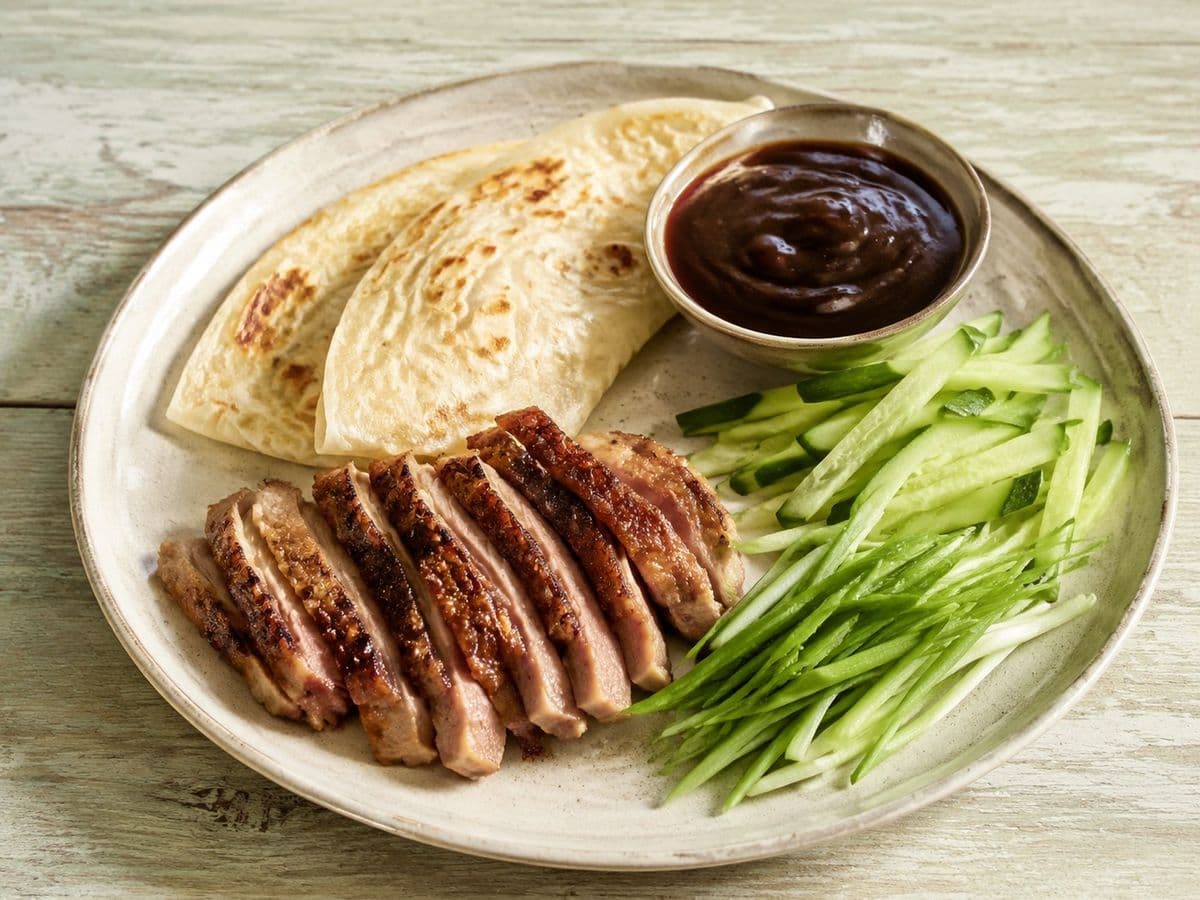
| Crispy Aromatic Duck | chicken | 1861 kcal | 517 kcal | 72% | 47.2g |
| Beef and Black Bean | stirfry | 547 kcal | 375 kcal | 31% | 38.7g |
| Salt and Pepper Squid | starters | 421 kcal | 208 kcal | 51% | 31g |
| Jiaozi | starters | 440 kcal | 249 kcal | 43% | 22g |
| Spring Rolls | starters | 429 kcal | 221 kcal | 48% | 15.8g |
| Gong Bao Prawns | fish | 583 kcal | 263 kcal | 55% | 34.1g |
| Twice Cooked Pork | pork | 560 kcal | 314 kcal | 44% | 35.5g |
| Dan Dan Noodles | noodles | 906 kcal | 475 kcal | 48% | 34.7g |
| Braised Tofu | tofu | 445 kcal | 314 kcal | 29% | 29g |
| Lemon Chicken | stirfry | 612 kcal | 294 kcal | 52% | 35.8g |
| Chilli Beef | stirfry | 611 kcal | 346 kcal | 43% | 35.1g |
| Sichuan Dry-Fried Green Beans | tofu | 269 kcal | 206 kcal | 23% | 16.1g |
| Cantonese Steamed Chicken | chicken | 684 kcal | 329 kcal | 52% | 43.2g |
| Beef Ho Fun | noodles | 736 kcal | 495 kcal | 33% | 34.8g |
| Congee | noodles | 419 kcal | 284 kcal | 32% | 23.7g |
| Steamed Pork Buns | starters | 370 kcal | 242 kcal | 35% | 16.7g |
| Fish Fragrant Aubergine | tofu | 663 kcal | 219 kcal | 67% | 15.5g |
| Cashew Chicken | stirfry | 722 kcal | 379 kcal | 48% | 38.9g |
| Prawn Toast | starters | 334 kcal | 170 kcal | 49% | 20.1g |
| Wor Tip | starters | 526 kcal | 325 kcal | 38% | 23.5g |
| Singapore Noodles | noodles | 747 kcal | 492 kcal | 34% | 42.1g |
| Steamed Scallops with Garlic | fish | 384 kcal | 251 kcal | 35% | 18.1g |
| Red-Braised Chicken | chicken | 576 kcal | 313 kcal | 46% | 41.2g |
| Dry-Fried Chilli Chicken | chicken | 815 kcal | 389 kcal | 52% | 48g |
| Ma Po Aubergine | tofu | 435 kcal | 261 kcal | 40% | 25.9g |
| Sweetcorn Soup | soup | 263 kcal | 281 kcal | -7% | 24.9g |
| Wonton Noodle Soup | soup | 770 kcal | 470 kcal | 39% | 42.4g |
| Beef Brisket Noodle Soup | noodles | 832 kcal | 590 kcal | 29% | 55.1g |
| Sesame Prawn Balls | starters | 579 kcal | 171 kcal | 70% | 22.4g |
| Chinese Broccoli with Garlic | tofu | 175 kcal | 85 kcal | 51% | 4.9g |
| Egg Foo Young | stirfry | 509 kcal | 212 kcal | 58% | 27.4g |
| Pork and Chive Dumplings | starters | 451 kcal | 256 kcal | 43% | 20.7g |
| Sichuan Cucumber Salad | tofu | 235 kcal | 197 kcal | 16% | 15g |
| Orange Chicken | stirfry | 768 kcal | 298 kcal | 61% | 35.6g |
| Steamed Egg Custard | soup | 250 kcal | 137 kcal | 45% | 17.7g |
| Braised Duck with Star Anise | chicken | 885 kcal | 280 kcal | 68% | 32.5g |
| Stir-Fried Beansprouts | tofu | 191 kcal | 142 kcal | 26% | 13g |
| Yangzhou Fried Rice | noodles | 568 kcal | 375 kcal | 34% | 32.4g |
| Mongolian Beef | stirfry | 622 kcal | 330 kcal | 47% | 35.1g |
| Hainanese Chicken Rice | chicken | 991 kcal | 555 kcal | 44% | 54.6g |
| Sichuan Boiled Fish | fish | 728 kcal | 338 kcal | 54% | 34.9g |
| Steamed Minced Pork with Egg | pork | 418 kcal | 265 kcal | 37% | 33.6g |
| Almond Tofu | soup | 466 kcal | 185 kcal | 60% | 9.7g |
| Mango Pudding | soup | 263 kcal | 135 kcal | 49% | 10.3g |
| Egg Tarts | starters | 261 kcal | 147 kcal | 44% | 5.3g |
| Cold Sesame Noodles | noodles | 700 kcal | 466 kcal | 33% | 35.5g |
The ones I wouldn't touch
Dishes drafted for this book that didn't survive. If every dish survived lightening, that chapter would be a marketing device and you should trust none of the rest. Why some dishes cannot be lightened goes through the reasoning.
Gai Lan with Oyster Sauce
Blanched greens with oyster sauce is already the lightest thing on a Chinese table. 600g of gai lan is about 78 kcal. The only fat in it is whatever you dress it with, and the swap kit already tells you to blanch rather than stir-fry, which takes the oil from 45g to a few drops of sesame at the end.
Do that and you have saved 350 kcal across 4 people, which is real, and you have also finished. There is nothing else to take out.
I drafted a version that added 400g of firm tofu to raise the protein. It worked, in the sense that the numbers moved. It also turned a side dish into a main course and then compared the two, which is exactly the arithmetic this book exists to avoid.
Blanch the greens for 90 seconds, drain them hard, dress them hot with oyster sauce and a few drops of sesame oil. Eat them next to something else. That is the dish and it does not need me.
Salt Baked Chicken
Traditional Chinese salt baked chicken is a masterpiece of culinary simplicity. You take a whole bird, wrap it tightly in parchment paper, and bury it in a massive wok or clay pot filled with scorching hot coarse salt. There is no sugary glaze to cut. There is no deep-frying oil to drain away. There is no heavy wheat batter to strip off. The cooking method relies entirely on the chicken's own skin rendering down under the paper, basting the meat in its own fat while the salt acts as a dry kiln to seal in the flavour.
I cannot strip the fat out of this dish without fundamentally destroying it. The only lever I have available is the chicken skin. To make the numbers look better and hit the brief for this book, I would have to peel the skin off the bird before cooking it, or swap the whole chicken for bare, skinless breasts.
If you bury a skinless chicken breast in a mountain of hot salt, even wrapped in paper, you are going to create a dusty, desiccated tragedy. The intense dry heat will pull every single drop of moisture out of the lean meat because there is no fat left to protect it. You'll be left chewing on something that resembles a chalkboard eraser. It isn't a clever culinary hack, it's a ruin.
This book is about making sensible trades, not pointless sacrifices. Some traditional dishes are already as pure as they can get, and this is exactly one of them. I refuse to give you a fake, dry win that tastes like sawdust just to claim a nutritional victory. If you want salt baked chicken, go out and eat the real thing, skin and all, and enjoy it.
Sesame Balls
The editor asked me to look at traditional sesame balls. These are glorious, deep-fried spheres of glutinous rice dough, stuffed to the brim with sweet red bean paste and rolled in sesame seeds. They're a masterpiece of texture. You bite through a crispy, nutty shell, hit a layer of chewy, sticky dough, and finish with a molten, sugary centre.
My job is to strip out the fat, drop the sugar, and push the protein up. I'm a working chef, not a wizard. Some things simply can't survive the transition, and this is one of them.
Let's look at the filling first. Traditional sweet bean paste is essentially pure sugar and mashed beans. To push the protein up in a dessert, I'd normally reach for egg whites or a lean dairy option like quark. But if you try to stuff a traditional sesame ball with sweetened cheese or egg, the moisture turns to steam in the hot oil and blows the dough apart. I know, because I tried it. I spent an afternoon scraping exploded dough off my kitchen walls.
Then you have the cooking method. To drop the fat, you've got to ditch the deep fryer and use the oven. But baking glutinous rice dough simply doesn't work. The shock of the hot oil is what makes the balls puff up and hollow out in the centre. Bake them on a tray, and they turn into dense, heavy rocks that could smash a window. You lose the entire point of the dish.
Then there's the dough itself. You can't make a sesame ball without glutinous rice flour. It provides the signature chew that makes Chinese bakery treats so good. If I swap it for plain flour or cornflour to try and bake a structured shell, I'm just making a dry pasty. It isn't a smart swap, it's a punishment.
I even looked at making a savoury version to hit the targets. To genuinely make the maths work for this book, I'd have to swap the sweet filling for minced lean pork or chicken breast, ditch the sugar, and bake the whole thing on a wire rack. At that point, you're eating a baked chicken meatball rolled in sesame seeds. That's a completely different recipe, and calling it a sesame ball is an insult to anyone expecting a dessert.
So I'm putting my hands up. This dish fails the test. I can't remove the fat and sugar while bumping up the protein without completely destroying everything that makes a sesame ball worth eating. If you want one, go to a proper Chinese restaurant, order a fresh plate, and enjoy the sugar and the oil. Eat a couple of them and accept what it costs your daily intake. I refuse to ruin a brilliant dish just to hit a mathematical target.
Chilli Oil
Chilli oil is exactly what it says on the tin. It's a massive pool of hot vegetable oil infused with dried chillies and spices. That's the entire recipe. To get more protein for your calories, I have to either add lean meat or strip out the fat. I can't add chicken breast to a condiment, and if I take away the oil, you're left with a bowl of dry red flakes.
There isn't a clever way around this. It isn't a sauce you can thin out with stock or vinegar, it's pure liquid fat. If you want a sharp heat, use fresh chillies. If you want proper Chinese chilli oil to spoon over your tofu, you have to eat the fat and accept the cost. Trying to change this recipe is a total waste of time.
Where the numbers come from
- FoodData Central, SR Legacy Release (April 2018). U.S. Department of Agriculture, Agricultural Research Service. Public domain (U.S. Government work).
- McCance & Widdowson's Composition of Foods Integrated Dataset (CoFID) 2021. Public Health England / Office for Health Improvement and Disparities. Open Government Licence v3.0.
- FoodData Central, Branded Foods (October 2024 release). U.S. Department of Agriculture, Agricultural Research Service. Public domain (U.S. Government work).
Retrieved 2026-08-21. Nothing in these books is dietary or medical advice. Danny Vale is a cook.