Chinese · Authentic-ish Chinese
Sichuan Boiled Fish
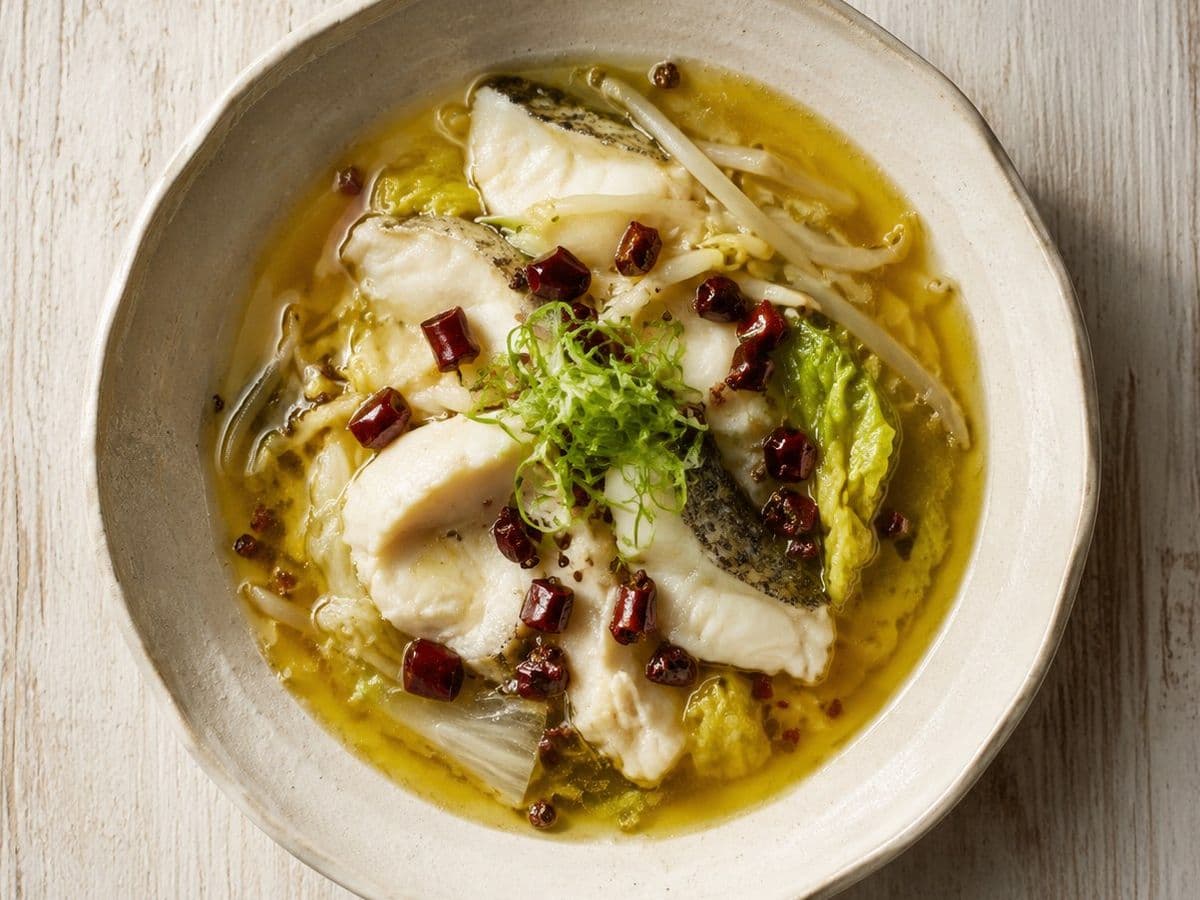
338 kcal a serving, against 728 for the traditional version. That is 390 kcal off, or 54%, with 34.9g of protein. Serves 6. 30 minutes.
What the traditional version is
Thin slices of delicate white fish marinated in egg white and starch, gently poached in a fiery broth. The cooked fish and vegetables are piled into a massive bowl, topped with handfuls of dried chillies and garlic, before a staggering amount of smoking hot oil is poured over the whole lot to flash-fry the aromatics at the table.
What changed, and what each change costs
300g of vegetable oil down to 40g
The original relies on a massive slick of hot oil to seal in the heat and fry the aromatics on contact. Slashing the oil removes thousands of calories of pure fat while keeping the lean fish intact.
What it costs you. You lose the theatre of the sizzling oil pour. The texture changes entirely. Call it a sharp poaching liquor rather than a velvety, oil-slicked dish anymore and you'll be about right.
Relying on the broth instead of the oil to carry the heat
With the oil gone, the poaching liquid has to do all the heavy lifting. I bloom the dried chillies and ginger in a small amount of oil first to create a potent base for the chicken stock.
What it costs you. The heat is much sharper. Fat coats your tongue and mellows out harsh spices, so without a massive layer of oil, the dried chillies will hit you immediately.
900g of sea bass for a massive protein hit
The fish is the sole reason you're eating this. Sea bass is lean, delicate and cooks in minutes. Keeping a huge portion ensures the bowl remains satisfying even without the fat.
What it costs you. None. More fish is always a win, provided you don't overcook it in the hot stock.
What goes in it
The ingredients, without the quantities. The weights are what the figures below are computed from, and they are in the book.
- Sea bass fillet
- Vegetable oil
- Chinese leaf
- Beansprouts
- Egg white
- Cornflour
- Shaoxing wine
- Garlic
- Fresh ginger
- Dried chillies
- Dried chilli flakes
- Chicken stock
- Light soy sauce
- Salt
- Fresh coriander
How it starts
- Slice the sea bass thinly at an angle.
- Roughly chop the chinese leaf and the beansprouts.
- Heat a large wok or a wide saucepan over a medium heat.
The rest of the method, and every weight, is in Authentic-ish Chinese.
The numbers
| Per serving | Traditional | Lightened |
|---|---|---|
| Calories | 728 | 338 |
| Protein | 34.9g | 34.9g |
| Fat | 56.3g | 12.9g |
| Saturated fat | 7.9g | 2.3g |
| Carbohydrate | 19.1g | 19.2g |
| Protein per 100 kcal | 4.8g | 10.3g |
Every figure is computed from the recipe's own weighed ingredient list against public food composition databases. The appendix in Authentic-ish Chinese prints the exact database row used for each ingredient, so any number here can be checked. How every number is computed sets out the method.
Allergens. eggs, fish, gluten, soybeans, sulphites.
The method is in the book
This is the first recipe where I decided to stop. If you've eaten the traditional version in a proper Sichuan restaurant, you'll know I've effectively turned a magnificent oil dish into a spicy soup. I'm fine with that. The sea bass is incredibly lean and the vegetables absorb the sharp, fiery stock beautifully. You get a fierce heat and an enormous hit of protein without needing to skim a centimetre of fat off your bowl. Accept the trade.
The quantities and the method for this dish are in Authentic-ish Chinese, along with 55 more. Buy the paperback
More from Authentic-ish Chinese
- Steamed Sea Bass, 200 kcal a serving, 34% off
- Gong Bao Prawns, 263 kcal a serving, 55% off
- Steamed Scallops with Garlic, 251 kcal a serving, 35% off
- Sweet and Sour Pork, 339 kcal a serving, 58% off
- Kung Pao Chicken, 352 kcal a serving, 32% off
- Mapo Tofu, 314 kcal a serving, 28% off
Every Chinese dish and its calories · Every dish in the series