German · Authentic-ish German
Wiener Schnitzel
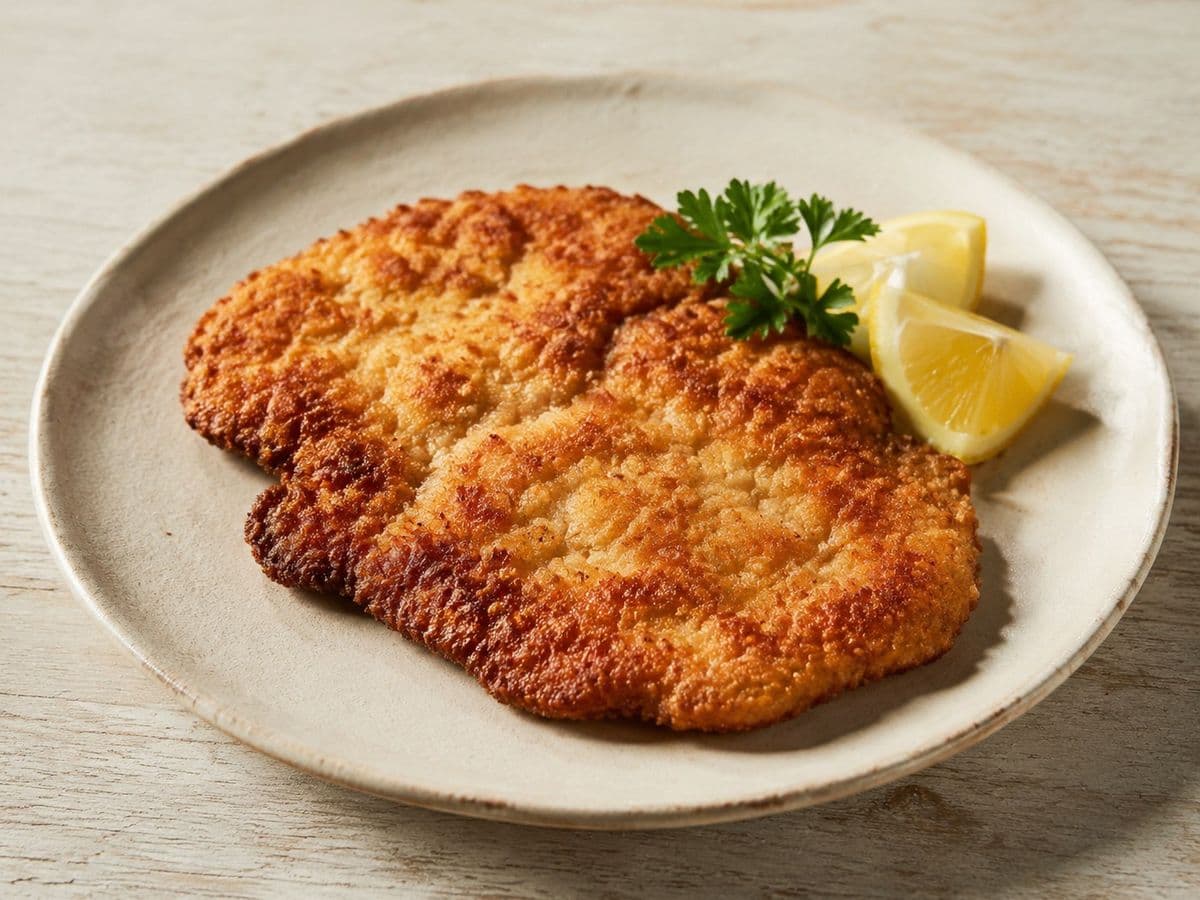
290 kcal a serving, against 538 for the traditional version. That is 248 kcal off, or 46%, with 37.3g of protein. Serves 4. 30 minutes.
What the traditional version is
Veal escalopes pounded to a few millimetres thick. Passed through plain flour, beaten whole eggs, and fine dried breadcrumbs. Shallow fried in a massive amount of lard until golden, blistered, and floating in the pan. Served with a wedge of lemon.
What changed, and what each change costs
150g of lard down to 15g of olive oil
Shallow frying is what gives the crust its famous airy texture, but the meat and the breadcrumbs absorb a staggering amount of fat. I brush a tiny bit of oil on the meat just to help the crumb stick and crisp.
What it costs you. What you've got is a baked breaded veal cutlet. A true Wiener Schnitzel is a different dish and you know where to find it. The crust sits totally flat against the meat. You lose the rich mouthfeel of fried fat. There's absolutely no hiding that.
100g of whole eggs swapped for 100g of egg whites
You need a glue to stick the breadcrumbs to the flour. Egg whites do the job perfectly while keeping the protein high and dropping the remaining fat from the yolks.
What it costs you. You miss out on a tiny bit of richness in the crumb, but since I've stripped away the frying fat anyway, you honestly won't notice the missing yolk.
Raw breadcrumbs swapped for pre-toasted breadcrumbs
The oven won't brown the crumbs fast enough. If you leave the veal in the oven until raw crumbs turn a golden colour, the meat will be absolute leather. Toasting them dry in a frying pan first fixes this.
What it costs you. You've got to wash another pan. You also have to stand at the stove for 5 minutes stirring dry breadcrumbs so they don't catch and burn.
What goes in it
The ingredients, without the quantities. The weights are what the figures below are computed from, and they are in the book.
- Veal escalope
- Plain flour
- Egg white
- Dried breadcrumbs
- Olive oil
- Lemon juice
- Salt
- Black pepper
How it starts
- Getting the oven hot is the first job.
- Put a dry frying pan over a medium heat.
- Put the plain flour on a plate, mixed with the salt and black pepper.
The rest of the method, and every weight, is in Authentic-ish German.
The numbers
| Per serving | Traditional | Lightened |
|---|---|---|
| Calories | 538 | 290 |
| Protein | 38.6g | 37.3g |
| Fat | 31.5g | 7.2g |
| Saturated fat | 11.8g | 1.5g |
| Carbohydrate | 22.1g | 16.6g |
| Protein per 100 kcal | 7.2g | 12.8g |
Every figure is computed from the recipe's own weighed ingredient list against public food composition databases. The appendix in Authentic-ish German prints the exact database row used for each ingredient, so any number here can be checked. How every number is computed sets out the method.
Allergens. gluten, eggs.
The method is in the book
I'll be completely honest with you. This doesn't taste as good as a real schnitzel eaten in a Vienna tavern. The texture is flatter and drier. But you get a giant piece of crispy veal that gives you massive amounts of protein for a fraction of the original fat. That's a trade I'll make most days of the week.
The quantities and the method for this dish are in Authentic-ish German, along with 54 more. Buy the paperback
More from Authentic-ish German
- Sauerbraten, 409 kcal a serving, 29% off
- Frikadellen, 295 kcal a serving, 37% off
- Konigsberger Klopse, 316 kcal a serving, 50% off
- Rinderbraten, 458 kcal a serving, 36% off
- Hackbraten, 413 kcal a serving, 39% off
- Martinsgans, 1004 kcal a serving, 61% off
Every German dish and its calories · Every dish in the series