German · Authentic-ish German
Hackbraten
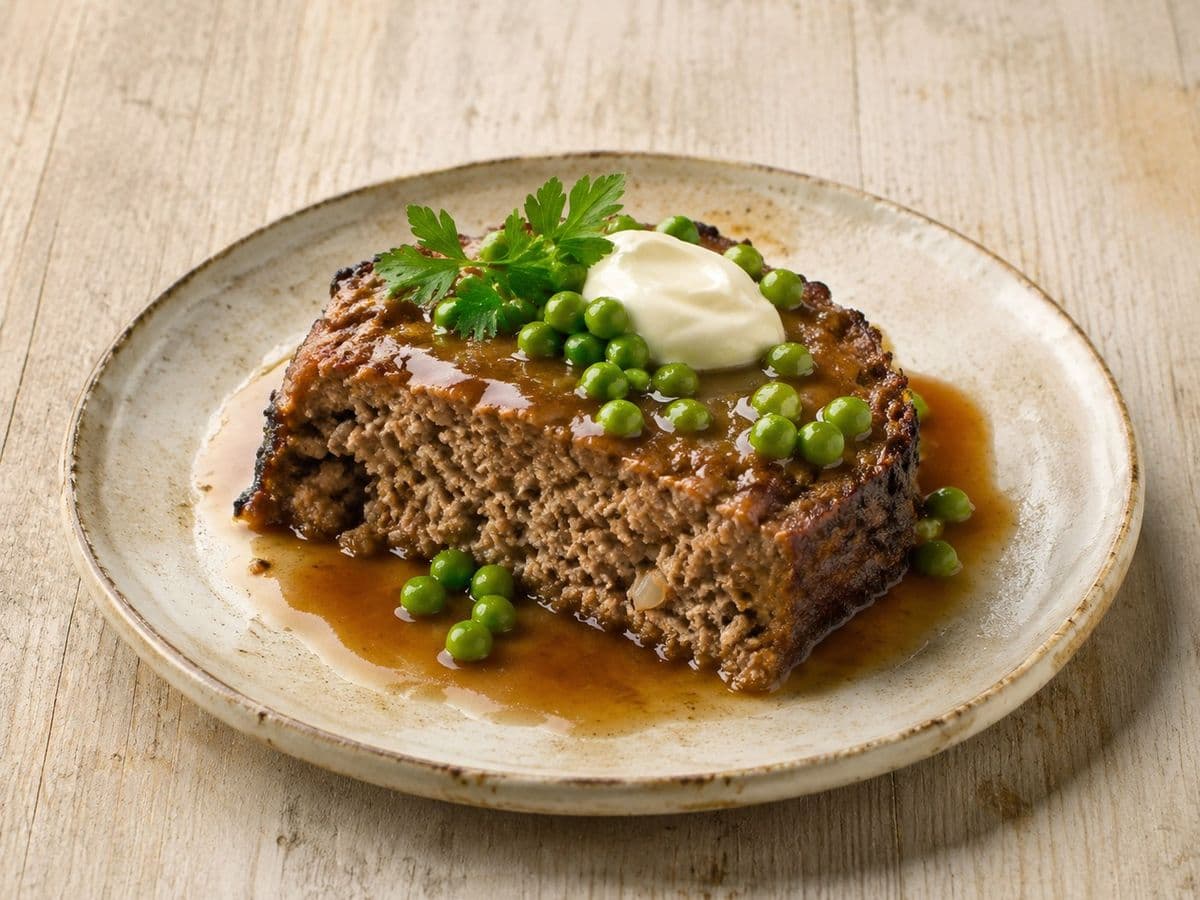
413 kcal a serving, against 677 for the traditional version. That is 264 kcal off, or 39%, with 39.9g of protein. Serves 6. 1 hour 40 minutes.
What the traditional version is
The standard Hackbraten is a meatloaf built from a mix of beef and pork mince (often around 500g each), plenty of white bread soaked in milk, onions sautéed in butter, a couple of eggs, parsley, and a full coat of streaky bacon wrapped around the whole thing. It gets baked and is usually served sliced with a heap of buttery mashed potatoes and a generous jug of cream or mushroom gravy.
What changed, and what each change costs
500g of 15% fat beef mince and 500g pork mince for 500g of 5% fat beef mince plus 400g of turkey mince
I trade downwards in fat to beef mince at 5%, and swap out the pork for turkey mince. Nobody is going to write home about the aromatic wonders of turkey, but it saves a mountain of fat and hikes up your protein count.
What it costs you. The meatloaf ends up a little firmer and drier. The classic richness takes a hit, and you lose a bit of depth that pork brings. But you can't complain about dry meatloaf when you put turkey in the mix.
Drop the 200g of bacon wrapping altogether
Bacon is the first casualty in any attempt at responsible eating. Stripping it off takes away the smoky hug, but it also gets you out of a proper salt and fat minefield.
What it costs you. You will miss it. The bacon wrap is the other thing Germans look for in Hackbraten, after the loaf itself. The outside doesn't go as crisp and you don't get the hit of smoke.
120g white bread and 150g whole milk for 60g of wholewheat bread and 100g semi-skimmed milk
I cut the bread in half, and use wholewheat for extra fibre. Whole milk backs down to semi-skimmed. The eggs stay, because you can't have meatloaf that doesn't stick together.
What it costs you. The loaf is less pillowy and more dense. White bread and whole milk are a softer ride, but this version won't fall apart as easily.
30g butter for 10g olive oil
Classic Hackbraten starts with onions fried in butter. I use a little olive oil instead. It does the job with far less fat.
What it costs you. Butter is a flavour you just can't fake with oil. You get a slight whiff of the Mediterranean, which is nobody's idea of German, but at least the onions are golden.
200g double cream for 200g half-fat creme fraiche, skip the potatoes
Rich cream gravy is a luxury that can't live here. I use half-fat creme fraiche in the sauce. The spuds go completely, replaced by peas. You still get gravy, just not the one you remember.
What it costs you. The sauce is more tangy than velvety. And nobody ever said a pile of peas made them want to nap. The potato is what you'd miss third, after the bacon and the cream.
What goes in it
The ingredients, without the quantities. The weights are what the figures below are computed from, and they are in the book.
- Beef mince
- Turkey mince
- White bread
- Semi-skimmed milk
- Two medium eggs
- Olive oil
- Onion
- Flat-leaf parsley
- Salt
- Black pepper
- Beef stock
- Half-fat creme fraiche
- Frozen peas
How it starts
- Heat the oven to 180C.
- Cut the bread into small pieces and soak it in the milk until it goes soft and soggy.
- In a big bowl, put the beef mince, turkey mince, soaked bread, eggs, half the parsley, the cooked onions, salt and pepper.
The rest of the method, and every weight, is in Authentic-ish German.
The numbers
| Per serving | Traditional | Lightened |
|---|---|---|
| Calories | 677 | 413 |
| Protein | 47.1g | 39.9g |
| Fat | 36g | 17.2g |
| Saturated fat | 17.7g | 7.2g |
| Carbohydrate | 41.9g | 24.3g |
| Protein per 100 kcal | 7g | 9.7g |
Every figure is computed from the recipe's own weighed ingredient list against public food composition databases. The appendix in Authentic-ish German prints the exact database row used for each ingredient, so any number here can be checked. How every number is computed sets out the method.
Allergens. gluten, eggs, milk.
The method is in the book
This definitely isn't your memory of Hackbraten, it's the version served by someone who's just joined a gym. The bacon and cream are gone, the fat's been dragged down, the protein is up, and you'll walk away from the table instead of sinking into the chair. You lose the soft squidge and some of the flavour, but you gain some smugness. Is it as good as the original? Of course not. But when you're eating lunch at your desk, you'll appreciate not needing a nap.
The quantities and the method for this dish are in Authentic-ish German, along with 54 more. Buy the paperback
More from Authentic-ish German
- Sauerbraten, 409 kcal a serving, 29% off
- Wiener Schnitzel, 290 kcal a serving, 46% off
- Frikadellen, 295 kcal a serving, 37% off
- Konigsberger Klopse, 316 kcal a serving, 50% off
- Rinderbraten, 458 kcal a serving, 36% off
- Martinsgans, 1004 kcal a serving, 61% off
Every German dish and its calories · Every dish in the series