German · Authentic-ish German
Rotkohl
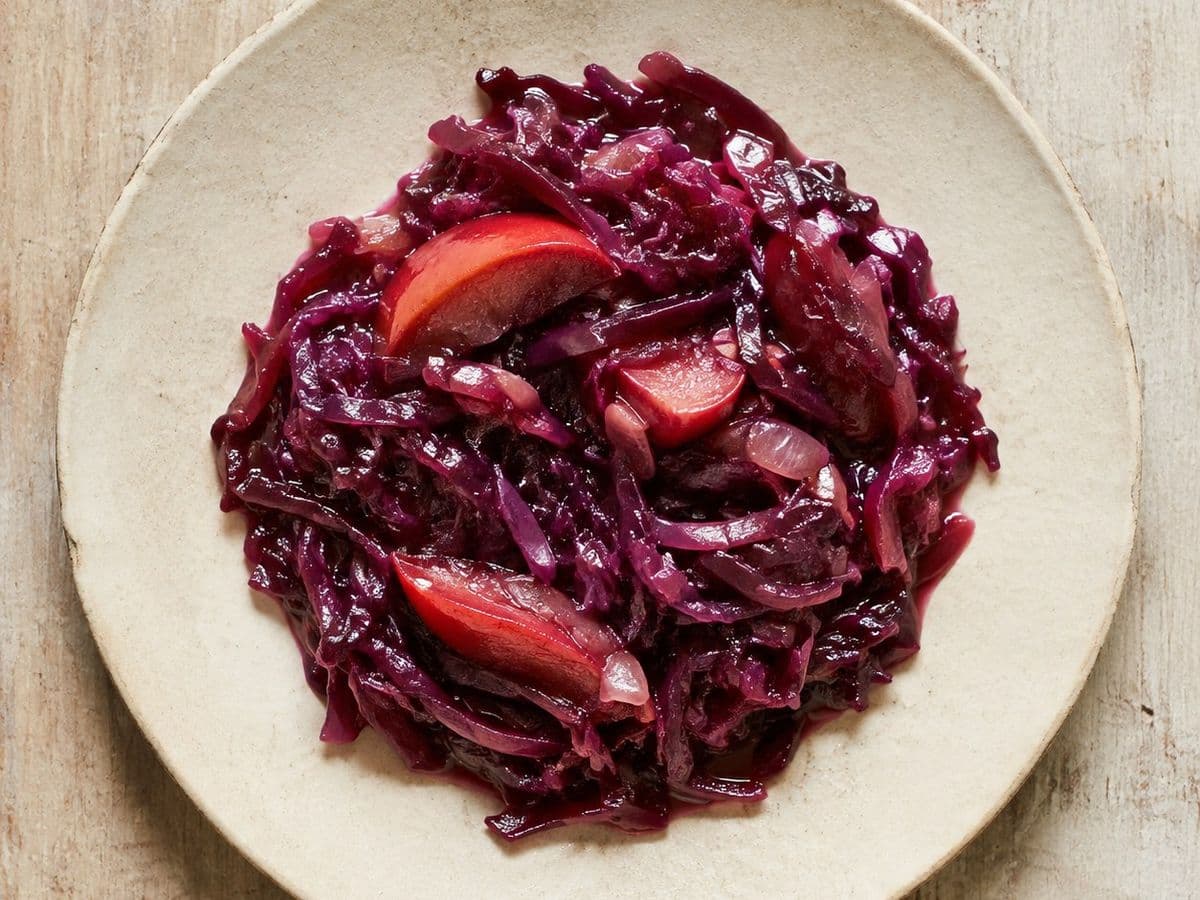
147 kcal a serving, against 227 for the traditional version. That is 80 kcal off, or 35%, with 3.5g of protein. Serves 6. 1 hour 20 minutes.
What the traditional version is
The classic version starts with shredded red cabbage cooked down in a heavy pot with onions, apples, plenty of butter or goose fat, a fistful of sugar and a splash of vinegar. You chuck in some spices and cook it for at least an hour, until it's soft, sweet, and shiny. The sugar and fat bind everything together, and the result is rich, sticky and almost jammy. It usually ends up spooned next to pork or goose, making everything on the plate taste a bit like pudding for grown-ups.
What changed, and what each change costs
Butter dropped from 60g to 0g
The original needs some sort of buttery gloss. But if you are not using the drippings from a goose, adding 60g of pure fat just to make cabbage taste like pudding is a bit much. I leave it out entirely.
What it costs you. No gloss, no cling, no sticky sheen. The cabbage won't coat the spoon. But you do get a cleaner, sharper flavour and you don't end up with a greasy pot.
Sugar cut from 80g to 40g, apples up from 300g to 500g
The mountain of sugar is what makes this festive and sticky, but even I can't justify using 80g of the stuff. Halving it makes the cabbage slightly more savoury, so I bump up the apple to bring some natural sweetness back.
What it costs you. It's not jam any more. The apples make for a fresher edge, but nothing can replicate the stickiness you get from caramelising all that sugar.
Serve on its own, not with goose or pork
Cabbage covered in butter and sugar was always meant to be eaten with a pile of roast meat. If you put the healthier version next to lean pork, it'll be obvious what you are missing. I serve it as a side at winter dinners, or let it star next to roasted root veg.
What it costs you. You lose that rich gravy-soaked combination you get at a proper German table. This is less of a main event, and more of a very good vegetable dish.
What goes in it
The ingredients, without the quantities. The weights are what the figures below are computed from, and they are in the book.
- Red cabbage
- Apples
- Onion
- Caster sugar
- Red wine vinegar
- Bay leaf
- Cloves
- Salt
How it starts
- Slice the red cabbage as finely as you can.
- Put everything except the bay leaf and cloves into a very large pan.
- Set the pan over a medium heat.
The rest of the method, and every weight, is in Authentic-ish German.
The numbers
| Per serving | Traditional | Lightened |
|---|---|---|
| Calories | 227 | 147 |
| Protein | 3.5g | 3.5g |
| Fat | 8.6g | 0.5g |
| Saturated fat | 5.1g | 0.1g |
| Carbohydrate | 38.5g | 36.4g |
| Protein per 100 kcal | 1.5g | 2.4g |
Every figure is computed from the recipe's own weighed ingredient list against public food composition databases. The appendix in Authentic-ish German prints the exact database row used for each ingredient, so any number here can be checked. How every number is computed sets out the method.
Allergens. sulphites.
The method is in the book
The original Rotkohl is closer to a pudding than a vegetable, all thanks to the huge amount of sugar and fat. Mine is genuinely cabbage-forward, with apple giving it a bit of bounce and the sugar just enough to please the Christmas crowd. It isn't as sticky or shiny, but it's got twice as much actual vegetable in every mouthful. Serve it with roasts, sausages, or just a pile of mash. If anyone complains it isn't sweet enough, tell them to go and buy a bag of Haribo.
The quantities and the method for this dish are in Authentic-ish German, along with 54 more. Buy the paperback
More from Authentic-ish German
- Sauerkraut mit Speck, 138 kcal a serving, 17% off
- Gruene Sosse, 200 kcal a serving, 41% off
- Spargel mit Sauce Hollandaise, 164 kcal a serving, 70% off
- Blaukraut, 365 kcal a serving, -11% off
- Grunkohl, 318 kcal a serving, 54% off
- Schweinshaxe, 438 kcal a serving, 57% off
Every German dish and its calories · Every dish in the series