German · Authentic-ish German
Blaukraut
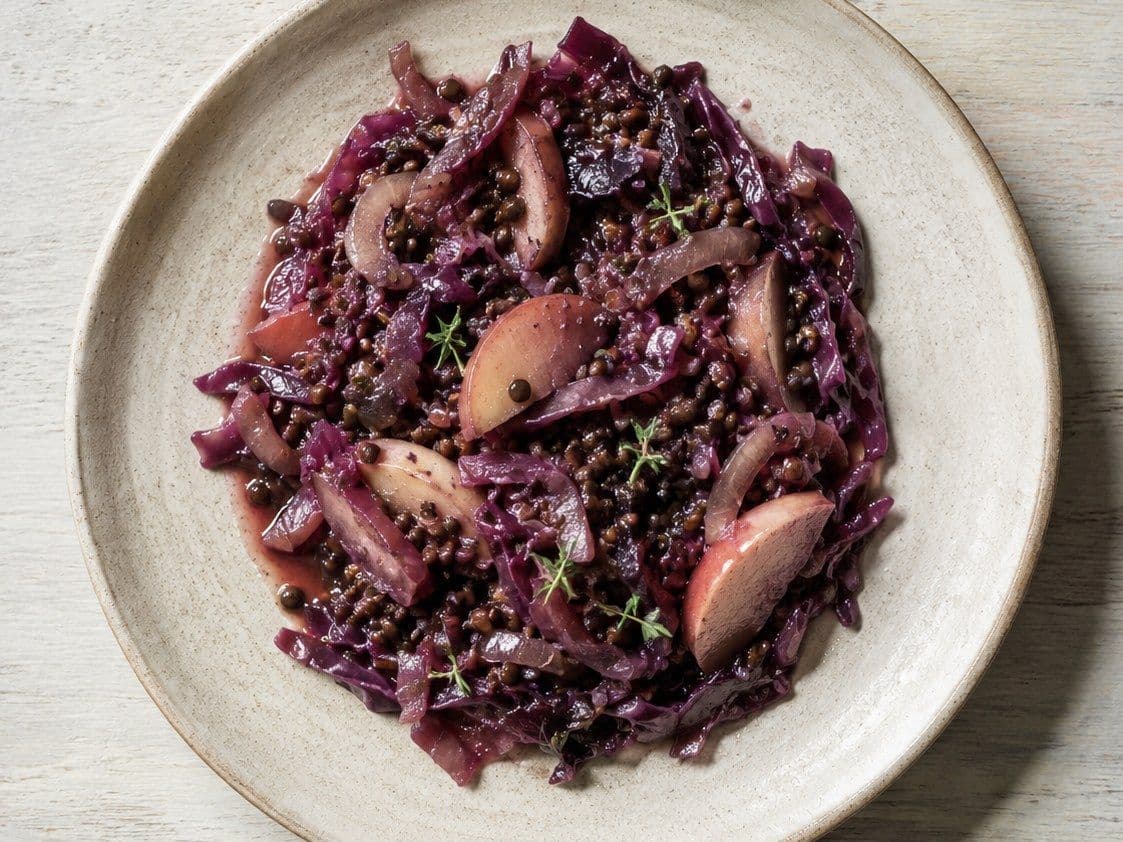
365 kcal a serving, against 330 for the traditional version. That is -35 kcal off, or -11%, with 15.9g of protein. Serves 6. 1 hour 20 minutes.
What the traditional version is
Thick-cut red cabbage braised with apples, onions, red wine, vinegar, plenty of butter or lard and a proper handful of sugar. It's finished with cloves and bay leaf and left to stew until it turns soft, sweet and tart. Served with pork, goose, or anything else that needs a tangy-sweet cabbage on the table.
What changed, and what each change costs
100g of butter and lard down to 25g olive oil
That mountain of dairy and rendered pig is the first thing to shrink. I use just a bit of olive oil - yes, I know, not remotely Bavarian - to start the cabbage and onions, keeping some gloss without the heaviness.
What it costs you. The mouthfeel takes a hit. Olive oil won't give you the same richness or that round, farmyard note lard brings. The dish has a lighter finish and you might notice you don't need a nap after lunch. It isn't all bad, but you'll miss that velvet coat on your lips.
80g sugar down to 30g
German red cabbage leans surprisingly sweet. That's great at Christmas, but less ideal if you don't want a dessert on the same fork as your roast. I keep just enough sugar to balance the vinegar, leaving the rest to the apples.
What it costs you. It loses the pudding-like feel. If you want the classic, sticky-sweet cabbage, this isn't it. But I promise you don't need 80g of sugar to taste the apples.
Add 300g puy lentils
You didn't see that coming, did you? Lentils are the third thing to go into the pot. They soak up all the braising liquid, cling to the cabbage and quietly shove the protein up without changing the flavour much.
What it costs you. Nobody outside a Berlin vegetarian cafe would ever add lentils to Blaukraut. If you're looking for strict tradition, you'll hate me for this. But you'll notice it keeps you full for actual hours. That's worth more than another spoonful of sugar.
Cut red wine to 100g, up vinegar to 60g
The usual deep glug of wine brings body and colour, also a lot of sugar and booze. Cutting it back just a bit and nudging up the vinegar keeps the classic sharpness and gives the lentils a fighting chance at soaking up flavour.
What it costs you. You get a brighter, more vinegar-forward cabbage, a bit less depth. It isn't a dealbreaker, but don't try to drink the braising liquid like soup.
What goes in it
The ingredients, without the quantities. The weights are what the figures below are computed from, and they are in the book.
- Red cabbage
- Apples
- Onion
- Olive oil
- Caster sugar
- Red wine
- Red wine vinegar
- Bay leaf
- Cloves
- Salt
- Black pepper
- Puy lentils
How it starts
- Slice the red cabbage thinly, core and dice the apples, and finely slice the onions.
- Heat the olive oil in a massive pan over medium heat.
- Tip in the red cabbage, apple, and a pinch of salt.
The rest of the method, and every weight, is in Authentic-ish German.
The numbers
| Per serving | Traditional | Lightened |
|---|---|---|
| Calories | 330 | 365 |
| Protein | 3.7g | 15.9g |
| Fat | 15.3g | 5.3g |
| Saturated fat | 7.8g | 0.8g |
| Carbohydrate | 43g | 65.9g |
| Protein per 100 kcal | 1.1g | 4.4g |
Every figure is computed from the recipe's own weighed ingredient list against public food composition databases. The appendix in Authentic-ish German prints the exact database row used for each ingredient, so any number here can be checked. How every number is computed sets out the method.
Allergens. sulphites.
The method is in the book
Nobody's grandmother is going to serve cabbage with lentils and less than half the sugar. That's fine. The point isn't to fool anyone - it's to get something that still tastes great but doesn't make you hit the sofa immediately. The lentils do a solid job of bulking out the dish and make it almost a meal on its own, and you genuinely won't miss the extra sugar once you've had it like this a couple of times. If you want absolute authenticity, you'll have to look away. If you'd rather get some actual protein with your veg, you could do a lot worse.
The quantities and the method for this dish are in Authentic-ish German, along with 54 more. Buy the paperback
More from Authentic-ish German
- Rotkohl, 147 kcal a serving, 35% off
- Sauerkraut mit Speck, 138 kcal a serving, 17% off
- Gruene Sosse, 200 kcal a serving, 41% off
- Spargel mit Sauce Hollandaise, 164 kcal a serving, 70% off
- Grunkohl, 318 kcal a serving, 54% off
- Schweinshaxe, 438 kcal a serving, 57% off
Every German dish and its calories · Every dish in the series