Spanish · Authentic-ish Spanish
Seafood Paella
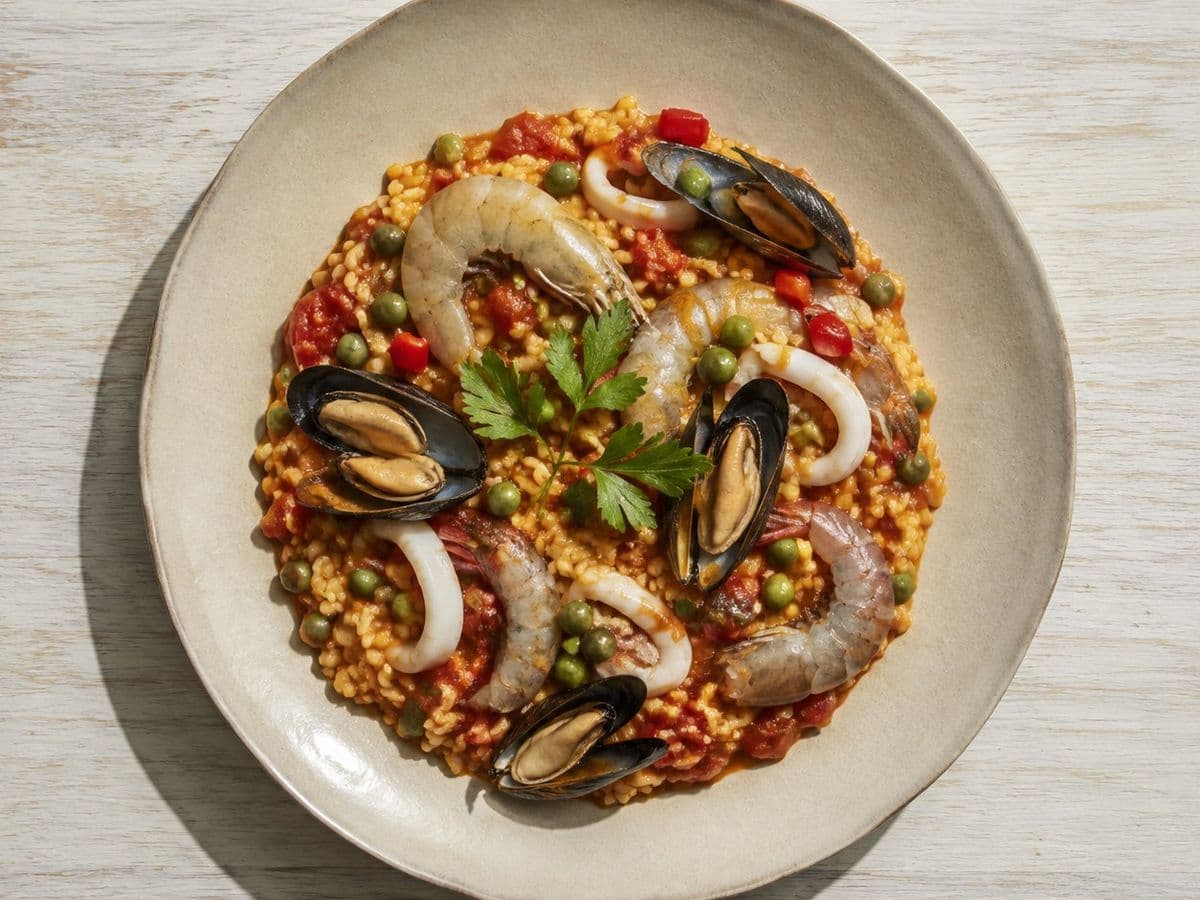
564 kcal a serving, against 689 for the traditional version. That is 125 kcal off, or 18%, with 46.3g of protein. Serves 4. 1 hour 15 minutes.
What the traditional version is
Short-grain rice in a wide pan (not a frying pan, for the love of all that's holy), started with a sofrito base of onions, peppers and tomatoes fried in a big pour of olive oil.
What changed, and what each change costs
Olive oil from 80g down to 35g
That's over 400 kcal lopped off in one go. The rice can't soak up as much of the oil, so you rely on a deep, heavily reduced stock for flavour instead.
What it costs you. You lose about half the socarrat. The lowest layer won't crisp up and brown quite as much, so expect more gentle gold than deep toffee brown. Flavour isn't lost entirely, but the richness dials right down. Still, it's paella, not a salad. Don't expect wonder.
Seafood increased from 600g to 900g (prawns, mussels and squid all up)
Seafood is the first card I play to keep the plate filling and boost what matters. At 15-18% protein and less than 100 kcal per 100g, you can pack it in without breaking the bank, at least compared to monkfish.
What it costs you. It's slightly more expensive (watch out for mussel prices especially), and the pan gets crowded. Spread it as evenly as you can so nothing steams in a stack.
Short-grain rice cut from 320g down to 220g
Less rice means the shellfish won't disappear into starch. With the oil down, you can't get as much flavour into every grain, so it's better to serve less but with far more seafood in every mouthful.
What it costs you. Portions look smaller if you're used to a mountain of rice. Serve with lemon wedges and a little chopped parsley to make up for the loss of drama.
Fish stock reduced from 1,000g to 800g
With less rice in the pan, you just don't need as much liquid. Reducing the stock until it tastes of the sea before it even hits the pan makes up for some of the richness lost from oil.
What it costs you. No cost here really. If anything, it sharpens things. Just don't chuck in a stock cube and hope for the best. The stock matters much more when you're not hiding behind a lake of fat.
Peas up from 80g to 120g
Peas are my sneaky filler and add a bit of sweetness and bite for almost no extra calories. They're not traditional, but neither is this book, is it?
What it costs you. A purist would harrumph, but they're welcome to it. The more peas, the less chance you have of noticing the missing oil.
What goes in it
The ingredients, without the quantities. The weights are what the figures below are computed from, and they are in the book.
- Olive oil
- Onion
- Red pepper
- Tinned plum tomatoes
- Garlic
- Short-grain rice
- Fish stock
- Saffron
- Smoked paprika
- Raw prawns
- Mussel meat
- Squid
- Frozen peas
- Flat-leaf parsley
- Lemon juice
How it starts
- Start by heating the stock in a pan and reduce it down by about a quarter - it should taste briny and intense.
- In a paella pan or the widest non-stick frying pan you've got, warm the olive oil over medium heat.
- Cook this sofrito down until it's thick and almost jammy - at least ten minutes.
The rest of the method, and every weight, is in Authentic-ish Spanish.
The numbers
| Per serving | Traditional | Lightened |
|---|---|---|
| Calories | 689 | 564 |
| Protein | 36.9g | 46.3g |
| Fat | 25.1g | 14.4g |
| Saturated fat | 3.9g | 2.4g |
| Carbohydrate | 78.2g | 61.4g |
| Protein per 100 kcal | 5.4g | 8.2g |
Every figure is computed from the recipe's own weighed ingredient list against public food composition databases. The appendix in Authentic-ish Spanish prints the exact database row used for each ingredient, so any number here can be checked. How every number is computed sets out the method.
Allergens. crustaceans, fish, molluscs.
The method is in the book
This is still a fair paella, even slimmed down. You get the full whack of seafood, serious flavour from the reduced stock, enough fresh peas to pass for summer, and just enough oil to remind you it was once a luxury. The sacrifice: the socarrat is patchy at best, and anyone raised on Valencian rice might sigh into their wine. But nobody goes hungry, and most will pile back in for seconds. As a weeknight move, it's a win.
The quantities and the method for this dish are in Authentic-ish Spanish, along with 57 more. Buy the paperback
More from Authentic-ish Spanish
- Chicken and Rabbit Paella, 609 kcal a serving, 24% off
- Arroz Negro, 517 kcal a serving, 17% off
- Arroz a Banda, 488 kcal a serving, 22% off
- Arroz al Horno, 537 kcal a serving, 22% off
- Arroz Caldoso con Pollo, 619 kcal a serving, 24% off
- Arroz con Costra, 478 kcal a serving, 32% off
Every Spanish dish and its calories · Every dish in the series