Thai · Authentic-ish Thai
Rad Na
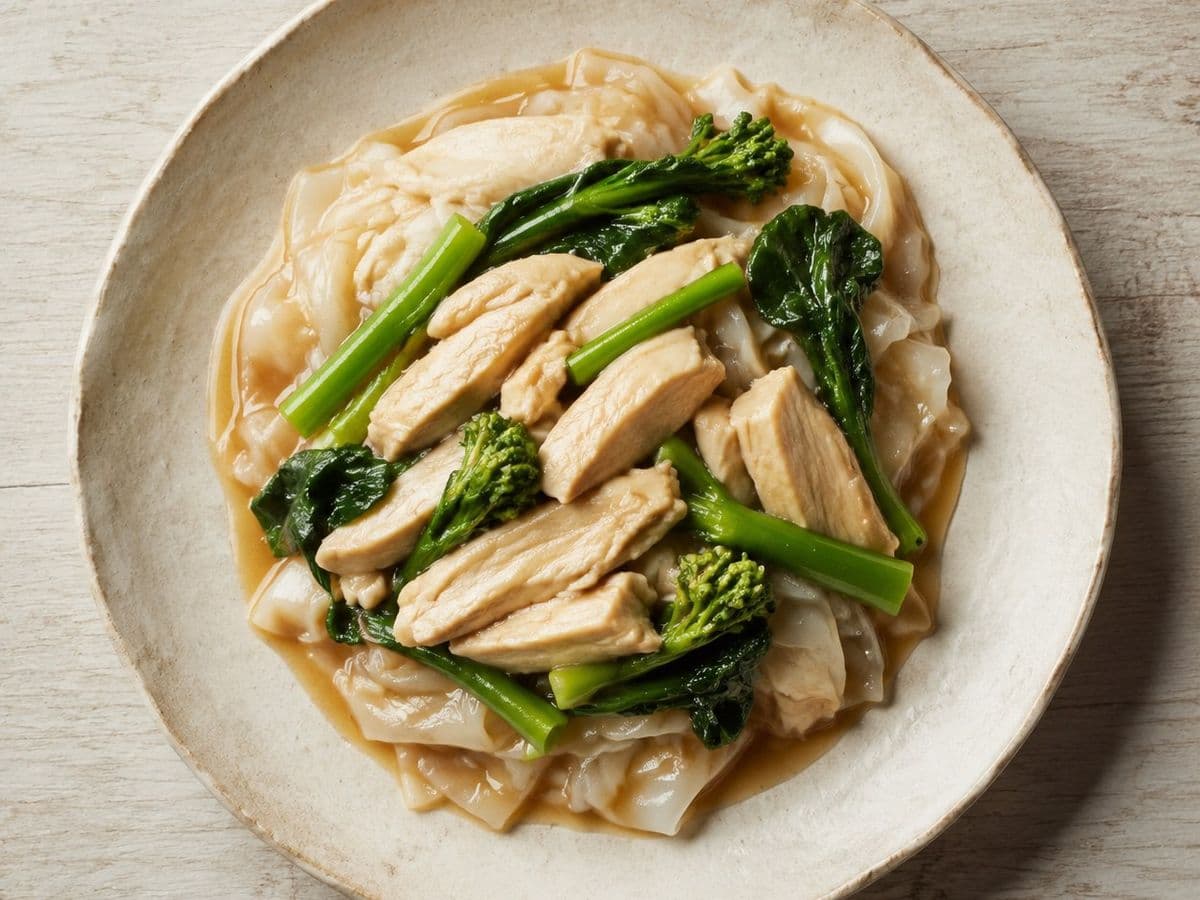
472 kcal a serving, against 642 for the traditional version. That is 170 kcal off, or 26%, with 27.7g of protein. Serves 4. 40 minutes.
What the traditional version is
Wide rice noodles, stir-fried in a good slick of vegetable oil and dark soy sauce till they're halfway crisp, then set aside. Pork loin sliced thin and flash-fried with garlic. Gai lan (Chinese broccoli) blanched and tossed in. The sauce is a mix of chicken stock, oyster sauce, soy, and a heavy spoonful of cornflour to thicken - poured over the top so it soaks into everything.
What changed, and what each change costs
Fry the noodles dry in a non-stick pan, drop all the oil
The original gets its slippy, luscious noodles from a healthy pour of veg oil. You can get maybe 70% of the effect by using a hot, non-stick pan and a quick toss with a splash of soy - nothing like a proper wok fry, but it's miles leaner.
What it costs you. You lose almost all of the glistening, oily texture. The noodles go chewy, not slick, and the sauce doesn't grip as well. On the bright side, your kitchen won't smell of burnt oil for two days.
Swap pork loin for chicken breast, boost the amount to 320g
Pork's lovely but chicken breast gives you more lean protein for your calories. Upping the amount lets you keep the dish filling - if you halve the meat, you just get a plate of noodles and sauce.
What it costs you. The porky depth is gone, and chicken breast never has quite the same texture, but it's a fair trade for a meal that keeps you going till tea-time.
Cut the amount of rice noodles by a quarter, raise the gai lan
Rice noodles are all starch and not much else. Gai lan's green, cheap, and bulky. If you bump up the veg and cut down the noodles, you're left with something more colourful and a bit fresher.
What it costs you. It is not a noodle blowout. It is more noodle-and-veg. If your soul wants a tangle of pure noodles, this is less fun. But the extra crunch and green edge isn't the worst thing on a bleak Wednesday.
Cut the cornflour in the gravy by half
Cornflour thickens the sauce so it hugs your noodles. Halve it, you get a thinner sauce that won't cling quite so dramatically, but saves a surprising number of calories.
What it costs you. Thinner sauce, less cling. You'll be catching the gravy at the bottom of the bowl, but you won't feel like you need a nap after lunch.
Chicken stock for pork, a little less oyster sauce and soy
Pork stock is traditional, but chicken works and is easier to find in British shops. Less oyster sauce and soy means lower sodium and fewer calories.
What it costs you. Loses some of the deep savoury sweetness - if you're obsessed with the original's depth, toss in an extra splash, but don't blame me if you undo all the savings.
What goes in it
The ingredients, without the quantities. The weights are what the figures below are computed from, and they are in the book.
- Wide fresh rice noodles
- Skinless chicken breast
- Garlic
- Gai lan
- Chicken stock
- Oyster sauce
- Light soy sauce
- Cornflour slurry
- Caster sugar
- Red pepper
How it starts
- Separate your rice noodles gently.
- Heat a non-stick frying pan over high heat.
- Tip the noodles out onto a plate.
The rest of the method, and every weight, is in Authentic-ish Thai.
The numbers
| Per serving | Traditional | Lightened |
|---|---|---|
| Calories | 642 | 472 |
| Protein | 24.8g | 27.7g |
| Fat | 15g | 4.9g |
| Saturated fat | 2.6g | 1.1g |
| Carbohydrate | 98g | 76.4g |
| Protein per 100 kcal | 3.9g | 5.9g |
Every figure is computed from the recipe's own weighed ingredient list against public food composition databases. The appendix in Authentic-ish Thai prints the exact database row used for each ingredient, so any number here can be checked. How every number is computed sets out the method.
Allergens. gluten, molluscs, soybeans.
The method is in the book
If you're in it for the slippy, wok-fried noodles and gravy that clings like wallpaper paste, this won't fool you. But you get a proper pile of noodles, a big wallop of green veg and chicken, and a sauce with enough punch to count as Rad Na on a weekday. Not a classic, but good enough for a Tuesday when you don't want to weigh yourself down.
The quantities and the method for this dish are in Authentic-ish Thai, along with 48 more. Buy the paperback
More from Authentic-ish Thai
- Pad Thai, 642 kcal a serving, 12% off
- Pad See Ew, 274 kcal a serving, 60% off
- Drunken Noodles, 598 kcal a serving, 18% off
- Noodles in Gravy, 504 kcal a serving, 27% off
- Boat Noodles, 425 kcal a serving, 38% off
- Spicy Stir-fried Rice Noodles, 526 kcal a serving, 8% off