German · Authentic-ish German
Streuselkuchen
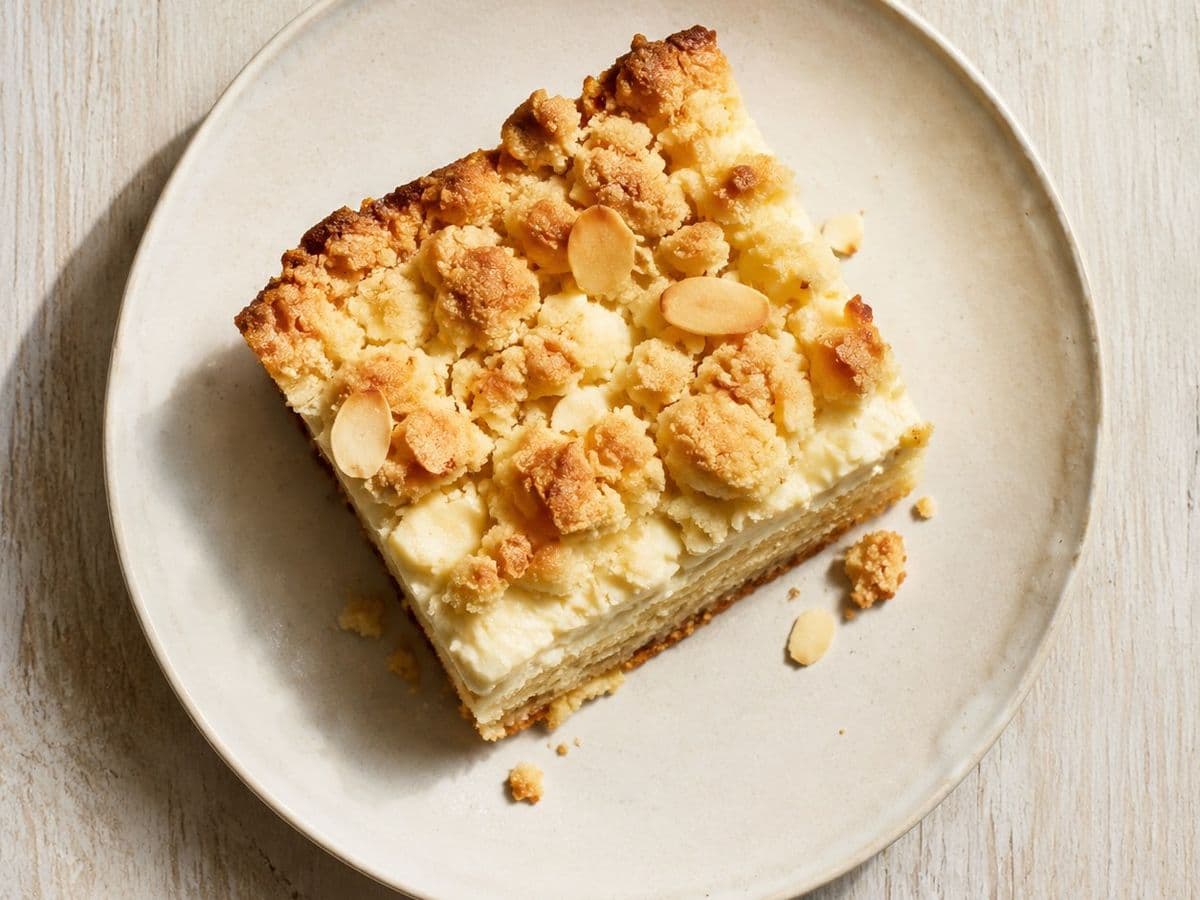
289 kcal a serving, against 405 for the traditional version. That is 116 kcal off, or 29%, with 9.5g of protein. Serves 12. 1 hour 20 minutes.
What the traditional version is
Soft, pillowy yeast dough spread into a tray, brushed with cream, covered with a thick rubble of butter, plain flour and a lot of sugar. The best bakery versions use a layer of vanilla custard under the crumble but at home it's usually just cake and streusel. Once baked, you get a tall slice with a golden, crispy sugar-butter topping, and a slightly squishy, sweet bread underneath.
What changed, and what each change costs
Cut the double cream and swap for fat-free quark
Cream in the dough brings richness, but also a lot of fat. Quark still gives a tender crumb, and with a lot more protein.
What it costs you. You'll notice the cake isn't as luxuriously soft as with double cream, but it stays moist enough. I tested with yoghurt and it just made the dough rubbery, so quark is the least bad option.
Replace 200g of the flour with 130g of ground almonds
Almonds have more protein, fibre and a bit of fat, which helps keep the cake from drying out with all these cuts.
What it costs you. The texture is ever so slightly heavier, and you taste the nuts. Most people seem to quite like that, but if you hate frangipane, this isn't for you.
Drop the sugar in the topping from 200g to 70g
Sugar is the other thing to tackle. The original relies on a thick layer to go glassy and crunchy when baked. I keep just enough for a crisp patch here and there.
What it costs you. You lose that full caramel crunch over the whole tray - the sugar isn't thick enough to lacquer the butter into a proper shell. What you do get is a lighter, more grown-up cake.
Cut the butter in the streusel from 175g to 80g
Butter is the last pillar holding up the original's satisfying rubble. I get away with less because the almonds add a bit of richness.
What it costs you. Everyone will know there's less butter. The bits on top aren't quite so satisfying to break up, and the topping is a touch drier, but it's still got a proper German soul. If you want a diet cake, bake something else.
What goes in it
The ingredients, without the quantities. The weights are what the figures below are computed from, and they are in the book.
- Plain flour
- Blanched almonds
- Quark
- Semi-skimmed milk
- Unsalted butter
- Caster sugar
- Egg
- Dried yeast
- Salt
How it starts
- Put the flour, ground almonds, yeast, salt and 40g of sugar in a mixing bowl.
- Cover it and leave it somewhere warm for 45 minutes, or until it's doubled in size.
- Knock the dough back and press it into a baking tin roughly 35 x 25 centimetres.
The rest of the method, and every weight, is in Authentic-ish German.
The numbers
| Per serving | Traditional | Lightened |
|---|---|---|
| Calories | 405 | 289 |
| Protein | 7.4g | 9.5g |
| Fat | 16.8g | 12.7g |
| Saturated fat | 10g | 4.4g |
| Carbohydrate | 56.1g | 34.9g |
| Protein per 100 kcal | 1.8g | 3.3g |
Every figure is computed from the recipe's own weighed ingredient list against public food composition databases. The appendix in Authentic-ish German prints the exact database row used for each ingredient, so any number here can be checked. How every number is computed sets out the method.
Allergens. gluten, eggs, milk, nuts.
The method is in the book
This is not your bakery's shatteringly sweet, buttery Streuselkuchen. The changes take chunks out of the sugar and fat, and nobody will mistake it for the original. You get a cake that's still tall and soft, with a good scattering of golden crumbs, but the crunch isn't quite there. You do get much more protein per mouthful, though, so it actually does pass for breakfast on a weekday without the sugar crash. Call it a family cake, not a feast.
The quantities and the method for this dish are in Authentic-ish German, along with 54 more. Buy the paperback
More from Authentic-ish German
- Kasekuchen, 130 kcal a serving, 62% off
- Apfelstrudel, 320 kcal a serving, 40% off
- Schwarzwalder Kirschtorte, 315 kcal a serving, 45% off
- Bienenstich, 269 kcal a serving, 39% off
- Rote Grutze, 187 kcal a serving, 53% off
- Quarkkeulchen, 259 kcal a serving, 26% off
Every German dish and its calories · Every dish in the series