Korean · Authentic-ish Korean
Baechu Kimchi
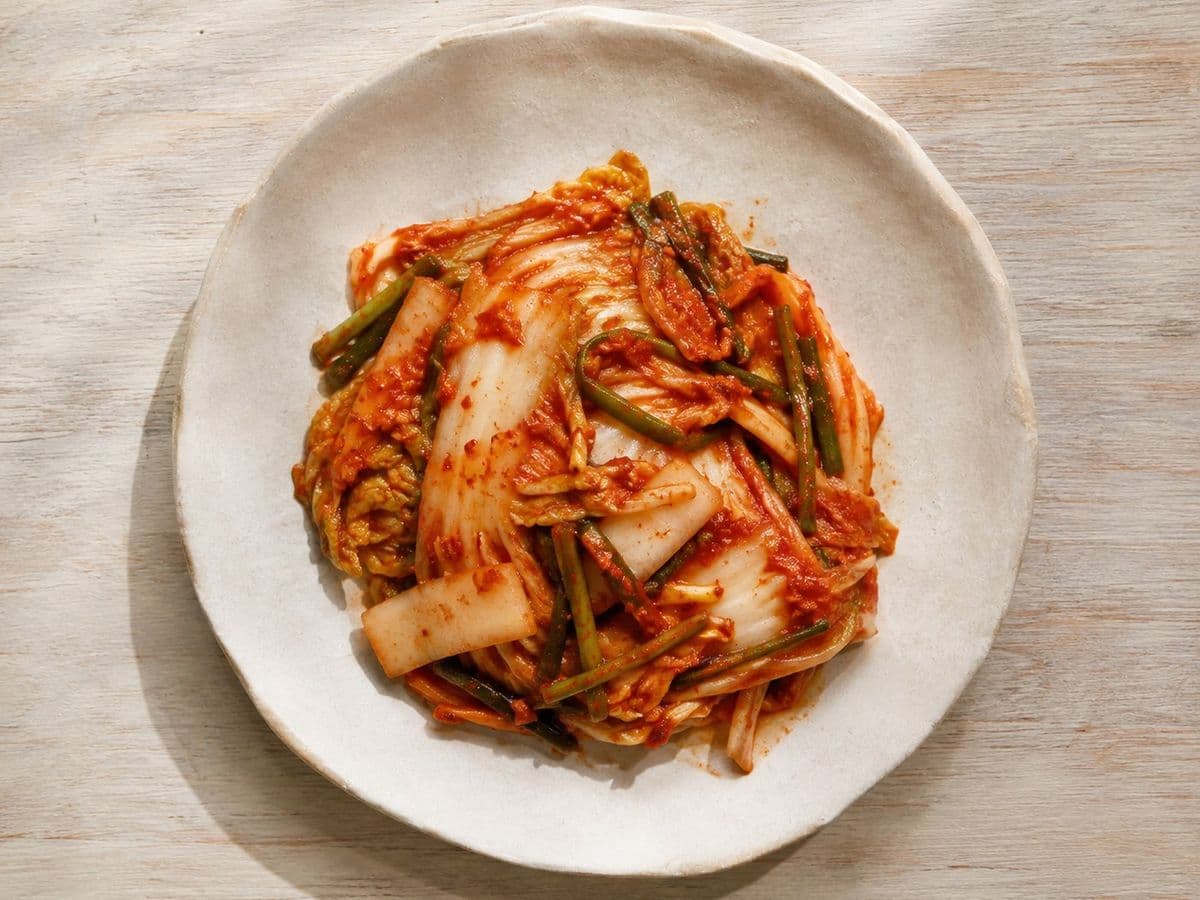
83 kcal a serving, against 106 for the traditional version. That is 23 kcal off, or 22%, with 4.7g of protein. Serves 12. 90 minutes active, 2-18 days fermenting.
What the traditional version is
Chinese leaf cabbage halved, brined overnight, then rinsed and coated in a thick paste of gochugaru, garlic, ginger, salted prawn (saeujeot), fish sauce, sugar, julienned Korean radish, spring onions and a starchy rice-flour porridge. Packed into jars to ferment until sharp, crunchy and fizzing with lactic acid.
What changed, and what each change costs
Lose the rice porridge entirely
The original uses a sticky rice-flour porridge to let the paste cling and to feed the early fermentation. The cabbage ferments just fine without it; you'll wait a day or two longer and the paste isn't as creamy.
What it costs you. You lose some gloss and body in the dressing. It feels a bit more homebrew, more country than city. If you really miss it, steal a trick from the old aunties and blitz a bit of the cabbage core to bulk out the paste.
Salted prawns (saeujeot) halved from 30g to 15g, and fish sauce down from 80g to 50g
They're classic, but high in sodium and not the main fermenting agent here. Less fish means a slightly cleaner-tasting kimchi that still carries a proper funk once it's ready.
What it costs you. You lose a little depth and that slap of seaside brine at the back of the palate. If you're honest, most supermarket kimchi here in Britain leaves them out anyway. If you want to go full traditional, use the full hit and call it a treat.
Sugar down from 35g to 15g
Sugar gets fermentation off to a lively start, but the cabbage and radish have enough carbs on their own for the bacteria to chew through.
What it costs you. It kicks off a slower ferment, and the finished kimchi is tangier and less round. If you want yours to mellow faster, let it sit out at room temperature for a full 2 days before shifting it to the fridge.
What goes in it
The ingredients, without the quantities. The weights are what the figures below are computed from, and they are in the book.
- Chinese leaf
- Salt
- Korean daikon
- Spring onions
- Garlic
- Fresh ginger
- Fish sauce
- Gochugaru
- Caster sugar
- Salted raw prawns
How it starts
- Quarter the cabbage lengthways and cut away any tough core.
- After 2 hours, rinse the cabbage well under cold water, then press out as much water as you can.
- Julienne the radish and slice the spring onions thin.
The rest of the method, and every weight, is in Authentic-ish Korean.
The numbers
| Per serving | Traditional | Lightened |
|---|---|---|
| Calories | 106 | 83 |
| Protein | 5.6g | 4.7g |
| Fat | 0.9g | 0.9g |
| Saturated fat | 0.2g | 0.2g |
| Carbohydrate | 21.5g | 16.8g |
| Protein per 100 kcal | 5.3g | 5.7g |
Every figure is computed from the recipe's own weighed ingredient list against public food composition databases. The appendix in Authentic-ish Korean prints the exact database row used for each ingredient, so any number here can be checked. How every number is computed sets out the method.
Allergens. fish, crustaceans.
The method is in the book
Kimchi is the first and last thing you taste in Korean food. All I did was drop a bit of sugar and rice starch: you might not even clock the difference until you eat them side by side. If you want the best, track down a good Korean grandma and bring her a bottle of soju. Otherwise, make this as written and your fridge will always have a proper pickle on hand. Kimchi isn't the problem, but it's part of the answer.
The quantities and the method for this dish are in Authentic-ish Korean, along with 51 more. Buy the paperback
More from Authentic-ish Korean
- Kongnamul Muchim, 95 kcal a serving, 23% off
- Sigeumchi Namul, 67 kcal a serving, 22% off
- Gyeranjjim, 82 kcal a serving, 35% off
- Dubu Buchim, 260 kcal a serving, 21% off
- Myeolchi Bokkeum, 99 kcal a serving, 25% off
- Gim Gui, 22 kcal a serving, 44% off
Every Korean dish and its calories · Every dish in the series