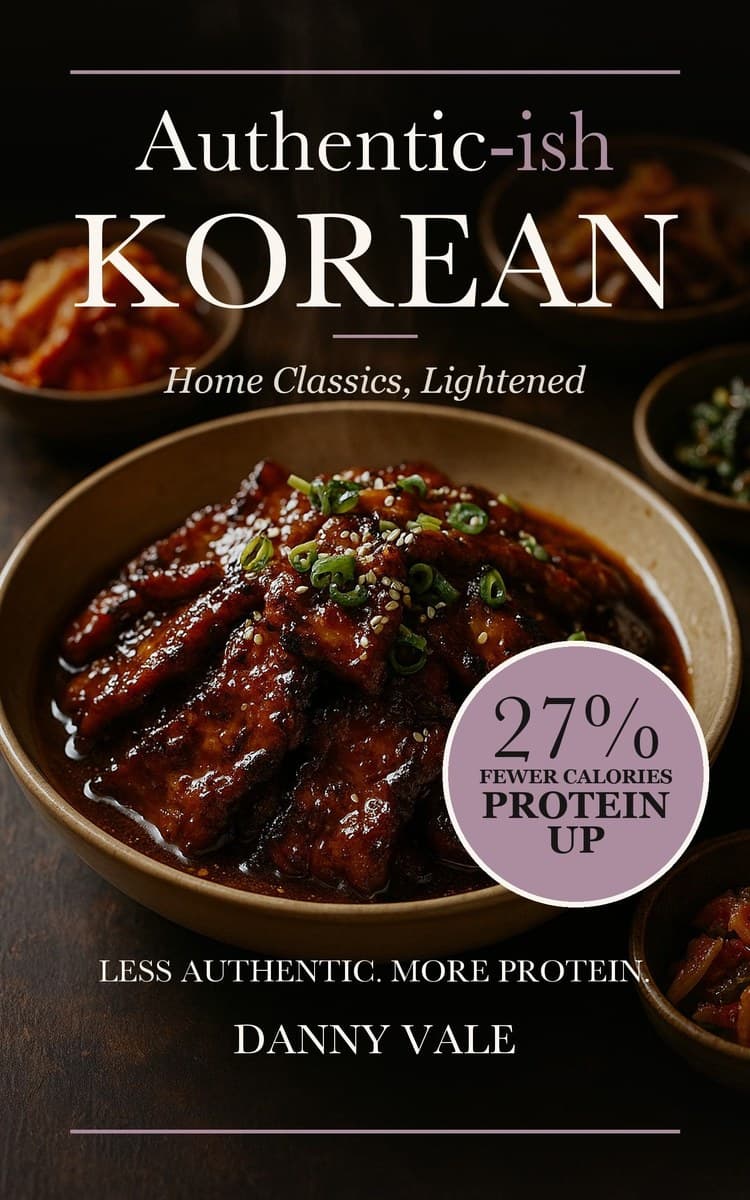
Bulgogi, Bibimbap and 50 more Korean classics, with the calories cut and the protein kept. 27% fewer calories on average, and every change costed.
Buy the paperbackKindle edition
What's in it
| Recipes | Chapters | Average calorie saving | Dishes rejected |
|---|---|---|---|
| 52 | 8 | 25% | 8 |
Every dish, and what came off it
Each figure is per serving, computed from the ingredient list. The traditional column is the real dish, not a strawman: it's costed from its own ingredient list so the saving is a measurement rather than a claim.
| Dish | Chapter | Traditional | This version | Saving | Protein |
|---|---|---|---|---|---|
| Baechu Kimchi | banchan | 106 kcal | 83 kcal | 22% | 4.7g |
| Kongnamul Muchim | banchan | 123 kcal | 95 kcal | 23% | 8.9g |
| Sigeumchi Namul | banchan | 86 kcal | 67 kcal | 22% | 4.2g |
| Gyeranjjim | banchan | 127 kcal | 82 kcal | 35% | 9.5g |
| Dubu Buchim | banchan | 330 kcal | 260 kcal | 21% | 26.8g |
| Myeolchi Bokkeum | banchan | 132 kcal | 99 kcal | 25% | 13.9g |
| Gim Gui | banchan | 39 kcal | 22 kcal | 44% | 0.9g |
| Jangjorim | banchan | 369 kcal | 318 kcal | 14% | 39.8g |
| Baek Kimchi | banchan | 70 kcal | 54 kcal | 23% | 3g |
| Kimchi Jjigae | stews | 505 kcal | 409 kcal | 19% | 43.5g |
| Doenjang Jjigae | stews | 207 kcal | 185 kcal | 11% | 18.7g |
| Sundubu Jjigae | stews | 444 kcal | 312 kcal | 30% | 29.5g |
| Budae Jjigae | stews | 673 kcal | 435 kcal | 35% | 35.2g |
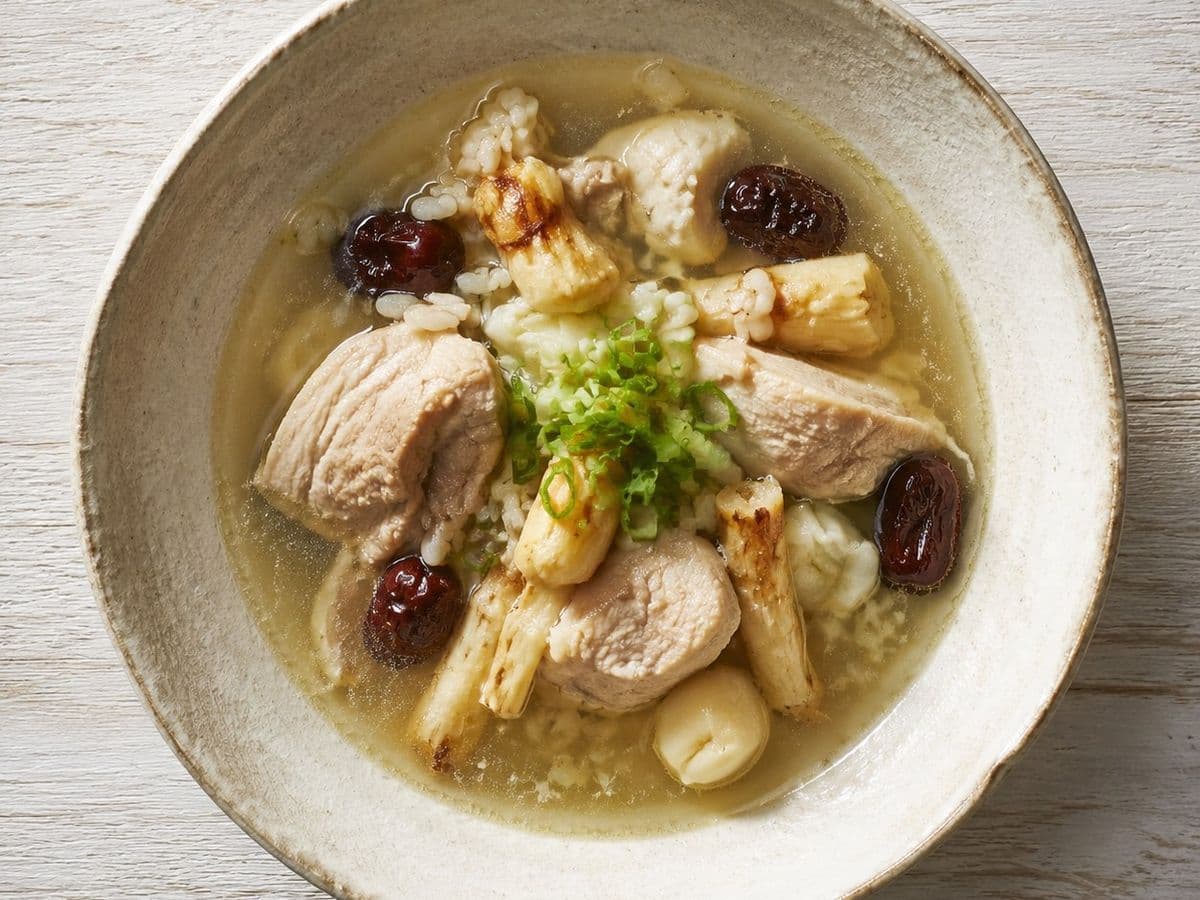
| Samgyetang | stews | 651 kcal | 343 kcal | 47% | 44.1g |
| Galbitang | stews | 388 kcal | 349 kcal | 10% | 37.7g |
| Miyeokguk | stews | 102 kcal | 87 kcal | 15% | 11.7g |
| Yukgaejang | stews | 477 kcal | 351 kcal | 26% | 35.5g |
| Bulgogi | grill | 338 kcal | 287 kcal | 15% | 35.6g |
| Dwaeji Bulgogi | grill | 622 kcal | 391 kcal | 37% | 37.5g |
| Galbi | grill | 563 kcal | 432 kcal | 23% | 38.8g |
| Dak Galbi | grill | 784 kcal | 475 kcal | 39% | 43.6g |
| Bossam | grill | 594 kcal | 313 kcal | 47% | 40.3g |
| Tteokgalbi | grill | 363 kcal | 286 kcal | 21% | 34.2g |
| Galbijjim | braises | 687 kcal | 471 kcal | 31% | 41.2g |
| Dakbokkeumtang | braises | 773 kcal | 443 kcal | 43% | 42.8g |
| Andong Jjimdak | braises | 873 kcal | 632 kcal | 28% | 56g |
| Gamja Jorim | braises | 219 kcal | 207 kcal | 5% | 9.9g |
| Dubu Jorim | braises | 262 kcal | 181 kcal | 31% | 18.9g |
| Kongjang | braises | 213 kcal | 167 kcal | 22% | 9.5g |
| Godeungeo Jorim | braises | 484 kcal | 412 kcal | 15% | 30.7g |
| Ojingeo Bokkeum | braises | 362 kcal | 267 kcal | 26% | 23.1g |
| Bibimbap | rice | 622 kcal | 492 kcal | 21% | 29.8g |
| Kimbap | rice | 654 kcal | 435 kcal | 33% | 18.2g |
| Kimchi Bokkeumbap | rice | 917 kcal | 610 kcal | 33% | 25.6g |
| Bulgogi Deopbap | rice | 455 kcal | 313 kcal | 31% | 26.4g |
| Dak Juk | rice | 425 kcal | 261 kcal | 39% | 25g |
| Ssambap | rice | 846 kcal | 489 kcal | 42% | 30.7g |
| Yubu Chobap | rice | 529 kcal | 425 kcal | 20% | 18g |
| Japchae | noodles | 404 kcal | 309 kcal | 24% | 15.6g |
| Naengmyeon | noodles | 700 kcal | 424 kcal | 39% | 38.5g |
| Bibim Naengmyeon | noodles | 618 kcal | 610 kcal | 1% | 46.8g |
| Kalguksu | noodles | 367 kcal | 411 kcal | -12% | 29.7g |
| Jjamppong | noodles | 603 kcal | 474 kcal | 21% | 32.5g |
| Makguksu | noodles | 495 kcal | 470 kcal | 5% | 22g |
| Haemul Pajeon | fried | 406 kcal | 362 kcal | 11% | 26g |
| Bindaetteok | fried | 564 kcal | 391 kcal | 31% | 28.9g |
| Mandu | fried | 372 kcal | 302 kcal | 19% | 20.5g |
| Tteokbokki | fried | 538 kcal | 322 kcal | 40% | 18g |
| Gamja Jeon | fried | 257 kcal | 184 kcal | 28% | 9.3g |
| Hotteok | pudding | 323 kcal | 175 kcal | 46% | 3.6g |
| Patbingsu | pudding | 411 kcal | 304 kcal | 26% | 11.5g |
| Songpyeon | pudding | 224 kcal | 202 kcal | 10% | 3.8g |
The ones I wouldn't touch
Dishes drafted for this book that didn't survive. If every dish survived lightening, that chapter would be a marketing device and you should trust none of the rest. Why some dishes cannot be lightened goes through the reasoning.
Oi Muchim
I really tried to fix this one, but there's nothing to fix. Oi muchim is already the banchan you serve when you've no calories left for anything fancier. Cucumbers and spring onions, a dusting of gochugaru and a splash of rice vinegar, a pinch of sugar for balance, and that's most of it. There's no oil, no nuts, barely any sugar, and the only protein in sight is whatever wafts in from the tofu two plates down.
I could shave off the bare teaspoon of sugar, or swap in a few grams of peanut crumbs for disaster, but neither move gets you anywhere interesting. The only way to raise the protein would be to tip in tofu or beansprouts, but then it's not oi muchim, it's a different dish entirely.
So I can't change this one without turning it into something else. Oi muchim is already as lean as it gets. Chopsticks down.
Musaengchae
Korean radish cut into matchsticks and tossed with gochugaru, vinegar, garlic, spring onion and a little sugar.
Korean radish is 18 kcal per 100g. The whole bowl, before anything is added to it, is 43 kcal a serving.
I tried to lighten it and made it heavier, which is the funniest failure in this book. Cutting the sugar saved 4 kcal a serving. Adding anything with protein in it to make the dish carry its weight, which is the move that rescues several other banchan in this chapter, took it from 43 kcal to 74. I had turned a nearly free side dish into a slightly less free one and called it an improvement.
The lesson is worth more than the recipe. A dish this light has no room in it. Every change you make to a 43 kcal bowl is a change upward, because there is nothing to take out and the only direction left is in.
Make it the normal way. Salt the radish for 10 minutes and squeeze it, because that is what stops the dressing going watery by the second day. Use plenty of gochugaru, enough vinegar to make you blink, and about a teaspoon of sugar for a whole bowl. It keeps three days in the fridge and it is the thing on the table that makes everything else taste less rich.
Gamjatang
Gamjatang is pork spine simmered for hours with potato, cabbage and a great deal of ground perilla seed, until the meat round the bones goes soft enough to pull off with chopsticks.
The dish is the bone. Not the meat on it, the bone: the marrow and the collagen and the fat that comes out of the neck joint over three hours and makes the broth cloudy and thick. That is what people order it for, and it is the whole reason it tastes different from every other pork stew in this book.
You cannot buy a lean bone. I tried building it on pork shoulder and it made a decent stew that had nothing to do with gamjatang. I tried chilling it overnight and lifting the fat cap, which is the trick that saves galbijjim in the chapter before this, and here it takes the body out of the broth and leaves you with spicy potato soup. The fat in a galbijjim is a side effect. The fat in a gamjatang is the point.
The potato in the name is a red herring, incidentally, or at least an argued one. Some say gamja means the potatoes floating in it and some say it is a butcher's word for that part of the spine. Either way, the potatoes are 77 kcal per 100g and they were never the problem.
Make it properly, eat it with rice and a lot of kimchi, and take the leftovers to work. It is a dish for a cold Sunday and it is not trying to be anything else.
Ground perilla seed, which is the other half of the flavour, is in none of the three databases this book uses, so the traditional version could not be costed honestly either.
Samgyeopsal
Here's the honest truth: you can't lighten samgyeopsal in a way that leaves it samgyeopsal. The pork belly is the dish. Swapping it for loin, chicken or tofu dodges the whole point - you end up with plain barbecue and apologies.
I could suggest trimming the rind, serving less, or swapping half the pork for mushrooms, but now you're just making stir-fry wraps, not samgyeopsal. There's nothing hiding here but pork belly and fire. If you want to eat samgyeopsal, eat samgyeopsal - maybe not every week, but definitely without regret. Save the hacks for dishes with something to actually cut.
Saengseon Gui
Grilled mackerel. You salt it, you leave it half an hour, you grill it skin side first until the skin blisters, and you eat it with rice and kimchi.
There is nothing in it. A mackerel, some salt, and a grill.
I costed it anyway, because that is the job, and this version came out at exactly the same number as the traditional one: 410 kcal a serving, and a protein density of 9.1g per 100 kcal on both sides of the page. There was no change to make. Mackerel is 205 kcal per 100g and it is 14% fat, but that fat is the fish, and taking it out is not a technique, it is a different fish.
The only lever anybody could reach for is the salt, and the salt is what draws the moisture out of the skin so it crisps. Cut it and you get a paler, softer, wetter fish. That is not lighter. That is worse.
So this is here as the clearest example of the thing this book keeps running into. Korean home cooking is full of dishes that were never heavy, and the honest response to a dish with nothing in it is to say so and print the recipe as it has always been made, rather than to invent a saving so the page has something to sell you.
Salt it. Grill it hard, skin down, and do not move it until the skin lifts off the bars by itself. Eat it with rice, kimchi and a bowl of doenjang jjigae, which is also fine exactly as it is.
Jjajangmyeon
Jjajangmyeon is wheat noodles under a thick black sauce made by frying chunjang, a fermented black bean paste, in a serious amount of oil with pork and onion, then thickening the lot with cornflour.
The frying is not a step you can skip. Raw chunjang is bitter and sharp, and the oil is what takes that off it. Every Korean recipe for this says the same thing: fry the paste in more oil than feels reasonable, then pour some of it off. Dry-fry it and you get a bitter sauce. Use half the oil and you get a slightly less bitter sauce.
I tried it four ways. Frying the paste in 20g of oil instead of 80g left an edge you could taste under the sugar. Frying it properly and then straining the sauce through a sieve took some of the oil back out and took the body with it. Swapping the pork belly for shoulder worked and saved about 90 kcal a serving, but the belly fat was never the main problem here, and a swap that fixes a tenth of the dish is a swap, not a recipe.
There is also a straightforward practical objection. Cutting the noodle portion is the only other lever, and jjajangmyeon is a bowl of noodles. A smaller bowl of noodles is not a lighter recipe. It is less dinner.
Order it. Eat the whole thing. It is one dish, once in a while, and the version you get at a Korean-Chinese place is better than anything this chapter could have offered you.
One footnote that belongs here rather than buried in the appendix: chunjang is in none of the three food composition databases this book uses, so even the traditional version above cannot be costed honestly. Every other recipe in this book prints a number. This one could not, and that is part of why it is in this chapter rather than the last one.
Yangnyeom Chikin
I've tried: less oil, air fryers, oven tricks, the whole lot. Lose the double fry and you drop the crunch that makes yangnyeom chikin what it is. Roast wings can be tasty, but they're a different beast: meatier, chewier, not that craggy shatter of a proper fry. The glaze, too, is a sugar bomb - if you cut it, the whole thing's off balance. I can't give you the real thing in lighter form, and I won't insult you pretending otherwise. If you want lower calories and more protein, eat roast chicken and dip it in gochujang. If you want the dish on the poster, get out the oil and don't wear a white shirt.
Yakgwa
Yakgwa is a flower-shaped biscuit made from flour worked with sesame oil and honey, stiffened with a splash of soju, deep-fried slowly at a low temperature, and then left to steep in ginger and honey syrup until it is heavy with it.
Read that back. The dough has oil in it. Then it is fried in more oil. Then it is soaked in syrup.
Every one of those three is load-bearing. The oil in the dough is what makes the texture short and slightly crumbling rather than hard. The slow fry is what cooks it through without colouring it, and baking gives you a dry biscuit that will not take up syrup. And the steeping is the entire point: an unsoaked yakgwa is a plain shortbread with a pattern pressed into it.
I baked a tray and steeped them properly. They floated, then went soggy on the outside and stayed dry in the middle, because a baked biscuit has no open structure for the syrup to move into. I tried halving the syrup on a fried batch, which worked, in the sense that it produced a slightly less sweet yakgwa, and saved almost nothing, because the frying was always the bigger number.
It is a ceremonial biscuit. It turns up at holidays and at ancestral rites and at the end of a formal meal, in ones and twos, not by the plateful. Make it properly at Chuseok, eat two, and give the rest away.
A note for completeness: soju is in none of the three food composition databases this book uses, so even the traditional version could not be fully costed. It is a small amount and it mostly cooks off, but the figure would have been a guess, and this book does not print guesses.
Where the numbers come from
- FoodData Central, SR Legacy Release (April 2018). U.S. Department of Agriculture, Agricultural Research Service. Public domain (U.S. Government work).
- McCance & Widdowson's Composition of Foods Integrated Dataset (CoFID) 2021. Public Health England / Office for Health Improvement and Disparities. Open Government Licence v3.0.
- FoodData Central, Branded Foods (October 2024 release). U.S. Department of Agriculture, Agricultural Research Service. Public domain (U.S. Government work).
Retrieved 2026-08-21. Nothing in these books is dietary or medical advice. Danny Vale is a cook.
Also from us
Seoul. The grill chapter is a Seoul chapter, and there is an Owner's Guide to the city.