Korean · Authentic-ish Korean
Baek Kimchi
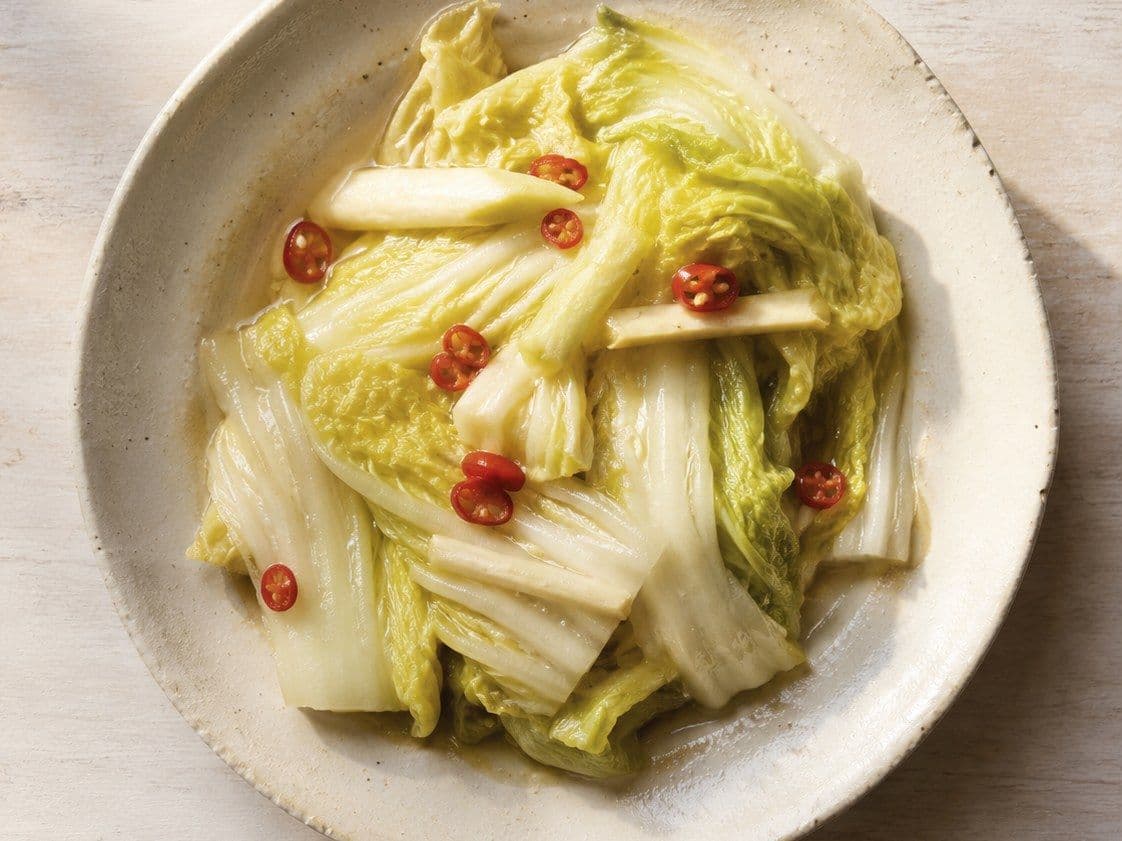
54 kcal a serving, against 70 for the traditional version. That is 16 kcal off, or 23%, with 3g of protein. Serves 12. 70 minutes active, 2-10 days fermenting.
What the traditional version is
Whole salted Chinese leaf cabbage, left to wilt and then soaked in a lightly sweetened brine with Asian pear, garlic, ginger and a few bits of carrot or radish. Everything is packed tightly into a jar to ferment for a week or ten days. You wind up with delicate, crunchy cabbage with a clean, gently fruity tang, best eaten cold.
What changed, and what each change costs
Cut the sugar in the brine from 30g to 10g
A lot of it's just there to nudge the ferment along, but the pear and carrot do plenty of that on their own. You lose a bit of sweetness, but the brine clears up and you still get enough tang by day eight.
What it costs you. It's a touch less mellow, but you're eating this for crunch and perfume, not depth. You probably won't miss it.
Leave out the water chestnuts entirely
They're traditional for crunch, but they add next to nothing in the way of flavour or nutrition and they're a pain to find in most British supermarkets. The carrot and radish do all the work here.
What it costs you. If you love water chestnut crunch, you'll miss it. Otherwise, you'll never know it's gone.
Add nothing. There is no second or third big change because the dish is already as lean as it gets
Baek kimchi basically is just salted, fermented veg in a lightly sweetened brine. There's no fat, hardly any sugar, and if you start swapping out the veg you just get pickled cabbage. There's no cheating the protein maths here.
What it costs you. You'll have to get your protein elsewhere. On a plate crowded with punchier banchan, that's not a disaster.
What goes in it
The ingredients, without the quantities. The weights are what the figures below are computed from, and they are in the book.
- Chinese leaf
- Salt
- Asian pear
- Carrot
- Korean radish
- Garlic
- Fresh ginger
- Spring onions
- Caster sugar
How it starts
- Quarter the cabbage and trim away the toughest bit of core, but leave enough that the leaves hold together.
- Rinse the cabbage under cold running water, then press out as much water as you can without tearing the leaves.
- Meanwhile, bring 2 litres of water to the boil and dissolve 25g salt and the sugar.
The rest of the method, and every weight, is in Authentic-ish Korean.
The numbers
| Per serving | Traditional | Lightened |
|---|---|---|
| Calories | 70 | 54 |
| Protein | 3.1g | 3g |
| Fat | 0.5g | 0.5g |
| Saturated fat | 0.1g | 0.1g |
| Carbohydrate | 15.6g | 11.5g |
| Protein per 100 kcal | 4.5g | 5.6g |
Every figure is computed from the recipe's own weighed ingredient list against public food composition databases. The appendix in Authentic-ish Korean prints the exact database row used for each ingredient, so any number here can be checked. How every number is computed sets out the method.
The method is in the book
Baek kimchi is the mild one at the party, and there's nowhere to hide any calories or fat. I cut the sugar, skipped the water chestnut, and stopped myself adding protein just to game the numbers. It still does its job: fresh, clean, a break from heat and noise. If you want more bite, let it ferment longer, but don't expect fireworks. For fireworks, go back to the red stuff.
The quantities and the method for this dish are in Authentic-ish Korean, along with 51 more. Buy the paperback
More from Authentic-ish Korean
- Baechu Kimchi, 83 kcal a serving, 22% off
- Kongnamul Muchim, 95 kcal a serving, 23% off
- Sigeumchi Namul, 67 kcal a serving, 22% off
- Gyeranjjim, 82 kcal a serving, 35% off
- Dubu Buchim, 260 kcal a serving, 21% off
- Myeolchi Bokkeum, 99 kcal a serving, 25% off
Every Korean dish and its calories · Every dish in the series