Korean · Authentic-ish Korean
Hotteok
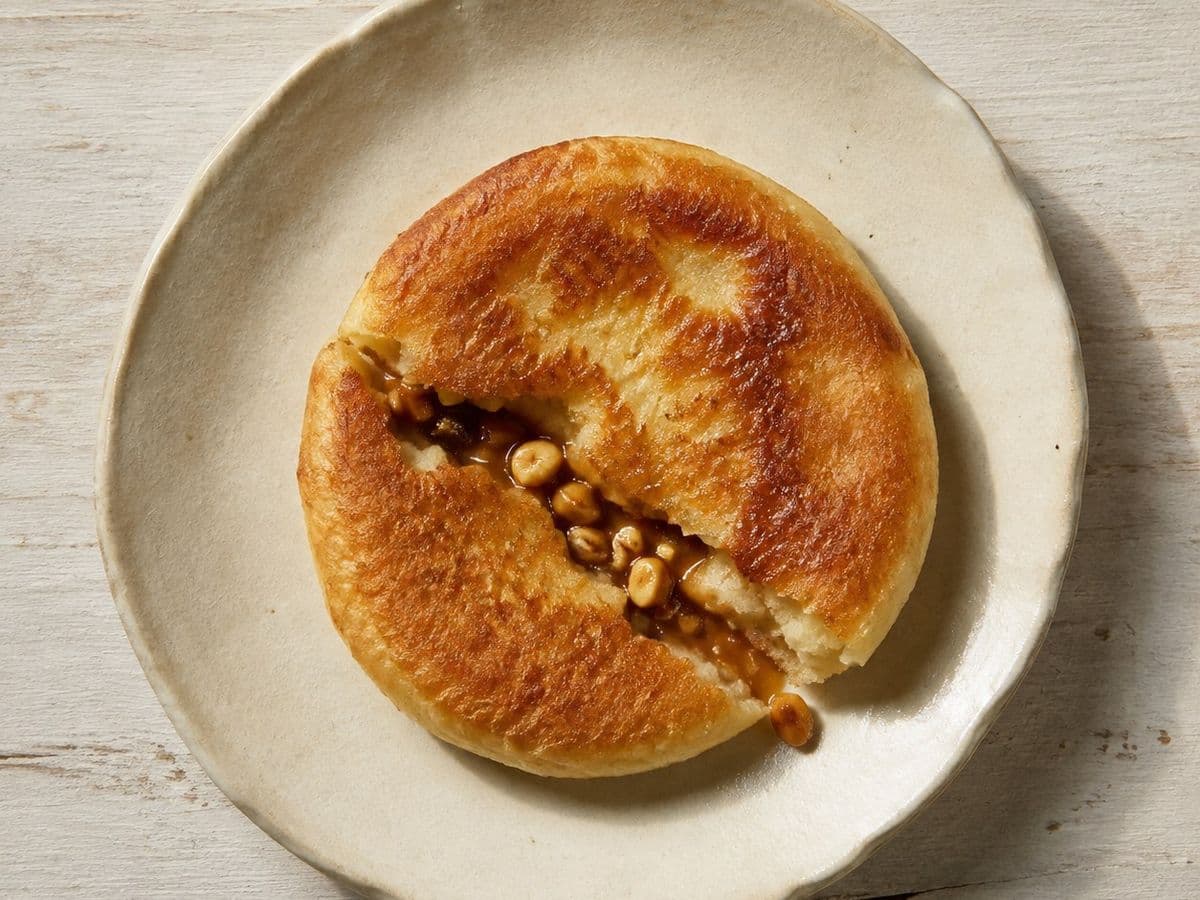
175 kcal a serving, against 323 for the traditional version. That is 148 kcal off, or 46%, with 3.6g of protein. Serves 8. 25 minutes active, 60 minutes rising.
What the traditional version is
A soft, chewy dough made from plain flour, glutinous rice flour, water, sugar and yeast, left to rise, then portioned and filled with a mixture of brown sugar, chopped nuts (usually walnuts or peanuts) and cinnamon.
What changed, and what each change costs
Half the plain flour swapped for white bread flour
Bread flour brings more gluten and protein, which won't fool anyone into thinking this is healthy but does make the pancakes just a bit more satisfying.
What it costs you. You'll get a chewier dough, which I like, but it's a shade less soft and yielding than pure plain flour. Still, it stands up better to a thinner filling without collapsing everywhere.
Replace whole milk with skimmed milk and add egg white
Whole milk is classic and rich, but skimmed does the job with far fewer calories, and an egg white bumps the protein. The dough rises just fine, but is a little less rich.
What it costs you. You lose the faint background sweetness and a bit of perfume, but hardly any texture. If you've only got semi-skimmed, use that. Don't ever bother with cream; you'll regret it as soon as you look at your pan.
Sugar for the filling cut from 120g to 75g
The filling is all about ooze and shock value, but you don't need quite as much - a thinner seam does the job, especially if you're actually planning to eat two.
What it costs you. You lose the scaffolding that tries to keep the molten centre neatly in the middle. Less sugar means a slightly less dramatic caramel core, and a bit more risk of leaks if you overfill.
Walnuts and peanuts halved
Nuts coat every street vendor's hotteok - they add texture, but pile on fat that, frankly, you don't notice as much when you're here for the sugar.
What it costs you. The crunch is more of a cameo than a main event now, but it's still there. If nuts are the best bit for you, go full traditional and don't apologise.
Oil for frying down from 40g to 18g
Korean stalls shallow-fry these in what looks like a shallow bath. At home you can get away with far less oil if you're not fussed about restaurant shine.
What it costs you. You lose the full, crispy crust, but you also lose the greasy fingers. If you want them glossy, go for the full oil - and plan to mop the pan afterwards.
Dough portion cut to 85% original
Easier, this one. Smaller pancakes mean less dough, less filling, more of them to go around, and you'll finish one before the sugar nuclear reactor inside scalds your mouth.
What it costs you. What you've got is a treat. A meal is a different dish and you know where to find it. Just smaller.
What goes in it
The ingredients, without the quantities. The weights are what the figures below are computed from, and they are in the book.
- Plain flour
- Strong white bread flour
- Glutinous rice
- Caster sugar
- Fresh yeast
- Salt
- Skimmed milk
- Egg white
- Water
- Vegetable oil
- Soft brown sugar
- Ground cinnamon
- Walnuts
- Peanuts
How it starts
- In a mixing bowl, whisk bread flour, plain flour, glutinous rice flour, sugar and salt.
- Stir in the skimmed milk, egg white and water.
- Cover and leave to rise for 1 hour somewhere warm.
The rest of the method, and every weight, is in Authentic-ish Korean.
The numbers
| Per serving | Traditional | Lightened |
|---|---|---|
| Calories | 323 | 175 |
| Protein | 6g | 3.6g |
| Fat | 10.6g | 5.1g |
| Saturated fat | 1.6g | 0.8g |
| Carbohydrate | 51.7g | 29.1g |
| Protein per 100 kcal | 1.8g | 2g |
Every figure is computed from the recipe's own weighed ingredient list against public food composition databases. The appendix in Authentic-ish Korean prints the exact database row used for each ingredient, so any number here can be checked. How every number is computed sets out the method.
Allergens. gluten, nuts, peanuts, milk, eggs.
The method is in the book
Hotteok is one of those things that's hard to justify but easy to eat. This take won't make you a champion bodybuilder, but there's a bit more protein and a little less sugar and fat sneaking in. If the smaller, less sticky version keeps you from eating four, that's already progress. The original is still the king of Seoul street corners, but this'll do you proud at home, especially when you fancy something hot and sweet after dinner.
The quantities and the method for this dish are in Authentic-ish Korean, along with 51 more. Buy the paperback
More from Authentic-ish Korean
- Patbingsu, 304 kcal a serving, 26% off
- Songpyeon, 202 kcal a serving, 10% off
- Baechu Kimchi, 83 kcal a serving, 22% off
- Kongnamul Muchim, 95 kcal a serving, 23% off
- Sigeumchi Namul, 67 kcal a serving, 22% off
- Gyeranjjim, 82 kcal a serving, 35% off
Every Korean dish and its calories · Every dish in the series