Japanese · Authentic-ish Japanese
Tamago Kake Gohan
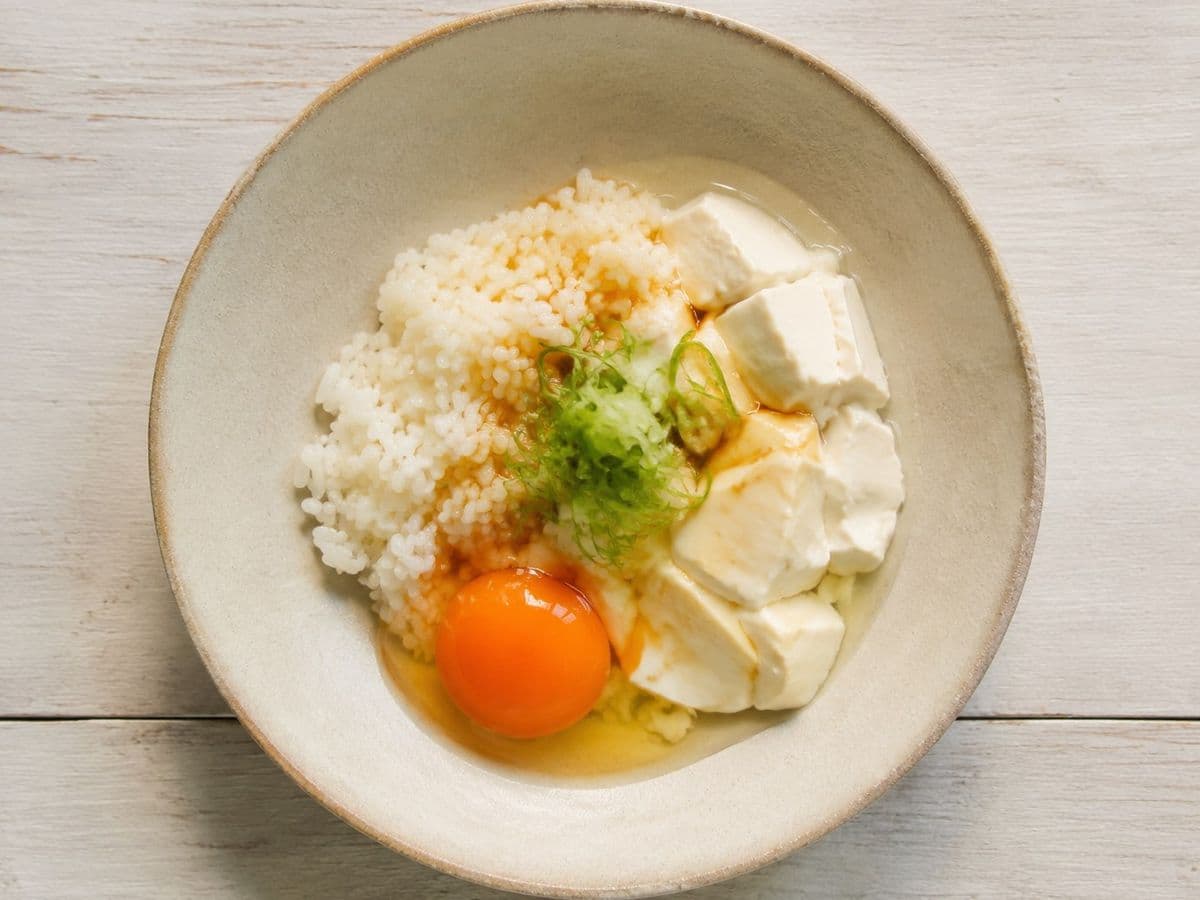
389 kcal a serving, against 618 for the traditional version. That is 229 kcal off, or 37%, with 15.7g of protein. Serves 2. .
What the traditional version is
Bowl of freshly cooked short-grain rice, raw egg cracked directly on top, with a splash of soy sauce. Stir until glossy and just warmed through, so the egg coats every grain. Sometimes there's a bit of spring onion or nori as a flourish, but it's mostly rice, egg and hope.
What changed, and what each change costs
Half of the rice replaced with silken tofu
Silken tofu holds almost no fat or starch but brings protein and a bit of body. Stir it straight into the rice for a subtle lift. You keep the smooth texture, just with a cold-to-hot trick that's more forgiving than it should be.
What it costs you. You do lose some of that perfect warmth and sticky chew. The tofu is blander, obviously, but the real cost is to the rice purists who'll claim this is sacrilege. They aren't wrong, but they're not getting any breakfast either.
Eggs unchanged, but use British Lion stamped or pasteurised only
You can't swap eggs out of tamago kake gohan, or it isn't tamago kake gohan, it's a bowl of sadness. But you do need eggs that won't leave you regretting breakfast.
What it costs you. You'll never notice the swap unless you're a hen.
Kept soy and nori as is, because there's nothing left to lose
At this point, if I tamper with the soy sauce, I might as well make porridge. No new protein but at least it's still breakfast.
What it costs you. Soy sauce isn't a health food. Don't drown it, just let it do its work.
What goes in it
The ingredients, without the quantities. The weights are what the figures below are computed from, and they are in the book.
- Hot cooked short-grain rice
- Silken tofu
- 2 medium British Lion stamped eggs
- Soy sauce
- Dried nori
- Spring onion
How it starts
- Cook the rice fresh and get it piping hot - don't even think about using leftovers from the back of the fridge.
- Divide the rice between two bowls.
- Crack one egg over each bowl.
The rest of the method, and every weight, is in Authentic-ish Japanese.
The numbers
| Per serving | Traditional | Lightened |
|---|---|---|
| Calories | 618 | 389 |
| Protein | 17.1g | 15.7g |
| Fat | 5.7g | 7.3g |
| Saturated fat | 1.8g | 2g |
| Carbohydrate | 120g | 62.7g |
| Protein per 100 kcal | 2.8g | 4g |
Every figure is computed from the recipe's own weighed ingredient list against public food composition databases. The appendix in Authentic-ish Japanese prints the exact database row used for each ingredient, so any number here can be checked. How every number is computed sets out the method.
Allergens. eggs, soybeans, gluten.
The method is in the book
You can't really dress this up. The tofu does a solid job of lifting the protein while keeping most of the creamy, comforting texture, but it isn't the same as actual rice. If you're after a bowl of Japanese nostalgia, the original's better. If you want fast, filling and a bit lighter, this works - just don't tell your Japanese friends what you've done. It's a protein hit for breakfast, lunch or a midnight snack, and all you need is a kettle, a microwave, a bowl, and a total disregard for culinary orthodoxy.
The quantities and the method for this dish are in Authentic-ish Japanese, along with 48 more. Buy the paperback
More from Authentic-ish Japanese
- Gyudon, 750 kcal a serving, 32% off
- Oyakodon, 711 kcal a serving, 23% off
- Katsudon, 638 kcal a serving, 30% off
- Chahan, 486 kcal a serving, 37% off
- Onigiri, 319 kcal a serving, 27% off
- Omurice, 726 kcal a serving, 36% off
Every Japanese dish and its calories · Every dish in the series