Japanese · Authentic-ish Japanese
Buta no Kakuni
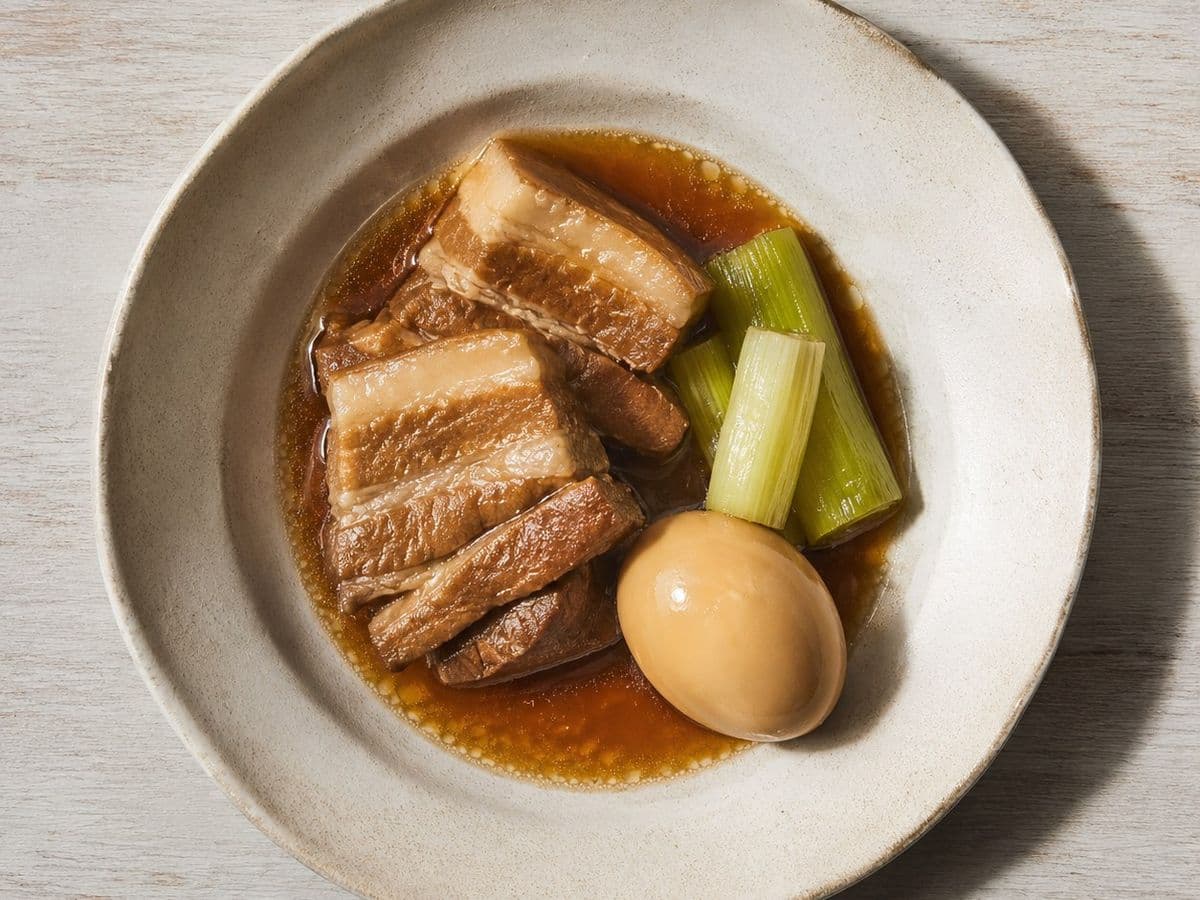
461 kcal a serving, against 739 for the traditional version. That is 278 kcal off, or 38%, with 54.2g of protein. Serves 4. .
What the traditional version is
Traditional buta no kakuni starts with pork belly in big bricks. You simmer it once to get rid of the worst of the fat, then braise it again with dashi, soy, sake, mirin, sugar and aromatics until it's collapsing and the layers of fat and meat become indistinguishable.
What changed, and what each change costs
Pork belly swapped for pork loin
Pork loin is about as lean as edible pork gets, and there's no way around it - the original is a festival of fat, and this is a diet buffet. Loin survives a long simmer surprisingly well if you keep the heat low and don't let it boil. You lose the layers and the sheer wobbly decadence, but you do get plenty of pork and the flavours still stick.
What it costs you. This isn't the same dish. Loin falls apart in strands rather than melting into itself, and you miss the soft, sticky, trembling fat. Still, with enough sauce, it's worth eating - but only if you aren't here for the jelly.
Sugar halved
Kakuni sauce is almost syrup when you do it properly. Halving the sugar moves you out of pudding territory but the mirin still brings quite a bit, and the pork's lost some unctuousness anyway.
What it costs you. The sauce isn't as sticky, and you won't be glazing anything. The sweetness is lighter, which is about what this dish deserves when you aren't using belly.
Eggs increased, now six instead of four
These are your main protein now that the fat's gone. Braised eggs in this sauce are close to the best thing about kakuni, and it's a brilliant excuse to eat more.
What it costs you. More eggs mean less room for pork. Can't say that's tragic in this version.
Same stock, less oil needed
Belly gives off buckets of fat, which you have to skim (or scoop) off the sauce. Loin barely sheds any, so you end up with a cleaner finish and less faff with ladles.
What it costs you. You miss out on the thick, glossy puddle you get from the real thing. Instead, you get something closer to a light stew. It'll do.
What goes in it
The ingredients, without the quantities. The weights are what the figures below are computed from, and they are in the book.
- Pork loin
- Dashi stock
- Sake
- Mirin
- Caster sugar
- Light soy sauce
- Fresh ginger
- Spring onions
- 6 medium eggs
- Spring onion
How it starts
- Bring a large pan of water to the boil.
- Wipe out the pan, then return the pork.
- Bring just up to the boil, then turn the heat right down.
The rest of the method, and every weight, is in Authentic-ish Japanese.
The numbers
| Per serving | Traditional | Lightened |
|---|---|---|
| Calories | 739 | 461 |
| Protein | 50.7g | 54.2g |
| Fat | 46.9g | 15.4g |
| Saturated fat | 16.5g | 4.7g |
| Carbohydrate | 20.4g | 15.6g |
| Protein per 100 kcal | 6.9g | 11.7g |
Every figure is computed from the recipe's own weighed ingredient list against public food composition databases. The appendix in Authentic-ish Japanese prints the exact database row used for each ingredient, so any number here can be checked. How every number is computed sets out the method.
Allergens. eggs, fish, gluten, soybeans.
The method is in the book
The truth: this is kakuni after you lost a bet. The sauce is all there, the eggs are glorious, but pork belly is the first and last reason to eat this dish. Loin's decent, there's proper flavour, and it's still comforting if you get the eggs just right. You'll miss the fat, though, especially when you see how clean your bowl ends up. That said, you can eat a fair bit more and not need a nap, and the leftovers don't congeal into solid jelly in the fridge. If you're after the full sumo experience, stick with the belly and go for a run tomorrow.
The quantities and the method for this dish are in Authentic-ish Japanese, along with 48 more. Buy the paperback
More from Authentic-ish Japanese
- Nikujaga, 378 kcal a serving, 13% off
- Chikuzenni, 285 kcal a serving, 30% off
- Saba no Misoni, 646 kcal a serving, 11% off
- Oden, 356 kcal a serving, 16% off
- Sukiyaki, 494 kcal a serving, 24% off
- Shabu Shabu, 518 kcal a serving, 30% off
Every Japanese dish and its calories · Every dish in the series