Japanese · Authentic-ish Japanese
Shabu Shabu
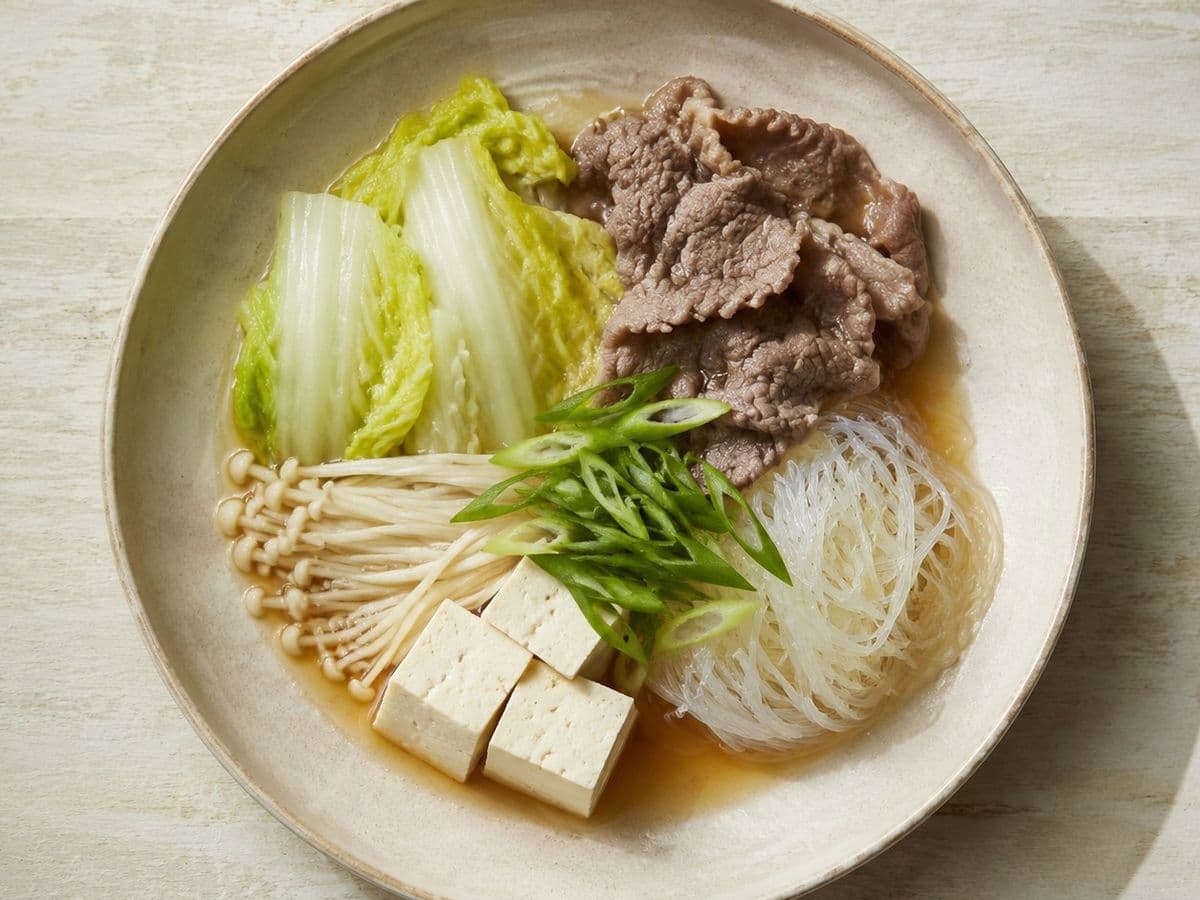
518 kcal a serving, against 737 for the traditional version. That is 219 kcal off, or 30%, with 44.5g of protein. Serves 4. .
What the traditional version is
Shabu shabu is a do-it-yourself beef hotpot. You start with a kombu stock brought just to the boil, then swish slices of well-marbled beef rump or sirloin through the broth for seconds until just pink.
What changed, and what each change costs
Lean beef swapped for traditional well-marbled sirloin
Using lean beef means you get all the flavour of the broth-soaked meat, but much less fat dribbling into your pot and your stomach. The point of shabu shabu is the clean, beefy taste. You don't need all that interlaced fat to get it.
What it costs you. You lose the melting, buttery mouthfeel you get from marbled beef. It chews a bit more, but it's not a tragedy. Just don't buy cheap stew meat or you'll need a dentist.
Sesame dipping sauce cut by two-thirds
Goma dare is delicious, but it's about 50% sesame paste and the rest isn't exactly mineral water. By rationing the sauce, you keep the taste (and the point of eating shabu shabu), but you don't drown every bite in it.
What it costs you. It's more dip-and-move than bathe-and-smother. The nutty richness is still there, but don't expect a thick coat on every bite unless you're happy to refill the bowl and start again.
Udon noodles swapped for shirataki noodles
Udon's all bounce and comfort, but most of it is starch and not much else. Shirataki noodles are mostly water and give you the noodle slurp with a fraction of the consequences.
What it costs you. Nobody in their right mind thinks konjac noodles are as satisfying as proper udon. They're sort of slippery, sort of chewy, and never quite fill you up, but you'll survive. If you can't face it, halve the udon instead.
Vegetables up by half
Bumping up the veg gives you more to cook (and eat) without much change to the experience. It's still hotpot - just heavier on cabbage, lighter on noodles.
What it costs you. The table looks greener and your bowl might, too. The spirit of shabu shabu's unchanged, unless you were secretly hoping for a noodle coma.
What goes in it
The ingredients, without the quantities. The weights are what the figures below are computed from, and they are in the book.
- Lean braising beef
- Dried kombu
- Water for broth
- Napa cabbage
- Enoki mushrooms
- Firm tofu
- Spring onions
- Shirataki
- Sesame paste for dipping
- Soy sauce for dipping
- Rice vinegar for ponzu
- Lemon juice for ponzu
- Mirin for ponzu
How it starts
- First, chill the lean beef in the freezer until firm but not rock hard - about 40 minutes.
- Fill a wide pot with 1.8 litres of water and drop in the kombu.
- Lay out your vegetables, tofu and noodles on a big platter, as theatrically as you like.
The rest of the method, and every weight, is in Authentic-ish Japanese.
The numbers
| Per serving | Traditional | Lightened |
|---|---|---|
| Calories | 737 | 518 |
| Protein | 55.4g | 44.5g |
| Fat | 24.7g | 16.3g |
| Saturated fat | 4.5g | 3.5g |
| Carbohydrate | 76.4g | 51.4g |
| Protein per 100 kcal | 7.5g | 8.6g |
Every figure is computed from the recipe's own weighed ingredient list against public food composition databases. The appendix in Authentic-ish Japanese prints the exact database row used for each ingredient, so any number here can be checked. How every number is computed sets out the method.
Allergens. gluten, milk, sesame, soybeans, sulphites.
The method is in the book
Lean beef in shabu shabu is about as honest a swap as you can make. You lose a little luxury, but gain bragging rights and a broth that isn't slick with grease. The smaller blob of sesame paste hurts a bit more - it isn't the same if you're a committed dipper, but you can still chase that nutty hit. Shirataki noodles are never going to fool udon fans, but after a few bites you get used to it. Overall, half the table will think I've ruined dinner, and the other half will ask for seconds. Either way, the pot's empty at the end.
The quantities and the method for this dish are in Authentic-ish Japanese, along with 48 more. Buy the paperback
More from Authentic-ish Japanese
- Nikujaga, 378 kcal a serving, 13% off
- Buta no Kakuni, 461 kcal a serving, 38% off
- Chikuzenni, 285 kcal a serving, 30% off
- Saba no Misoni, 646 kcal a serving, 11% off
- Oden, 356 kcal a serving, 16% off
- Sukiyaki, 494 kcal a serving, 24% off
Every Japanese dish and its calories · Every dish in the series