Korean · Authentic-ish Korean
Makguksu
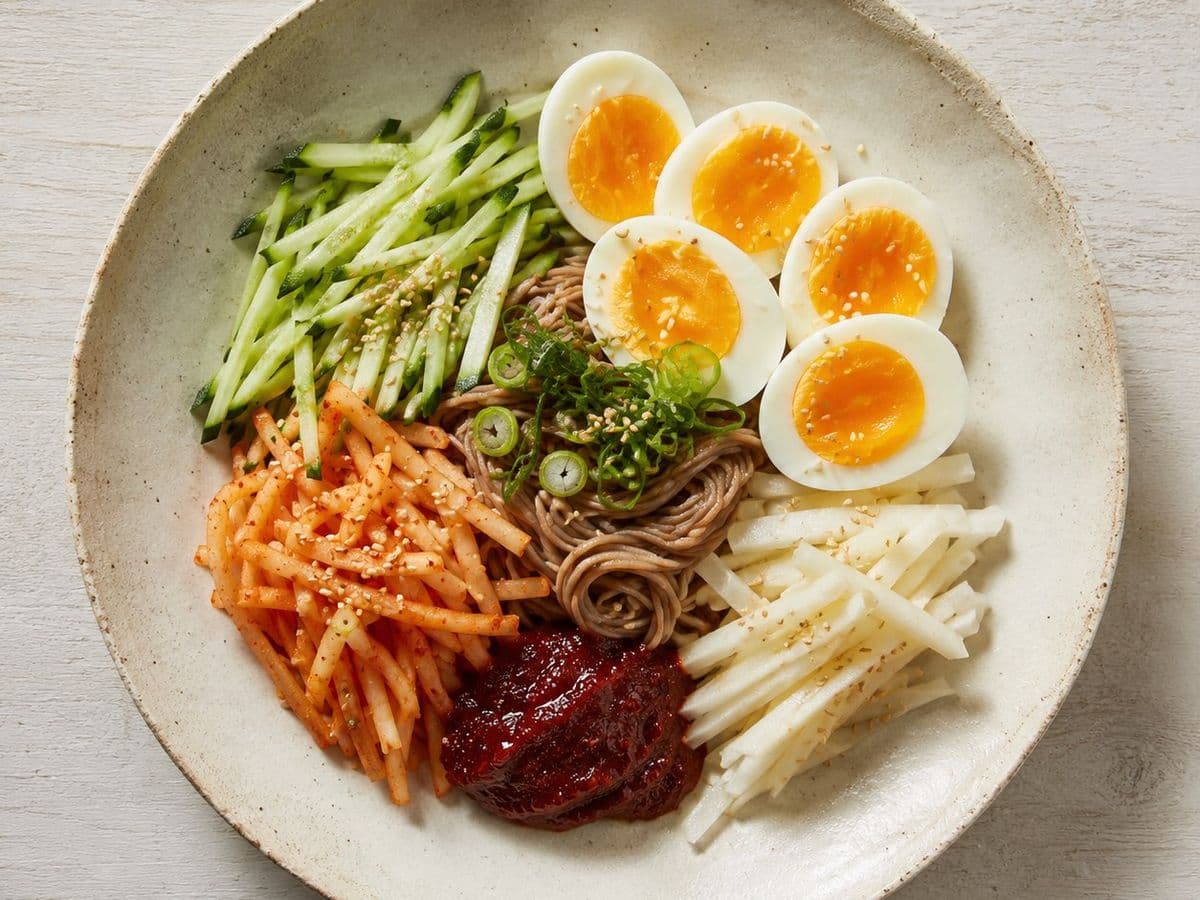
470 kcal a serving, against 495 for the traditional version. That is 25 kcal off, or 5%, with 22g of protein. Serves 4. 35 minutes active, 0 fermenting.
What the traditional version is
Somen or buckwheat noodles cooked and rinsed cold, heaped with julienned cucumber, radish, maybe some pickled cabbage, a halved boiled egg, and sometimes beef or Asian pear. Drowned in a sauce of gochujang, vinegar, soy, mustard, plenty of sugar and a dash of sesame oil. Finished with sesame seeds and more sliced veg. Served cold, often with ice in the bowl.
What changed, and what each change costs
Sugar cut from 55g to 12g, and mustard halved
You don't need more than a spoonful of sugar to balance the vinegar and gochujang. The original is sweet enough for pudding, and you'll taste more of the veg this way.
What it costs you. What you lose is that glossy-thick, sweet-and-sour shop sauce. It's more grown up, less sticky, but a proper makguksu should be sharper than soba with teriyaki, not a dessert. If you're missing the hit, add a little more pear or, I suppose, cheat with a tiny bit of honey.
Eggs increased from 2 to 4, bumped up cucumber and radish
A boiled egg is the first protein to land on the bowl. Most of the dish is carbs from noodles, so doubling the egg and veg means you'll actually get a bit fuller and don't just inhale a bowl of noodles.
What it costs you. You won't see much difference unless you're looking for it, but it's not traditional to lean so hard on the egg. Don't panic - this isn't a big loss unless you're a makguksu purist, and even then you'll survive.
Sesame oil and seeds cut by half
You want a bit of the nutty perfume, not a slick of oil. Most British buckwheat noodles are a bit softer and can go greasy fast. Less oil means the veg stays front and centre.
What it costs you. You lose some flavour and luxury from the finish. Not the end of the world, but don't make this for a Korean granny.
What goes in it
The ingredients, without the quantities. The weights are what the figures below are computed from, and they are in the book.
- Buckwheat noodles
- Cucumber
- Korean radish
- Asian pear
- Spring onions
- 4 medium eggs
- Gochujang
- Light soy sauce
- Red wine vinegar
- Caster sugar
- Mustard seeds
- Toasted sesame oil
- Sesame seeds
How it starts
- Boil the eggs for 8 minutes, then cool under cold running water.
- Cook the buckwheat noodles in boiling water according to the packet, usually 3 to 4 minutes.
- Slice the cucumber into matchsticks and do the same with the radish.
The rest of the method, and every weight, is in Authentic-ish Korean.
The numbers
| Per serving | Traditional | Lightened |
|---|---|---|
| Calories | 495 | 470 |
| Protein | 18.6g | 22g |
| Fat | 9.7g | 9.6g |
| Saturated fat | 1.9g | 2.4g |
| Carbohydrate | 89.8g | 79.8g |
| Protein per 100 kcal | 3.8g | 4.7g |
Every figure is computed from the recipe's own weighed ingredient list against public food composition databases. The appendix in Authentic-ish Korean prints the exact database row used for each ingredient, so any number here can be checked. How every number is computed sets out the method.
Allergens. eggs, gluten, mustard, sesame, soybeans, sulphites.
The method is in the book
You can't call this an outright improvement: if you want the classic punchy-sweet, go full sugar and don't look back. But with less sugar, more veg and a double hit of egg, you get a bowl that's fresh and satisfying, and actually keeps you going through a summer evening rather than sending you to sleep. If you want to chase nostalgia, there's a good Korean restaurant in New Malden that'll do it right. Otherwise, this is the bowl I make for myself on the hottest days, because it's faster and I don't need a nap afterwards.
The quantities and the method for this dish are in Authentic-ish Korean, along with 51 more. Buy the paperback
More from Authentic-ish Korean
- Japchae, 309 kcal a serving, 24% off
- Naengmyeon, 424 kcal a serving, 39% off
- Bibim Naengmyeon, 610 kcal a serving, 1% off
- Kalguksu, 411 kcal a serving, -12% off
- Jjamppong, 474 kcal a serving, 21% off
- Baechu Kimchi, 83 kcal a serving, 22% off
Every Korean dish and its calories · Every dish in the series