Korean · Authentic-ish Korean
Mandu
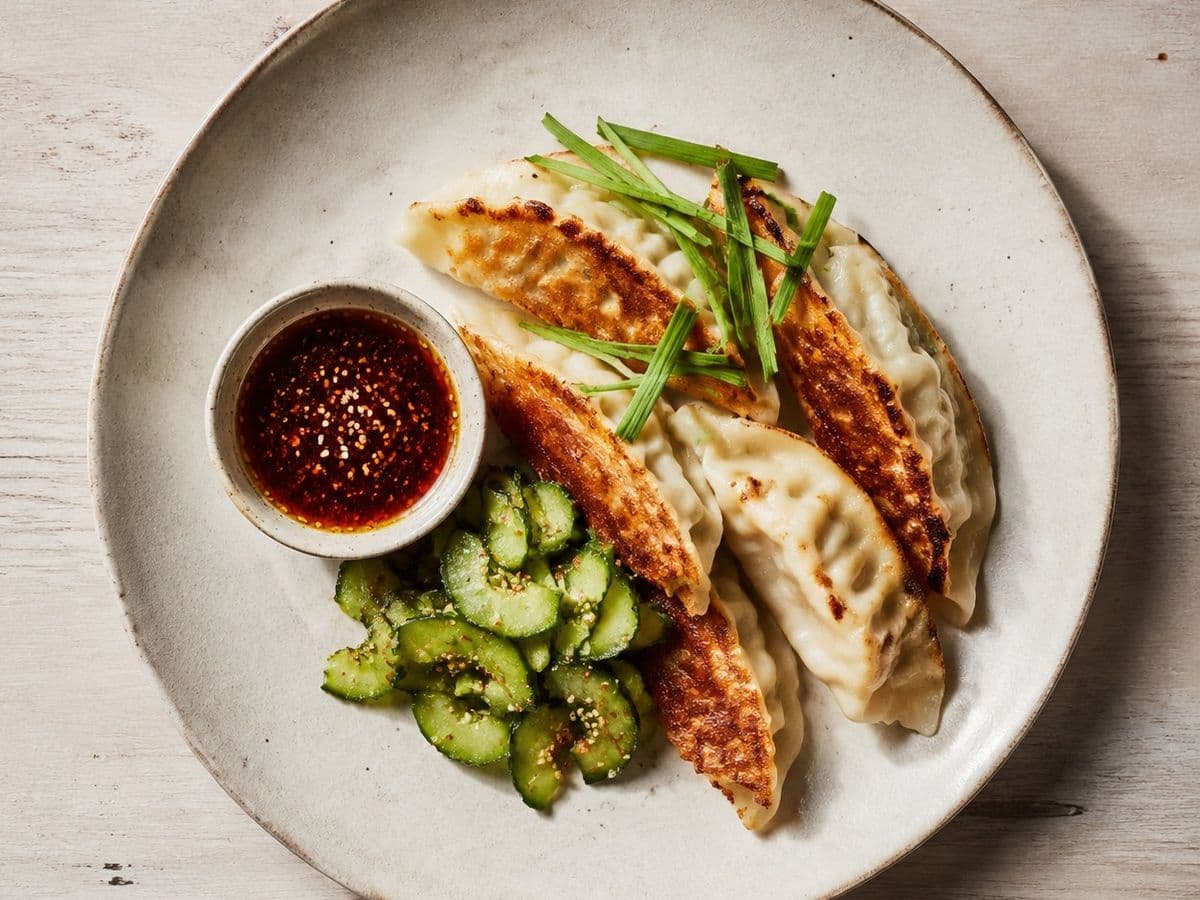
302 kcal a serving, against 372 for the traditional version. That is 70 kcal off, or 19%, with 20.5g of protein. Serves 6. 40 minutes active, 30 minutes resting.
What the traditional version is
Mandu start with a pork-rich filling: half-and-half pork belly and firm tofu, chopped kimchi, softened glass noodles, garlic, spring onion, soy sauce and a little sesame oil.
What changed, and what each change costs
Swap pork belly for lean pork loin, same weight
Pork belly is classic and gives good texture, but lean pork loin has a similar bite once chopped fine. The tofu's there to keep things juicy, so you're not left with cardboard.
What it costs you. It dials down the richness and the filling lands a bit lighter, but with plenty of sauce and kimchi, hardly anyone will notice. Use proper pork belly if you're aiming for maximum comfort, but I promise you won't miss it much.
Double the tofu from 150g to 300g
More tofu bumps up the protein, holds moisture and mimics that soft, slightly springy bite. It takes on all the pork and kimchi flavour you throw at it.
What it costs you. The filling is a touch less unctuous, and it won't quite coat the roof of your mouth like the full pork mix does. Not really a hardship - and for anyone who isn't a texture obsessive, it's barely worth mentioning.
Steam the dumplings instead of pan-frying
Skipping the frying pan means you lose a good glug of oil (and mess), which drops fat without thinning out the taste too much. Steaming keeps the wrappers tender.
What it costs you. You lose that golden bottom - the best bite in a fried mandu. But the filling's so flavour-packed it covers a multitude of sins. If you pine for crunch, fry off just a few and call them the cook's portion.
Cut the sesame oil in half (from 10g to 5g)
Sesame oil gives background warmth, but you don't need much to leave its mark. Halving it lowers the fat while keeping the hint of toastiness.
What it costs you. The sesame's a shade fainter. If you really need that full punch, drizzle a half-teaspoon over the dipping sauce instead.
Hold back on the dipping sauce: halve the vinegar, soy sauce and gochugaru
The sauce is a salt bomb. You're dipping, not drowning, so you never need the full batch. A little goes a long way.
What it costs you. No one will ever complain about having less sauce - unless they spill it. If you want more, just mix up another bowl.
What goes in it
The ingredients, without the quantities. The weights are what the figures below are computed from, and they are in the book.
- Pork loin
- Firm tofu
- Kimchi
- Glass noodles
- Spring onions
- Garlic
- Light soy sauce
- Toasted sesame oil
- Salt
- Plain flour
- Water
- Vinegar
- Gochugaru
How it starts
- If you're feeling brave, make your own wrappers: mix 220g plain flour with 110g water and a pinch of salt.
- Soak the glass noodles in boiling water 5 minutes, then drain and snip into 2cm lengths.
- Press the tofu between tea towels to get rid of excess moisture, then crumble into a big bowl.
The rest of the method, and every weight, is in Authentic-ish Korean.
The numbers
| Per serving | Traditional | Lightened |
|---|---|---|
| Calories | 372 | 302 |
| Protein | 15.4g | 20.5g |
| Fat | 17g | 7g |
| Saturated fat | 3.8g | 1.2g |
| Carbohydrate | 39.8g | 40.1g |
| Protein per 100 kcal | 4.1g | 6.8g |
Every figure is computed from the recipe's own weighed ingredient list against public food composition databases. The appendix in Authentic-ish Korean prints the exact database row used for each ingredient, so any number here can be checked. How every number is computed sets out the method.
Allergens. gluten, sesame, soybeans, sulphites.
The method is in the book
Mandu is the second thing people ask for after kimchi, and this version still delivers that dumpling fix with less fat weighing down the wrappers. Steaming instead of frying is honestly a win - unless you're a fried-dumpling obsessive, you won't miss the golden crust. The extra tofu softens the filling, but you keep all the porky, kimchi-laced flavour. If you want the purest street-food crunch, fry a few, steam the rest, and see who at the table can tell the difference.
The quantities and the method for this dish are in Authentic-ish Korean, along with 51 more. Buy the paperback
More from Authentic-ish Korean
- Haemul Pajeon, 362 kcal a serving, 11% off
- Bindaetteok, 391 kcal a serving, 31% off
- Tteokbokki, 322 kcal a serving, 40% off
- Gamja Jeon, 184 kcal a serving, 28% off
- Baechu Kimchi, 83 kcal a serving, 22% off
- Kongnamul Muchim, 95 kcal a serving, 23% off
Every Korean dish and its calories · Every dish in the series