Korean · Authentic-ish Korean
Tteokbokki
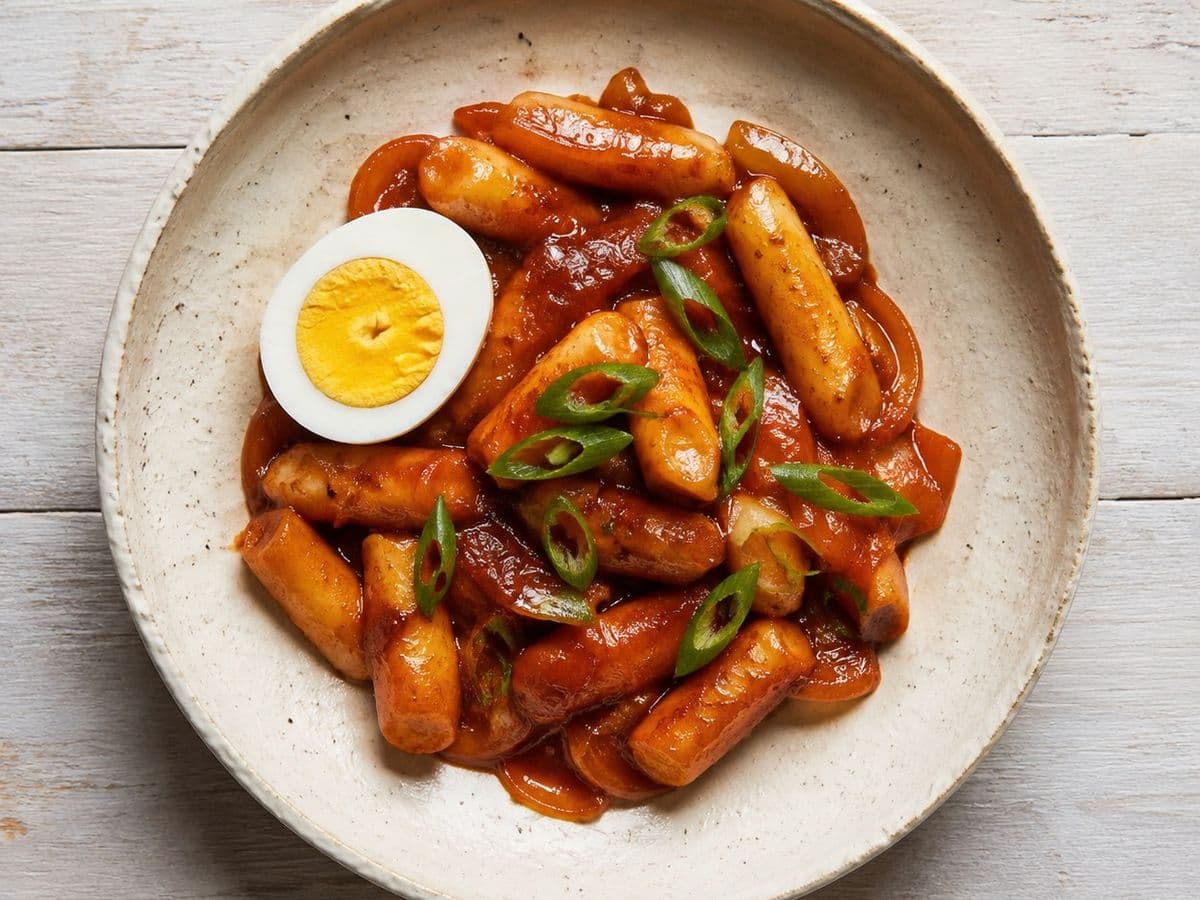
322 kcal a serving, against 538 for the traditional version. That is 216 kcal off, or 40%, with 18g of protein. Serves 4. 20 minutes.
What the traditional version is
Short, fat tubes of chewy rice cake (tteok) simmered in a thick, sticky sauce made from gochujang, sugar, soy sauce, fish cake, a little garlic and onion, often with boiled egg or a handful of spring onions thrown in. Served steaming hot: sweet, spicy, sticky and filling.
What changed, and what each change costs
Swap 400g rice cakes for 120g rice cakes and 250g firm tofu, diced
Rice cakes are nearly all starch and next to no protein. Tofu gives you the bite, sits in the sauce without falling apart, and brings in plenty of protein. You still get some tteok for chewiness, but you're not just eating compressed rice pudding.
What it costs you. The texture isn't quite there: tofu can't copy that same bouncy, glutinous chew. If you want the real deal, make the original and call it a carb day. This way, though, you get a good bowlful that actually fills you up.
Fish cake (eomuk) swapped for more tofu and a dash of extra soy
The traditional fish cake is mostly starch and processed fish, and you'll usually find it in long rectangles. It doesn't bring much protein per bite compared to tofu, and it doesn't do wonders for the sauce.
What it costs you. You lose a bit of that slippery, spongy fishiness. If you're desperate for the taste, add a splash more fish sauce or a chopped-up prawn or two.
Eggs held at one per pan (from two), spring onions doubled and water chestnut up
Boiled eggs are a classic, but you don't need a pair per person. The spring onions and water chestnut give freshness and crunch - and replace some of the missing bulk.
What it costs you. There's less egg to scoop up sauce with, but you'll barely notice with all the veg. If you must, sneak in another egg and be done with it.
Sugar halved (from 40g to 20g), gochujang cut by a third
The sauce doesn't need to be a sugar bomb. The gochujang already brings a mild sweetness, and cutting both brings out more of the savoury and lets you taste the chilli.
What it costs you. You lose that glossy, sticky, street-food sheen. It's less 'candy on rice' and more an actual meal. If you want the shiny version, just don't tell me.
What goes in it
The ingredients, without the quantities. The weights are what the figures below are computed from, and they are in the book.
- Korean tteok
- Firm tofu
- Gochujang
- Caster sugar
- Light soy sauce
- Onion
- Fish sauce
- Garlic
- Spring onions
- Water chestnuts
- 1 boiled egg
How it starts
- Slice the onion thin and soften it in a big frying pan over medium heat with just a splash of water, not oil.
- Once the onion's limp, add the garlic and stir until you smell it.
- Add the gochujang, sugar, soy sauce and fish sauce.
The rest of the method, and every weight, is in Authentic-ish Korean.
The numbers
| Per serving | Traditional | Lightened |
|---|---|---|
| Calories | 538 | 322 |
| Protein | 14.4g | 18g |
| Fat | 3.5g | 7.2g |
| Saturated fat | 1.1g | 1.3g |
| Carbohydrate | 109.6g | 48.5g |
| Protein per 100 kcal | 2.7g | 5.6g |
Every figure is computed from the recipe's own weighed ingredient list against public food composition databases. The appendix in Authentic-ish Korean prints the exact database row used for each ingredient, so any number here can be checked. How every number is computed sets out the method.
Allergens. eggs, fish, gluten, soybeans.
The method is in the book
You'll taste the swap - it isn't the full street-food experience, but it gets close on a cold night. The tofu cheats a bit and makes it a meal, not just a blood-sugar spike followed by a nap. If you want the bouncy, sticky-textured classic, you know what to do: just make it as it's meant to be. Me, I quite like my tofu-filled, veg-heavy version when I can face myself in the mirror the next day. The sauce, at least, still stains your shirt.
The quantities and the method for this dish are in Authentic-ish Korean, along with 51 more. Buy the paperback
More from Authentic-ish Korean
- Haemul Pajeon, 362 kcal a serving, 11% off
- Bindaetteok, 391 kcal a serving, 31% off
- Mandu, 302 kcal a serving, 19% off
- Gamja Jeon, 184 kcal a serving, 28% off
- Baechu Kimchi, 83 kcal a serving, 22% off
- Kongnamul Muchim, 95 kcal a serving, 23% off
Every Korean dish and its calories · Every dish in the series